India requires robust ecosystem to foster deep tech startup innovation
Source:Indian Express ↗
Why It Matters
Understanding the challenges and policies surrounding deep-tech innovation is crucial for GS Paper 3, which frequently tests candidates on India's Science and Technology developments, IPR issues, and economic policies regarding start-ups and R&D funding.
Summary
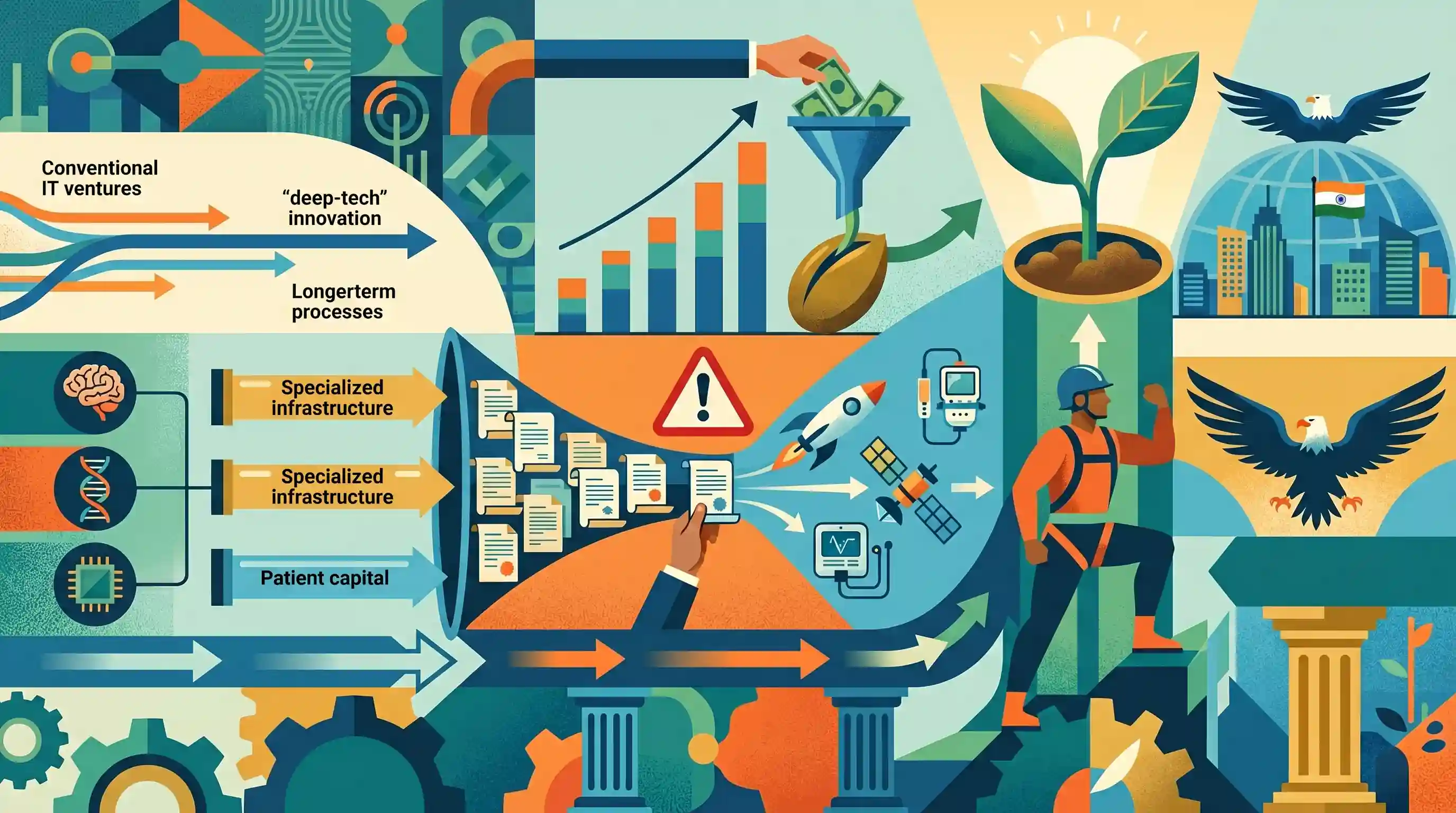
The article underscores the urgent need for India to cultivate an ecosystem conducive to deep-tech innovation, validating Union Minister Piyush Goyal's remarks on the subject. It distinguishes deep-tech startups—which focus on advanced fields like artificial intelligence, biotechnology, and semiconductors—from conventional IT ventures, noting their requirement for patient capital, longer gestation periods, and specialized infrastructure. A critical gap identified is the translation of Intellectual Property Rights (IPR) into commercial success; although India files numerous patents, few reach the market. The piece highlights the importance of the National Deep Tech Startup Policy (NDTSP) and the Anusandhan National Research Foundation (ANRF) in driving research and development (R&D). To secure technological sovereignty and global competitiveness, the article advocates for increasing India's Gross Expenditure on R&D (GERD) and encouraging domestic venture capitalists to embrace higher risks.
Key Points
- India needs a robust ecosystem to foster deep-tech innovation, shifting focus from traditional IT services to sectors like AI, biotech, quantum computing, and semiconductors.
- Deep-tech startups face unique challenges, including long gestation periods, the need for patient capital, and specialized testing infrastructure.
- Despite ranking high globally in patent filings, India struggles with the commercialization of Intellectual Property Rights (IPR) into market-ready products.
- Government initiatives like the Anusandhan National Research Foundation (ANRF) and the National Deep Tech Startup Policy aim to catalyze R&D investment and enhance private sector participation.
- Boosting Gross Expenditure on R&D (GERD) and incentivizing domestic venture capital to take higher risks are essential steps for achieving technological sovereignty and global competitiveness.
Important Terms
Deep-Tech Startups

Startups rooted in fundamental scientific research and advanced engineering breakthroughs (e.g., AI, quantum computing, biotech) aimed at solving complex, large-scale problems rather than incremental service improvements.
UPSC context
GS Paper III: Science & Technology and Economy. Vital for understanding India's shift towards indigenous high-value technological sovereignty and R&D.
National Deep Tech Startup Policy (NDTSP)
A strategic framework aimed at bolstering India's deep-tech ecosystem by addressing challenges like high capital intensity, long gestation periods, and the need for specialized research infrastructure.
UPSC context
GS Paper III: Government Policies & Interventions. Tests knowledge of state-led initiatives to promote high-end innovation and 'Atmanirbhar Bharat'.
Anusandhan National Research Foundation (ANRF)
A statutory apex body established in 2023 to provide strategic direction for scientific research, fostering collaboration between academia, industry, and government departments to bridge the R&D gap.
UPSC context
GS Paper III: Science & Technology. A key institutional reform replacing SERB to enhance India's global standing in research and innovation.
Gross Expenditure on R&D (GERD)
The total amount spent on research and experimental development performed on the national territory, reflecting a country's commitment to innovation (India's is ~0.64% of GDP).
UPSC context
GS Paper III: Indian Economy and S&T. A critical indicator for comparing India’s innovation investment against global benchmarks like the US and China.
Patient Capital
Long-term investment where the investor is willing to wait for a return without seeking a quick exit, essential for the extended gestation periods of deep-tech ventures.
UPSC context
GS Paper III: Investment Models and S&T. Explains the financing challenges of R&D-heavy sectors compared to traditional consumer-facing IT ventures.
IPR Commercialization
The process of translating patented inventions into market-ready products. India faces a challenge here, ranking high in patent filings but low in actual market translation.
UPSC context
GS Paper III: Intellectual Property Rights. Focuses on the "Lab-to-Market" gap and the structural hurdles in India's innovation value chain.
Prelims Trap
"The private sector accounts for the majority of India's Gross Expenditure on R&D (GERD)."
In India, government sources still drive R&D funding (private sector is only ~36%). Aspirants confuse India's reality with developed nations, where private enterprises contribute 60-70%.
Static Concepts Connected
How does the ANRF Act 2023 restructure India's R&D funding ecosystem?
- Replaces SERB: Repeals and subsumes the Science and Engineering Research Board (SERB) Act of 2008 to create a centralized funding body.
- Private funding focus: Aims to mobilize ₹50,000 crore over five years, with ~70% targeted to come from non-government (private/philanthropic) sources.
- Broadened inclusion: Moves beyond pure hard sciences to actively fund R&D in state universities, humanities, and social sciences.
What are the defining economic characteristics of a "Deep Tech" startup?
- High gestation periods: Requires years of laboratory research, testing, and prototyping before yielding a commercially viable, market-ready product.
- Patient capital reliance: Necessitates long-term equity investors willing to absorb high upfront technical and scientific risks over extended horizons.
- IP-centric valuation: Valuations and competitive moats depend heavily on fundamental patents and proprietary scientific discoveries, rather than mere business model innovation.
Cross-Topic Patterns
Deep Tech & the Middle-Income Trap
Scaling deep tech (AI, semiconductors) is framed economically as essential to escape the middle-income trap by moving India up the global high-tech manufacturing value chain.
IPR Commercialization vs. Patent Filings
India ranks 6th globally in patent filings, yet weak university-industry linkages and testing infrastructure mean the "lab-to-market" translation rate remains persistently low.

Expect a 2026 Prelims statement contrasting India's GERD composition (government-led) against developed nations, paired with ANRF targets.
Linked PYQs · 3
Linked PYQs · 3
- 2024MainsGS3
What is the present world scenario of intellectual property rights with respect to life materials? Although, India is second in the world to file patents, still only a few have been commercialized. Explain the reasons behind this less commercialization.
- 2023MainsGS3
Faster economic growth requires increased share of the manufacturing sector in GDP, particularly of MSMEs. Comment on the present policies of the Government in this regard.
- 2015MainsGS2
The quality of higher education in India requires major improvements to make it internationally competitive. Do you think that the entry of foreign educational institutions would help improve the quality of higher and technical education in the country? Discuss.
