India Prioritizes Strategic Trade Terms Over Deadlines with US
Source:Indian Express ↗
Why It Matters
The article provides critical insights into India's evolving external trade strategy—prioritizing favorable terms over quick deals—and its pragmatic stance on Chinese FDI. It also highlights key indicators of India's external sector resilience, such as remittances and import cover, which are essential concepts for GS-3 (Economy) and GS-2 (International Relations).
Summary
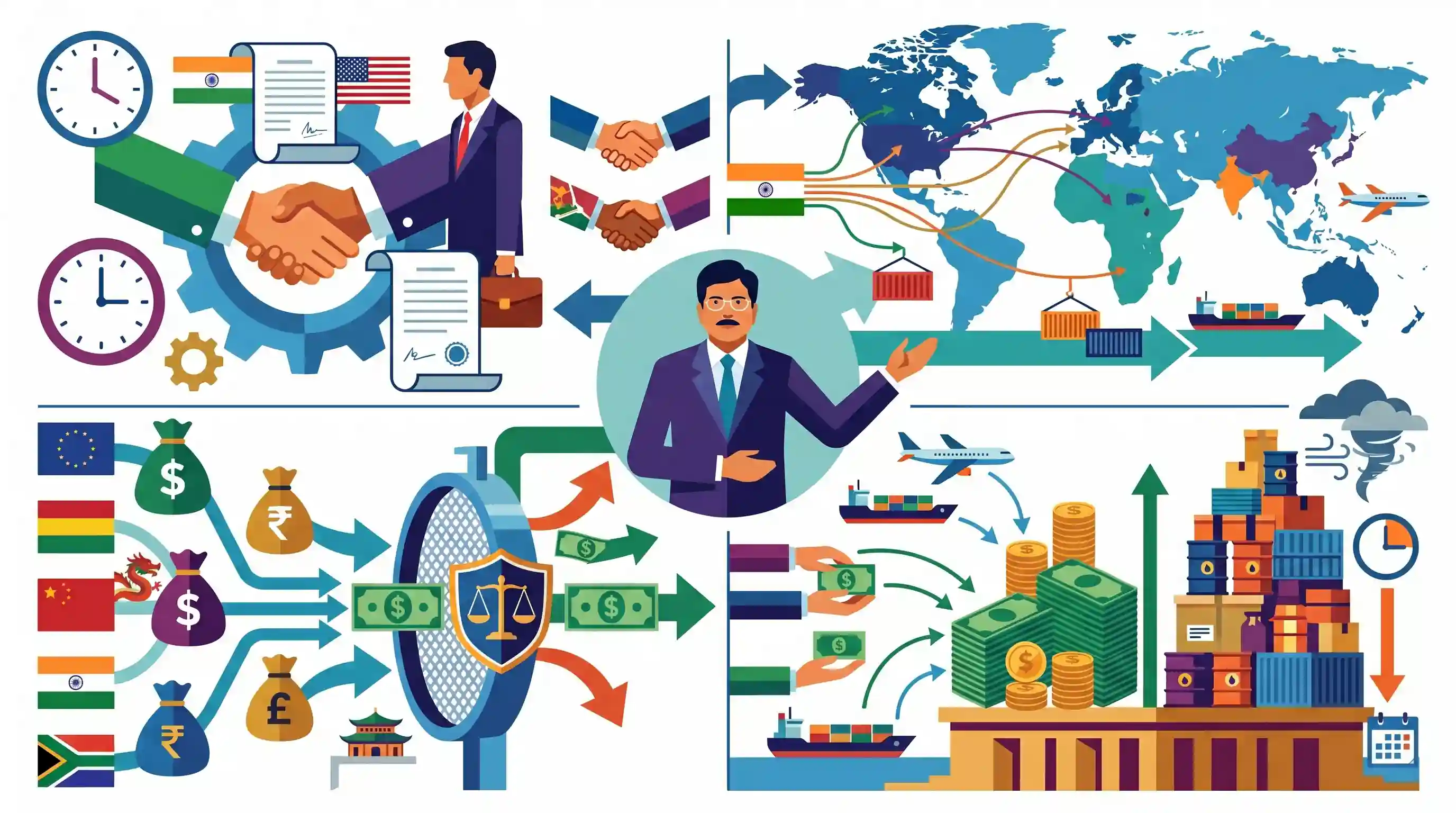
Union Minister Piyush Goyal stated that India is prioritizing a high-quality trade agreement with the US without imposing strict deadlines, though an initial tranche could be finalized soon. Concurrently, India is expanding preferential trade discussions globally to boost exports. Goyal affirmed India's openness to foreign direct investment (FDI), including from China, contingent upon it serving the national interest. He also highlighted India's robust macroeconomic fundamentals, noting that strong annual remittances of $137 billion and a 10-month import cover provide significant buffers against global economic shocks and help manage the country's trade deficit.
Key Points
- Commerce Minister Piyush Goyal stated there is no strict deadline for the India-US trade deal, prioritizing the "best deal" over a rushed timeline.
- A potential "first tranche" of the India-US trade agreement could be finalized by mid-July.
- India is expanding preferential trade discussions with South America, Africa, Europe, Asia, and Australia to increase market access for domestic exporters.
- The government remains open to foreign investments, including from China, provided they align with India's national interests.
- India's macroeconomic stability is strong, supported by robust annual remittances of $137 billion and an import cover of about 10 months, which help offset the trade deficit.
- The government envisions expanding the economy to $30 trillion and exports to $6 trillion by 2047.
Important Terms
India-US Trade Policy Forum (TPF)

An institutional mechanism co-chaired by the Indian Commerce Minister and USTR to resolve trade and investment issues and facilitate market access between India and the US.
UPSC context
GS Paper II (International Relations); tests understanding of bilateral economic diplomacy and strategic trade hurdles with India's largest trading partner.
Import Cover
A macroeconomic indicator measuring the number of months of imports a country's foreign exchange reserves can finance; India currently maintains a robust 10-month cover.
UPSC context
GS Paper III (Economy); vital for assessing external sector stability, reserve adequacy, and resilience against global liquidity shocks.
Remittances
Money sent by migrants to their home country; India is the world's top recipient, reaching $137.67 billion in 2024, which significantly stabilizes its current account.
UPSC context
GS Paper III (Economy); tests knowledge of Balance of Payments (BoP) components and the economic contribution of the Indian diaspora.
Foreign Direct Investment (FDI)
An investment made by a foreign individual or company into business interests in another country, typically involving management control and long-term capital commitment.
UPSC context
GS Paper III (Economy); examines policy frameworks for capital inflows and the balancing of economic liberalization with national security interests.
Trade Deficit
An economic condition where the total value of a nation's imports of goods and services exceeds the total value of its exports.
UPSC context
GS Paper III (Economy); fundamental for analyzing trade balance, competitiveness, and the effectiveness of export-promotion schemes like PLI.
Preferential Trade Agreement (PTA)
A trade pact between countries that reduces tariffs for specific products but is less comprehensive than a Free Trade Agreement (FTA).
UPSC context
GS Paper III (Economy); tests understanding of international trade architecture and India's strategy for diversifying export markets.
Prelims Trap
"Foreign Direct Investment (FDI) from countries sharing a land border with India is strictly prohibited."
It is not prohibited. Press Note 3 (2020) merely shifted such FDI to the 'government approval route' to prevent opportunistic takeovers, not an outright ban.
Static Concepts Connected
Where do remittances and import cover fit into India's macroeconomic indicators?
- Remittances: Counted under 'Invisibles' (Net Secondary Income) in the Current Account. They are unilateral, non-debt-creating transfers that offset the trade deficit.
- Import Cover: A core indicator of external sector resilience showing how many months of imports can be funded solely by the RBI's current foreign exchange reserves.
How is FDI regulated from neighboring countries?
- Press Note 3 (2020): Requires investors from nations sharing land borders with India to seek mandatory government approval before investing, overriding the automatic route.
- Original Objective: Introduced to halt opportunistic, hostile takeovers of domestic firms whose valuations crashed during pandemic disruptions.
- Current Stance: The government remains selectively open to this FDI if it demonstrates clear value addition (e.g., high-tech manufacturing) serving India's 'national interest.'
Cross-Topic Patterns
PTAs & the 'China Plus One' shift
India is expanding preferential trade pacts alongside strategic FDI approvals to position itself as the primary alternative in global supply chains, leveraging Western de-risking from China.
Remittances as a BoP shock-absorber
The $137B inflow highlights how India's diaspora directly stabilizes macroeconomics. Remittances act as a non-debt-creating shock absorber, continuously offsetting the structural merchandise trade deficit.

Expect a multi-statement question interlinking Current Account components (remittances) with Forex reserve adequacy (import cover) in 2026.
Linked PYQs · 3
Linked PYQs · 3
- 2018MainsGS3
How would the recent phenomena of protectionism and currency manipulations in world trade affect macroeconomic stability of India?
- 2016MainsGS3
Justify the need for FDI for the development of the Indian economy. Why there is gap between MOUs signed and actual FDIs? Suggest remedial steps to be taken for increasing actual FDIs in India.
- 2013PrelimsGS1
The balance of payments of a country is a systematic record of
