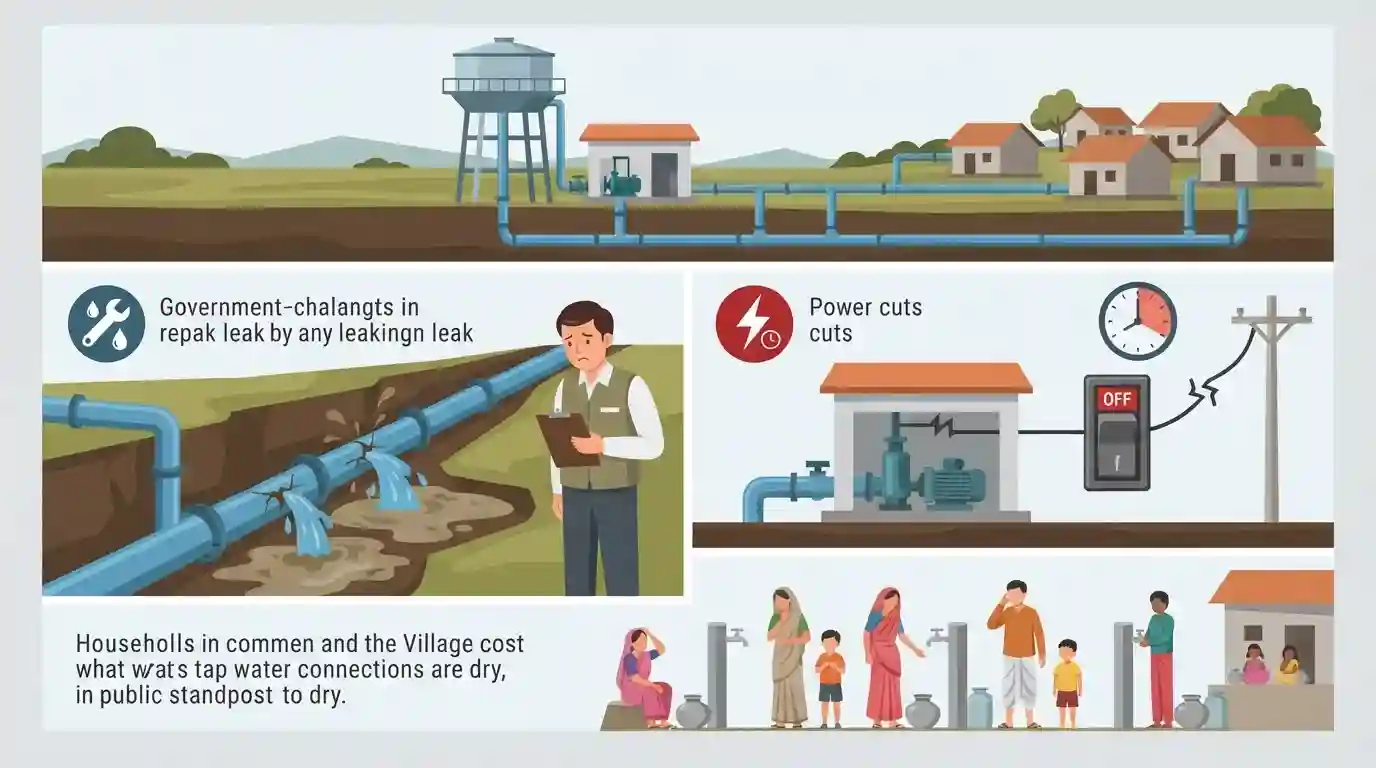
Pipeline leaks and power cuts hinder rural water supply schemes
Source:theprint ↗
Why It Matters
Understanding the ground-level execution challenges of flagship government welfare schemes like the Jal Jeevan Mission is crucial for governance, public administration, and social sector policy questions in UPPSC PCS Prelims.
Summary
A recent study points out that pipeline leaks and frequent power cuts are the major operational challenges impeding rural water supply schemes in India, threatening the sustainability of initiatives aimed at providing tap water access to rural households.
Key Points
- A recent study highlights significant operational challenges facing rural water supply schemes, specifically identifying pipeline leaks and power cuts as major roadblocks.
- The findings emphasize the need for robust infrastructure maintenance, reliable electricity supply, and community-based management to ensure sustainable drinking water delivery in rural areas under initiatives like the Jal Jeevan Mission.
- Infrastructure bottlenecks directly impact the targets of universal household tap water connectivity and long-term water security.
Important Terms
Jal Jeevan Mission

A flagship Central Government scheme launched in 2019 under the Ministry of Jal Shakti to provide functional household tap connections (FHTCs) to every rural household, aiming for long-term drinking water security and sustainability.
UPSC context
Important for GS Paper II (Government Policies & Interventions) and GS Paper III (Infrastructure & Rural Development). Tests knowledge of welfare schemes.
National Rural Drinking Water Programme
A erstwhile centrally sponsored program launched in 2009 to provide safe drinking water to rural areas, which was later restructured and subsumed into the Jal Jeevan Mission in 2019.
UPSC context
Important for GS Paper II (Social Sector Schemes) and evolution of public policy and drinking water initiatives in rural India.
Ministry of Jal Shakti
The Union Ministry created in 2019 by merging the Ministry of Water Resources, River Development & Ganga Rejuvenation and the Ministry of Drinking Water and Sanitation to oversee water resource management.
UPSC context
Important for GS Paper II (Governance and Ministries) and administrative setups regarding water security and sanitation in India.
Prelims Trap
Jal Jeevan Mission is a 100% centrally funded scheme implemented directly by central authorities without state or community involvement.
Aspirants often assume JJM is solely a central-sector funding scheme without state cost-sharing or community operation components.
Static Concepts Connected
What are the core implementation principles and funding pattern of the Jal Jeevan Mission?
- Launch & Goal: Launched in 2019 to provide Functional Household Tap Connection (FHTC) to every rural household by 2024.
- Funding Pattern: Implemented on a 90:10 sharing pattern for Himalayan/North-Eastern states, 50:50 for other states, and 100% for UTs.
- Community Role: Relies heavily on community engagement through Pani Samitis (Village Water and Sanitation Committees) for operation and maintenance.
Cross-Topic Patterns
Jal Jeevan Mission + Local Body Grants
The push for universal tap water under Jal Jeevan Mission intersects directly with the 15th Finance Commission grants tied to drinking water and sanitation performance indicators.
Rural Electrification + Drinking Water Security
Rural electrification schemes like Deendayal Upadhyaya Gram Jyoti Yojana are foundational to powering rural water pumping stations and preventing supply disruptions.

Expect a multi-statement question on Jal Jeevan Mission targets, funding pattern, and operational bottlenecks like power and leakage.
Linked PYQs · 2
Linked PYQs · 2
- 2015UPPSC_PRELIMSGS1
National Rural Drinking Water Programme is one of the components of
- 2019UPPSC_PRELIMSGS1
Rural Sanitation Strategy launched by Ministry of Jal Shakti in September 2019 relates to which of the following periods?
