Andhra Pradesh Launches Pillale Sampada to Address Low Fertility
Source:The Hindu ↗
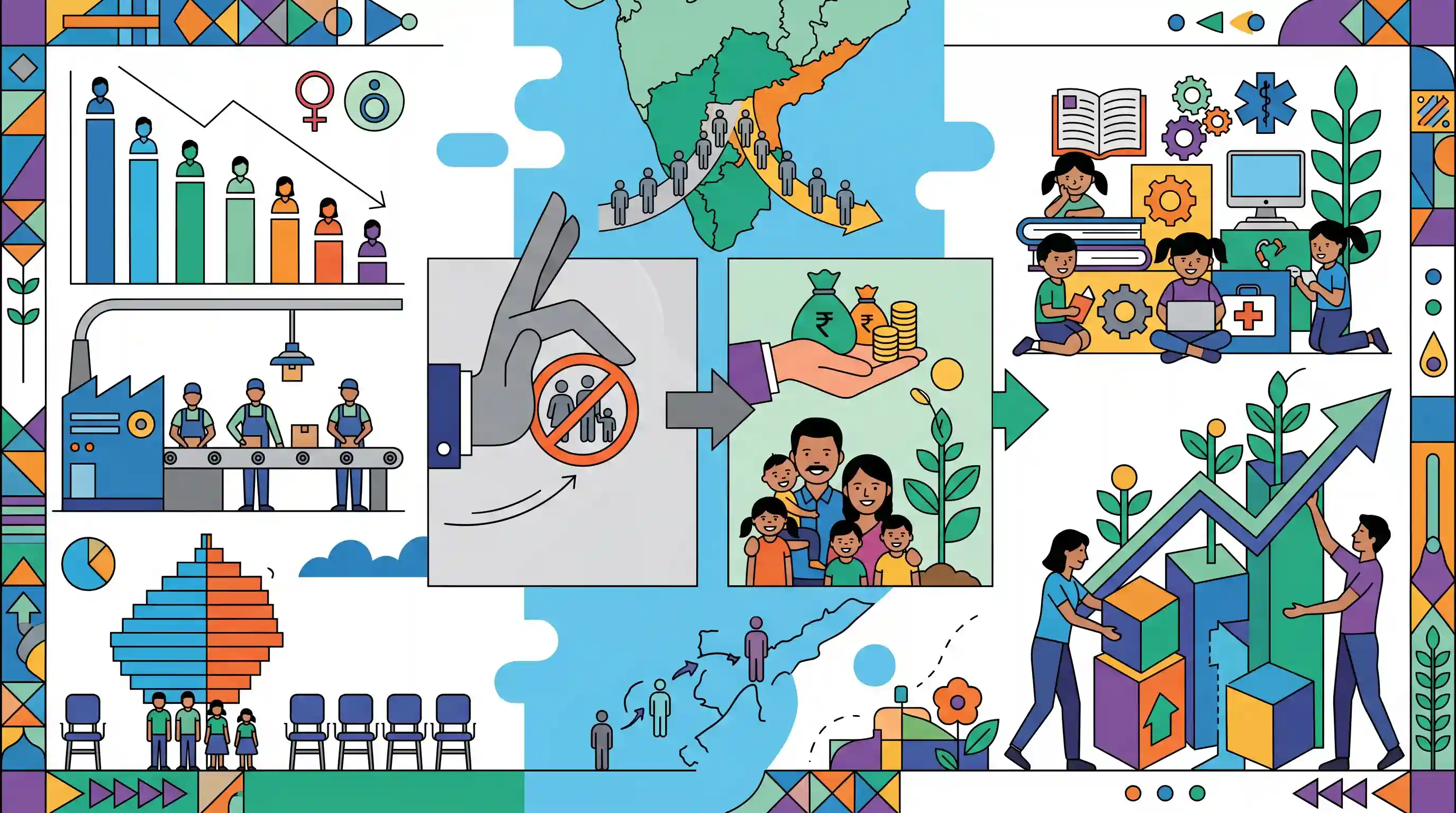
Why It Matters
Highlights the stark regional variations in India's demographic transition, demonstrating how southern states are pivoting to pro-natalist policies to counter a looming 'demographic winter' and preserve their workforce, contrasting with historical national narratives on population control.
Summary
The Andhra Pradesh government has introduced the 'Pillale Sampada' (Children are Wealth) policy to address the state's declining Total Fertility Rate (TFR), which has fallen to 1.50. Fearing a potential "demographic winter" characterized by an aging population and a shrinking workforce, the state is shifting from historical population control measures to pro-natalist policies. The initiative involves providing financial incentives to encourage larger families, aiming to secure human resources for long-term economic sustainability. This reflects a broader demographic transition occurring in southern Indian states, posing new socio-economic challenges.
Key Points
- The Andhra Pradesh government has launched the 'Pillale Sampada' (Children are Wealth) initiative to boost population growth in response to a declining Total Fertility Rate (TFR).
- AP's TFR currently stands at 1.50, below the replacement level of 2.1 and the national average of 1.9, raising concerns about a shrinking future workforce and an aging population.
- The state plans to offer financial incentives to encourage larger families, representing a significant shift from its historical focus on population control.
- This policy highlights the emerging challenge of a "demographic winter" in southern Indian states, contrasting with the demographic dividend typically associated with India's overall population.
Important Terms
Pillale Sampada

The Andhra Pradesh government's pro-natalist policy framework ('Children are Wealth') providing financial incentives, nutritional support, and educational benefits to encourage larger families and address declining birth rates.
UPSC context
GS II: Government Policies; GS I: Social Issues. Tests understanding of state-level interventions for demographic management.
Total Fertility Rate (TFR)
The average number of children a woman is expected to have during her reproductive years (15-49). Andhra Pradesh's TFR is currently 1.5, below India's 2.0.
UPSC context
GS I: Population Geography; GS III: Economy. Key metric for assessing demographic transition and workforce sustainability.
Demographic Winter
A sustained period of fertility falling below the replacement level, leading to a shrinking workforce, aging population, and potential economic stagnation.
UPSC context
GS I: Society/Geography (appeared in 2024). Tests knowledge of global and regional population decline challenges.
Replacement Level Fertility
The fertility level (typically 2.1) at which a population exactly replaces itself from one generation to the next without migration.
UPSC context
GS I: Geography. Fundamental concept for demographic analysis and population stabilization goals.
Pro-natalist Policy
State-sponsored measures—such as cash transfers or expanded parental leave—designed to increase birth rates and support families in response to low fertility.
UPSC context
GS II: Social Justice/Governance. Highlights the shift from family planning to population care in certain Indian states.
Demographic Debt
The economic burden and fiscal strain caused by an aging population and a shrinking working-age group; the negative opposite of a demographic dividend.
UPSC context
GS III: Indian Economy. Relevant for discussing long-term fiscal health and workforce planning.
Prelims Trap
"India's national Total Fertility Rate (TFR) currently stands at the population replacement level of 2.1."
India's overall TFR has already fallen to 2.0 (NFHS-5), below the replacement level. Aspirants often confuse the demographic target (2.1) with India's current statistical reality.
Static Concepts Connected
What defines 'Replacement Level Fertility' and why is it specifically 2.1?
- Definition: The average number of children a woman would need to have to reproduce herself by bearing a daughter who survives to childbearing age.
- The 0.1 Factor: The extra 0.1 accounts for infant/child mortality and the natural biological skew in the sex ratio at birth (slightly more boys are born than girls).
What are the final stages of the Demographic Transition Model?
- Stage 3 (Late Expanding): Falling birth rates and low death rates leading to a peak in the working-age population. Characterized by the 'Demographic Dividend'.
- Stage 4/5 (Low/Declining): Birth and death rates are both low, leading to a stable or shrinking population, an aging society, and a high elderly dependency ratio.
Cross-Topic Patterns
Demographic Transition & Delimitation Politics
Pro-natalist shifts highlight Southern anxieties over the impending post-2026 Lok Sabha delimitation, where successful historical population control could paradoxically reduce their political representation.
Demographic Winter & The Care Economy
States with TFRs under 1.5 will see rapid spikes in elderly dependency ratios, necessitating a shift from youth-centric employment policies toward building robust 'care economy' and geriatric welfare infrastructure.

Expect a GS2 Mains question linking asymmetric demographic transitions (North vs. South) to federal tensions and delimitation.
Linked PYQs · 3
Linked PYQs · 3
- 2024MainsGS1
What is the concept of a 'demographic winter'? Is the world moving towards such a situation? Elaborate.
- 2016MainsGS2
Demographic Dividend in India will remain only theoretical unless our manpower becomes more educated, aware, skilled and creative." What measures have been taken by the government to enhance the capacity of our population to be more productive and employable?
- 2021MainsGS1
Discuss the main objectives of Population Education and point out the measures to achieve them in India in detail.
