TDS System Constitutional Validity and Tax Administration
Source:The Hindu ↗
Why It Matters
This petition raises novel constitutional questions concerning the limits of the state's power to delegate tax collection duties to private entities. If the Supreme Court entertains these arguments regarding 'forced labour' and fundamental rights violations, it could significantly impact India's direct tax administration and compliance framework.
Summary
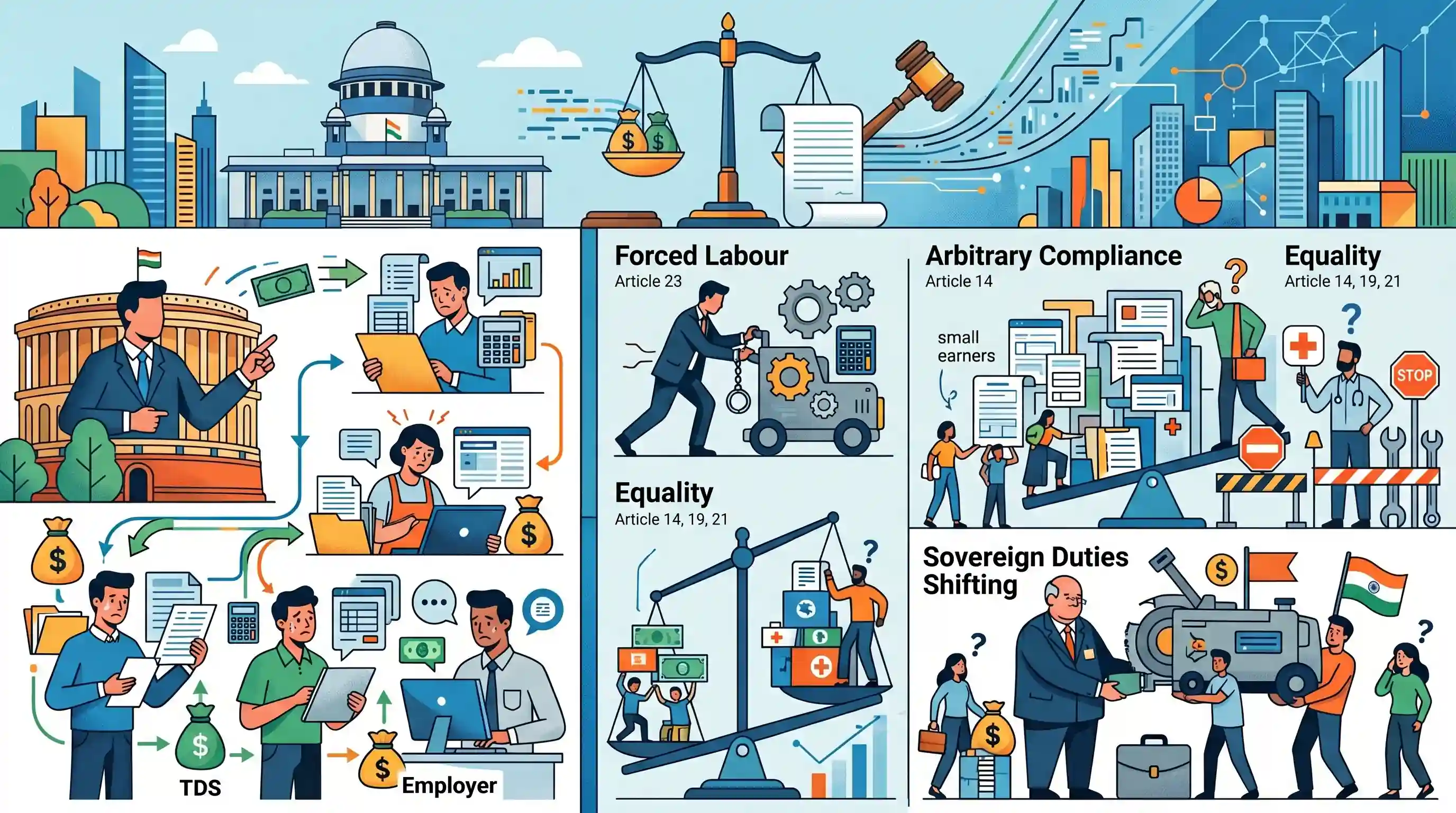
A Public Interest Litigation (PIL) filed in the Supreme Court seeks to abolish the Tax Deducted at Source (TDS) system, arguing it violates several constitutional fundamental rights. The petitioner claims that forcing private citizens to act as tax collectors for the government without compensation constitutes 'forced labour' under Article 23. Furthermore, the petition states that the TDS framework imposes arbitrary compliance burdens, violating the right to equality (Article 14), right to practice a profession (Article 19), and right to life and liberty (Article 21), while disproportionately impacting smaller earners and shifting sovereign duties to private entities.
Key Points
- A PIL has been filed in the Supreme Court seeking the abolition of the Tax Deducted at Source (TDS) system under the Income Tax Act.
- The petitioner argues that the TDS system is arbitrary and violates Fundamental Rights, specifically Articles 14, 19, 21, and 23.
- The core argument asserts that mandating private individuals and entities to collect taxes on behalf of the state without compensation amounts to 'forced labour' under Article 23.
- The PIL contends that the system disproportionately affects the economically weaker sections and imposes heavy compliance costs and penalties on ordinary citizens.
Important Terms
Tax Deducted at Source (TDS)

A mechanism where tax is collected at the point of origin (salary, rent, etc.). The payer (deductor) deducts a prescribed percentage and remits it to the government on behalf of the recipient (deductee).
UPSC context
GS Paper 3: Indian Economy (Direct Taxation); relevant for understanding tax compliance mechanisms and revenue stability for the government.
Article 23
A Fundamental Right under the 'Right against Exploitation' that prohibits traffic in human beings and 'begar' (forced labour) without payment, including work performed under legal or economic compulsion.
UPSC context
GS Paper 2: Indian Constitution (Fundamental Rights); tests the broad interpretation of 'forced labour' in modern administrative contexts.
Public Interest Litigation (PIL)
Legal action initiated in a court for the protection of 'Public Interest'. It allows any citizen to seek judicial redress for violations of rights of people unable to approach the court.
UPSC context
GS Paper 2: Judiciary; core mechanism for judicial activism and protecting constitutional rights of marginalized or broad groups.
Income Tax Act, 1961
A foundational statute enacted to levy, administer, and recover direct taxes in India. It prescribes the rules for income calculation, exemptions, deductions (like TDS), and penal provisions for non-compliance.
UPSC context
GS Paper 3: Economy (Fiscal Policy); statutory basis for India’s direct tax regime and recent discussions on tax simplification.
Law Commission of India
An executive body (neither statutory nor constitutional) established by the government for a fixed tenure to conduct legal research and advise the Ministry of Law and Justice on legal reforms.
UPSC context
GS Paper 2: Governance (Executive bodies); crucial for legal reforms, reviewing obsolete laws, and advising on constitutional validity of legislations.
Article 14
Guarantees that the State shall not deny to any person 'equality before the law' or 'equal protection of the laws' within the territory of India, prohibiting arbitrary state action.
UPSC context
GS Paper 2: Indian Constitution; central to arguments against laws that impose disproportionate or arbitrary burdens on specific classes of citizens.
Prelims Trap
Article 23 strictly prohibits the State from demanding any compulsory, unpaid service from citizens under any circumstances.
False. Article 23(2) expressly allows the State to impose compulsory service for public purposes, provided it does not discriminate on grounds of religion, race, caste, or class.
Static Concepts Connected
What is the scope and exception of Article 23 regarding forced labour?
- Begar defined: Compulsory work without remuneration. Article 23 prohibits it to protect individuals from exploitation by both State and private entities.
- State exception: Article 23(2) allows the State to impose compulsory service for public purposes, making the prohibition on unpaid labour non-absolute.
What are the core constitutional principles governing taxation in India?
- Authority of law: Article 265 mandates that no tax shall be levied or collected except by authority of law, ensuring parliamentary oversight of state extraction.
- Constitutional limits: Taxes must not violate Article 14 (Equality) and must align with DPSP Article 39(c) to prevent wealth concentration.
Cross-Topic Patterns
Judicial review of economic policy
The SC traditionally exercises high restraint in economic policy (like TDS frameworks). PILs challenging tax codes test the boundaries between judicial review and legislative domain in India.
TDS as a formalisation tool
TDS isn't just about revenue; it tracks financial trails, directly linking GS2 constitutional rights with GS3 objectives of tax base widening, anti-evasion, and formalising the economy.

Expect a Prelims statement testing the exact exceptions to Article 23 (compulsory public service) masked within an economic/tax context.
Linked PYQs · 4
Linked PYQs · 4
- 2024PrelimsGS1
Under which of the following Articles of the Constitution of India, has the Supreme Court of India placed the Right to Privacy ?
- 2021PrelimsGS1
What is the position of the Right to Property in India?
- 2025PrelimsGS1
Consider the following statements : Statement I: In India, income from allied agricultural activities like poultry farming and wool rearing in rural areas is exempted from any tax. Statement II: In India, rural agricultural land is not considered a capital asset under the provisions of the Income-tax Act, 1961. Which one of the following is correct in respect of the above statements?
- 2025PrelimsGS1
With reference to the Government of India, consider the following information: Organization Some of its functions It works under I. Directorate of Enforcement Enforcement of the Fugitive Economic Offenders Act, 2018 Internal Security Division-I, Ministry of Home Affairs II. Directorate of Revenue Intelligence Enforces the Provisions of the Customs Act, 1962 Department of Revenue, Ministry of Finance III. Directorate General of Systems and Data Management Carrying out big data analytics to assist tax officers for better policy and nabbing tax evaders Department of Revenue, Ministry of Finance In how many of the above rows is the information correctly matched?
