Supreme Court PIL seeks wage review for staff in state temples
Source:The Hindu ↗
Why It Matters
It highlights the intersection of labor rights and religious administration, questioning the scope of recent labor reforms (Code on Wages) and the constitutional boundaries of state control over religious institutions in the context of Indian secularism.
Summary
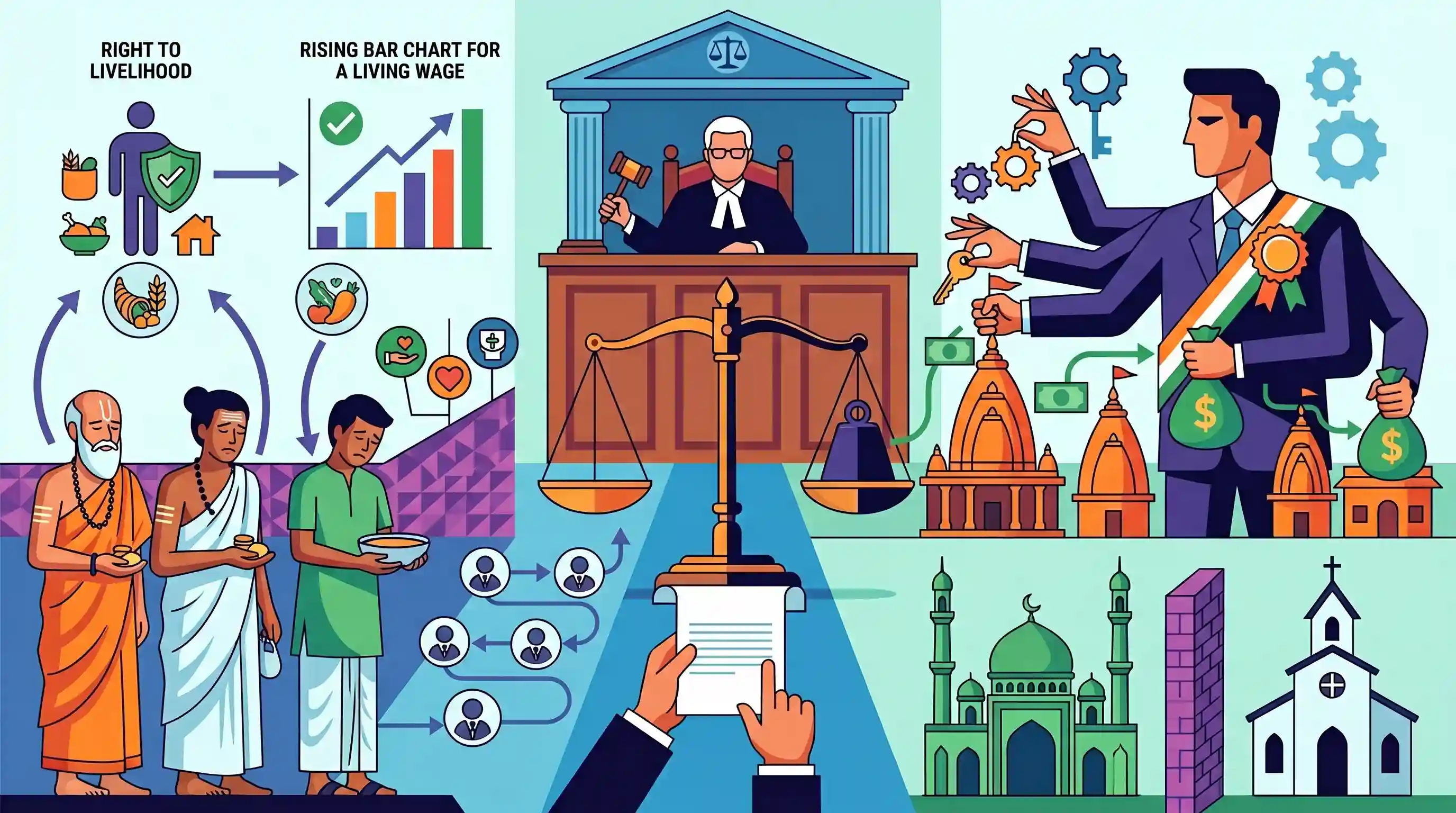
A Public Interest Litigation (PIL) filed by advocate Ashwini Upadhyay in the Supreme Court seeks the constitution of a judicial commission to review the wages and benefits of priests, sevadars, and staff in state-controlled temples. The petition argues that these workers should be classified as 'employees' under the Code on Wages, 2019. It contends that the current failure to pay even the minimum wage violates the Right to Livelihood (Article 21) and the Directive Principles of State Policy regarding a living wage (Article 43). Additionally, the plea raises questions about the nature of Indian secularism, highlighting that while states act as employers by exercising administrative and financial control over thousands of Hindu temples, they do not exercise similar control over mosques or churches.
Key Points
- A PIL in the Supreme Court seeks a judicial commission to review wages and benefits of priests, sevadars, and staff in state-controlled temples.
- The petition demands that temple staff be formally recognized as 'employees' under Section 2(k) of the Code on Wages, 2019.
- Denial of minimum wages is argued to be a violation of the Right to Livelihood (Article 21) and the Directive Principles of State Policy on securing a living wage (Article 43).
- The PIL also highlights an asymmetry in state secularism, noting that state governments exercise direct administrative and financial control over lakhs of Hindu temples—acting as de facto employers—while exempting mosques and churches from such oversight.
Important Terms
Code on Wages, 2019

A landmark labor reform consolidating four central acts to universalize minimum wages and timely payment for all workers across organized and unorganized sectors.
UPSC context
GS Paper 2 (Governance) & GS Paper 3 (Labour Reforms); tests knowledge of legislative consolidation and worker welfare.
Indian Secularism
A constitutional model of 'principled distance' where the State respects all religions equally while retaining the power to intervene for social reform and administrative regulation.
UPSC context
GS Paper 1 (Society) & GS Paper 2 (Polity); tests the conceptual distinction from Western-style strict separation of Church and State.
Article 25(2)(a)
A constitutional provision under Article 25 that empowers the State to regulate economic, financial, or other secular activities associated with religious practices.
UPSC context
GS Paper 2 (Fundamental Rights); central to legal debates regarding government control over Hindu temple administration and finances.
Living Wage (Article 43)
A Directive Principle under Article 43 seeking a wage level that ensures not just subsistence, but a decent standard of life, health, education, and leisure.
UPSC context
GS Paper 2 (DPSP) & GS Paper 3 (Economy); tests the socio-economic obligations of the State beyond basic minimum wages.
Public Interest Litigation (PIL)
A legal mechanism allowing any public-spirited citizen to approach courts for the enforcement of public interest, particularly for those unable to seek justice due to poverty.
UPSC context
GS Paper 2 (Judiciary); tests understanding of judicial activism and the expansion of 'locus standi' in Indian law.
Right to Livelihood
A judicial interpretation of Article 21 (Right to Life) which holds that a person's means of survival are essential to their constitutional right to life.
UPSC context
GS Paper 2 (Fundamental Rights); tests the evolution of Article 21 through landmark Supreme Court rulings like Olga Tellis.
Prelims Trap
The State is barred from regulating the financial and administrative affairs of religious institutions.
Article 25(2)(a) explicitly empowers the State to regulate economic, financial, political, or other secular activities associated with religious practices, allowing state management of temple finances.
Static Concepts Connected
How does the Constitution balance religious freedom with state intervention?
- Article 25(2)(a): Permits the State to regulate or restrict any economic, financial, political, or secular activity associated with religious practice.
- Article 26: Guarantees religious denominations the right to manage matters of religion, but the administration of their property must be done strictly 'in accordance with law'.
- Principled Distance: Unlike Western models of strict separation, Indian secularism allows active state intervention in religious institutions for social reform, temple entry, and administrative accountability.
What is the constitutional distinction between a minimum wage and a living wage?
- Minimum Wage: A statutory right (now under the Code on Wages, 2019) ensuring bare sustenance, basic health, and education for an employee.
- Living Wage (DPSP): A Directive Principle (Article 43) directing the State to secure a wage that ensures a decent standard of life, leisure, and social/cultural opportunities.
- Right to Livelihood: The Supreme Court (Olga Tellis case, 1985) expanded Article 21 to include the 'Right to Livelihood', making severe wage deprivation a potential fundamental rights violation.
Cross-Topic Patterns
Labor Codes meet the Temple Economy
Extending the Code on Wages, 2019 to religious workers bridges modern labor reforms with the massive, largely unregulated administrative machinery of state-controlled temples.
Asymmetric Secularism and the Waqf debate
The selective state control over Hindu temples through HR&CE acts is frequently contrasted against relatively autonomous Waqf boards, fueling broader polity debates on uniform secular administration.

A multi-statement 2026 prelims question will likely test Article 25(2)(a) exceptions alongside the Code on Wages' 'employee' definition.
Linked PYQs · 4
Linked PYQs · 4
- 2024MainsGS2
Discuss India as a secular state and compare with the secular principles of the US constitution.
- 2024MainsGS3
Discuss the merits and demerits of the four 'Labour Codes' in the context of labour market reforms in India. What has been the progress so far in this regard?
- 2017PrelimsGS1
Which principle among the following was added to the Directive Principles of State Policy by the 42nd Amendment to the Constitution?
- 2020PrelimsGS1
Which part of the Constitution of India declares the ideal of Welfare State?
