Ministerial Appointment: Supreme Court PIL challenges Bihar minister
Source:the-tribune ↗
Why It Matters
This issue highlights crucial Indian polity concepts regarding the appointment of non-legislators as ministers, the executive-legislature relationship, constitutional limitations under Article 164(4), and the Supreme Court's jurisprudence on checking the misuse of cabinet appointments. These are highly recurring topics in BPSC and other state civil services exams.
Summary
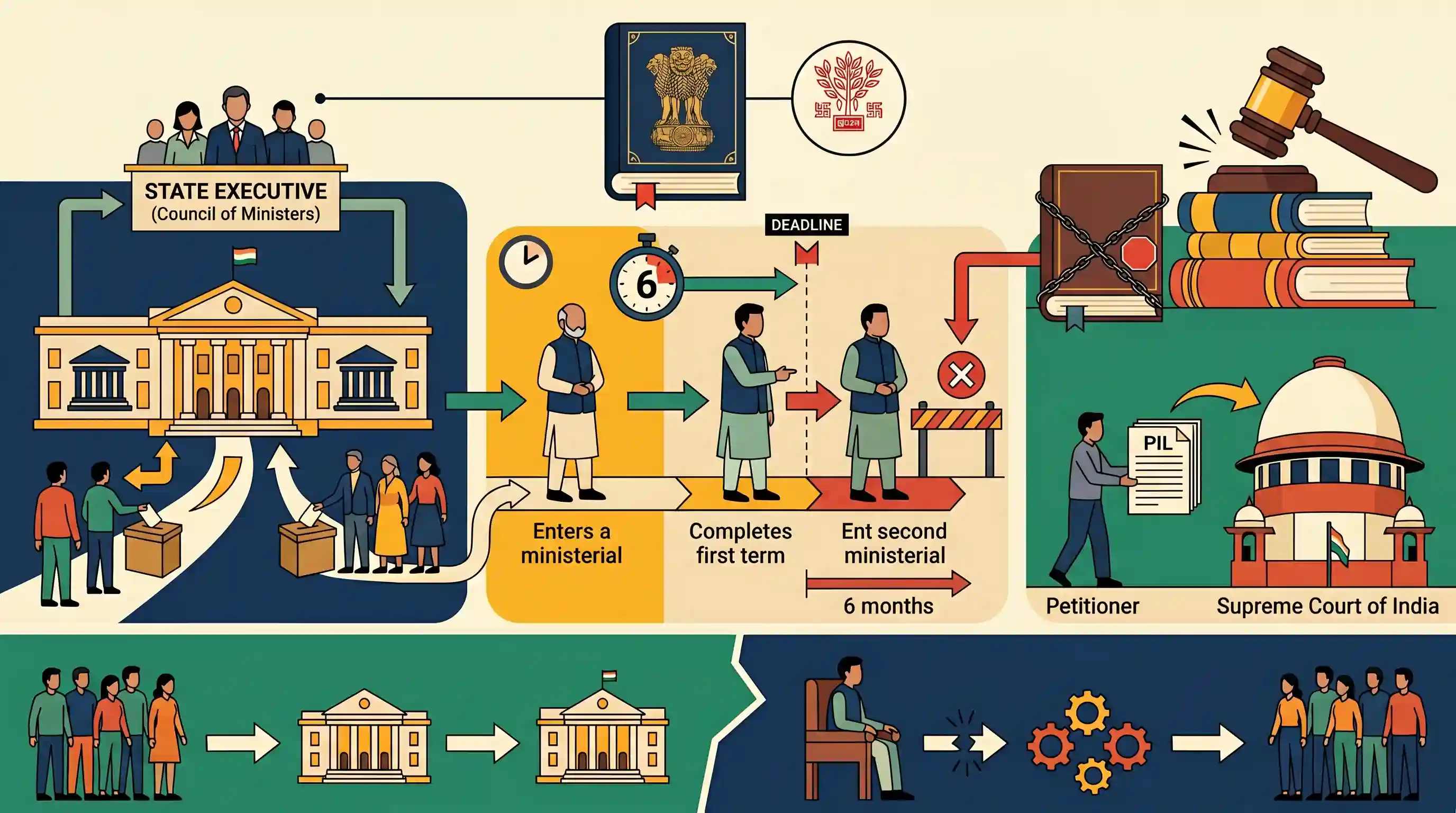
A Public Interest Litigation (PIL) in the Supreme Court challenges the re-appointment of Deepak Prakash as Bihar's Panchayati Raj Minister in the Samrat Choudhary-led government. Deepak Prakash was appointed as a minister twice without being a member of the Bihar Legislative Assembly (Vidhan Sabha) or Legislative Council (Vidhan Parishad). The petitioner contends that his six-month constitutional eligibility period under Article 164(4) expired on May 20, 2026, and his subsequent re-appointment constitutes a subversion of parliamentary democracy and violates the landmark S.R. Chaudhury v. State of Punjab (2001) judgment.
Key Points
- A PIL has been filed in the Supreme Court of India by activist Rakesh Kumar Singh challenging the re-appointment of Bihar Panchayati Raj Minister Deepak Prakash (son of Rashtriya Lok Morcha leader Upendra Kushwaha) without being elected to either house of the Bihar Legislature.
- Under Article 164(4) of the Indian Constitution, a non-legislator can be appointed as a minister but must get elected or nominated to the State Legislature within six consecutive months; otherwise, they cease to be a minister.
- Deepak Prakash was first appointed on November 20, 2025, in the Nitish Kumar-led government and resigned on April 15, 2026, when the entire Council of Ministers resigned. He was re-appointed on May 7, 2026, in the newly formed Samrat Choudhary-led government.
- The petitioner argues that his six-month grace period from the first appointment expired on May 20, 2026, and since he failed to secure legislative membership, his re-appointment in the new cabinet is a 'colourable exercise of power' to bypass democratic mandates.
- The petition relies on the landmark Supreme Court ruling in S.R. Chaudhury v. State of Punjab (2001), which held that Article 164(4) is a 'one-time exception' and a non-legislator minister cannot bypass the six-month deadline by resigning just before the term ends and getting reappointed.
Important Terms
Article 164 of the Indian Constitution

Constitutional provision governing the appointment, oath, salaries, and collective responsibility of state ministers. Under clause (4), any minister who is not a member of the state legislature must secure a seat within six consecutive months.
UPSC context
GS Paper II (Polity), testing state executive appointments, ministerial eligibility, and accountability.
S.R. Chaudhury v. State of Punjab (2001) Judgment
A landmark Supreme Court ruling establishing that repeatedly re-appointing a non-legislator as a minister, without being elected to the legislature within the six-month constitutional grace period, is unconstitutional and subverts representative democracy.
UPSC context
GS Paper II (Polity), testing landmark judicial precedents on executive power and constitutional morality.
Article 171 of the Indian Constitution
Constitutional provision defining the composition, structure, and indirect election methods of State Legislative Councils (Vidhan Parishads), limiting council strength to one-third of the state's Legislative Assembly size.
UPSC context
GS Paper II (Polity), testing bicameral state legislatures and indirect representation mechanisms.
Bihar Legislative Assembly (Vidhan Sabha)
The directly elected lower house of Bihar’s bicameral legislature, consisting of 243 members (MLAs) representing territorial constituencies. It holds primary legislative power, particularly over money bills, and has a standard five-year term.
UPSC context
GS Paper II (Polity), testing state legislative functions, representation, and cabinet responsibility.
Bihar Legislative Council (Vidhan Parishad)
The upper house of Bihar’s bicameral legislature, comprising 75 members. As a permanent revising body not subject to dissolution, its members serve six-year terms, with one-third retiring every two years.
UPSC context
GS Paper II (Polity), testing bicameralism and the working of state second chambers.
Rashtriya Lok Morcha
A Bihar-based political party founded by Upendra Kushwaha in 2023. Allied with the National Democratic Alliance, it represents marginalized communities and was previously known as the Rashtriya Lok Janata Dal.
UPSC context
GS Paper II (Governance), testing regional political dynamics and federal coalition systems.
Prelims Trap
A non-legislator minister can reset their six-month constitutional grace period if a new Chief Minister takes oath and forms a fresh cabinet.
The Supreme Court ruled in S.R. Chaudhury (2001) that Article 164(4) is a strict one-time exception per legislative term. Changing the Chief Minister or forming a 'new' cabinet does not reset the 6-month clock for an unelected minister.
Static Concepts Connected
What are the constitutional limitations on State Ministers under Article 164?
- Individual tenure limit: A non-member can be appointed but ceases to be a minister if not elected/nominated to the State Legislature within six consecutive months.
- Collective responsibility: The Council of Ministers is collectively responsible to the Legislative Assembly of the State.
- Size limits: The total strength of ministers (including the CM) cannot exceed 15% of the Assembly's strength, and cannot be less than 12 (91st Amendment).
How are Legislative Councils created and composed under the Constitution?
- Creation mechanism: Under Article 169, Parliament can create or abolish a State Legislative Council if the Assembly passes a special majority resolution.
- Bicameral states: Currently, only six states possess a bicameral legislature: Andhra Pradesh, Telangana, Uttar Pradesh, Bihar, Maharashtra, and Karnataka.
- Nomination powers: The Governor can nominate members with special knowledge in literature, science, art, cooperative movement, and social service.
Cross-Topic Patterns
Judicial review of executive appointments
This case showcases how the Supreme Court uses judicial review to enforce democratic accountability, preventing the executive from using literal interpretations of constitutional provisions to bypass legislative oversight.
Bicameralism as a back-door entry
The Bihar case highlights how Legislative Councils (Vidhan Parishad) are frequently used by ruling parties to nominate or elect executive members who cannot secure direct public mandates.

Article 164(4) limits on non-legislator ministers and the 91st Amendment size caps will likely be tested via a multi-statement question in 2026.
Linked PYQs · 3
Linked PYQs · 3
- 2023BPSC_PRELIMSGS1
The Council of Ministers in a State is collectively responsible to
- 2024-IBPSC_PRELIMSGS1
Which of the following Constitutional Amendment in India has decided the maximum strength of the Council of Minister with Chief Minister in a State?
- 2022BPSC_PRELIMSGS1
The members of a State Legislative Council are not chosen by which of the following categories of persons?
