National SC ST Hub Office and Conclave in Raipur
Source:PIB ↗
Why It Matters
The National SC-ST Hub is a crucial instrument for promoting entrepreneurship among marginalized sections and ensuring compliance with public procurement mandates, directly linking to inclusive economic growth and MSME expansion.
Summary
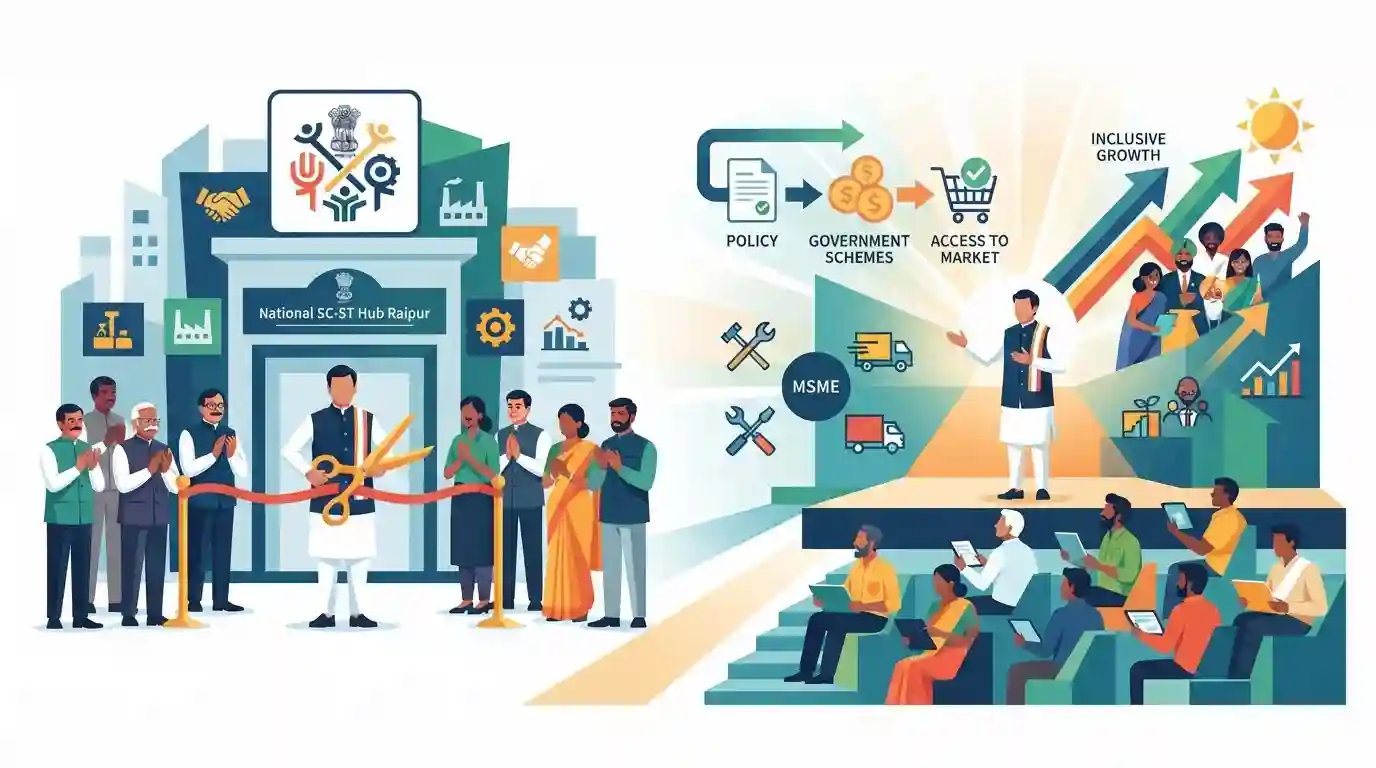
Union Minister for MSME inaugurated a new National SC-ST Hub office in Raipur and presided over a conclave aimed at fostering entrepreneurship among SC/ST communities, highlighting public procurement policies and inclusive economic growth.
Key Points
- Union Minister Shri Jitan Ram Manjhi inaugurated the National SC-ST Hub (NSSH) Office in Raipur, Chhattisgarh.
- The National SC-ST Hub aims to promote entrepreneurship culture among Scheduled Caste (SC) and Scheduled Tribe (ST) entrepreneurs.
- It provides support in capacity building, market access, and meeting the 4% public procurement mandatory goal from SC-ST owned enterprises under the Public Procurement Policy.
- The initiative highlights government focus on financial inclusion, inclusive growth, and strengthening MSMEs in tribal and backward regions.
Important Terms
National SC-ST Hub

A central sector scheme under the Ministry of MSME, implemented via NSIC, aimed at professional support, capacity building, and promoting entrepreneurship among SC/ST communities to achieve inclusive economic growth.
UPSC context
UPSC GS Paper II/III: Welfare schemes for vulnerable sections, affirmative action, and MSME growth.
Ministry of Micro, Small and Medium Enterprises
A statutory body under the Ministry of MSME that promotes, aids, and fosters the growth of micro, small, and medium enterprises across the country.
UPSC context
UPSC GS Paper III: Industrial policy, economic development, and employment generation.
Public Procurement Policy for Micro and Small Enterprises
A policy mandating central ministries and CPSEs to procure a minimum of 25% of annual requirements from MSEs, with a sub-target of 4% earmarked for SC/ST-owned enterprises.
UPSC context
UPSC GS Paper III: Government policies, public procurement norms, and affirmative action in business.
NSIC
A Mini Ratna PSU under the Ministry of MSME established to promote, aid, and foster the growth of micro, small, and medium enterprises in India.
UPSC context
UPSC GS Paper III: Role of public sector undertakings and institutional support for MSME ecosystem development.
Prelims Trap
mandatory goal of 4% total government procurement from SC-ST owned enterprises
The 4% procurement target for SC/ST enterprises is a sub-target *within* the overall 25% mandatory procurement from MSEs by Central ministries/CPSEs, not an independent 4% total budget mandate.
Static Concepts Connected
What are the key statutory and policy provisions for SC/ST entrepreneurship and public procurement in India?
- Procurement Policy:: Mandates a minimum 25% annual procurement of goods/services by Central Ministries, Departments, and CPSEs from Micro and Small Enterprises.
- SC/ST Sub-Target:: Out of the 25% total procurement mandate, a sub-target of 4% is specifically earmarked for MSEs owned by SC/ST entrepreneurs.
- National SC-ST Hub:: Setup by the Ministry of MSME through NSIC to provide professional support, capacity building, and market linkages to SC/ST entrepreneurs.
- NSIC Role:: A Central Public Sector Enterprise under the Ministry of MSME that acts as the implementing agency for various promotional schemes.
Cross-Topic Patterns
Affirmative Action Meets Public Procurement Policy
The 4% SC/ST public procurement sub-target bridges affirmative action policy with MSME mainstreaming, frequently examined in inclusive growth and targeted welfare questions.
Decentralized Tribal Growth & MSME Integration
Decentralization of NSSH offices to tribal-heavy states like Chhattisgarh operationalizes cooperative federalism and bottom-up regional development.

Public Procurement Policy's 4% SC/ST sub-target and NSIC's role in NSSH implementation are high-yield static-dynamic prelims traps.
Linked PYQs · 2
Linked PYQs · 2
- 2023MainsGS3
Faster economic growth requires increased share of the manufacturing sector in GDP, particularly of MSMEs. Comment on the present policies of the Government in this regard.
- 2022MainsGS3
Is inclusive growth possible under market economy ? State the significance of financial inclusion in achieving economic growth in India.
