Nasha Mukt Bharat Abhiyaan Community Outreach in Hyderabad
Source:PIB ↗
Why It Matters
Demonstrates grassroots mobilization and public awareness models used under national frameworks like Nasha Mukt Bharat Abhiyaan to address drug abuse and public health security.
Summary
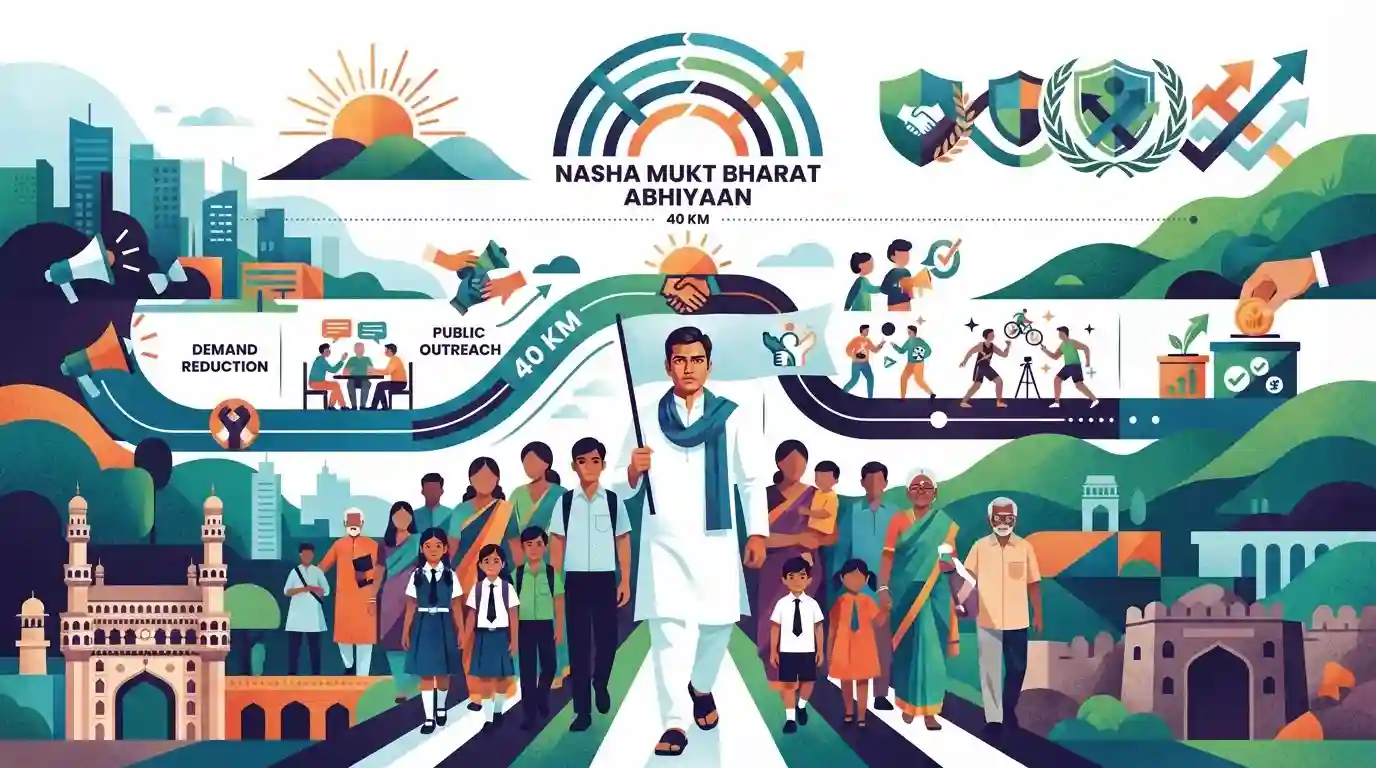
Union Minister G. Kishan Reddy spearheaded a 40-km walkathon in Hyderabad under the 'Nasha Mukt Bharat Abhiyaan' initiative to raise community awareness against substance abuse, highlighting public outreach and demand reduction strategies.
Key Points
- Union Minister G. Kishan Reddy led a 3-day, 40-km Padyatra titled ‘Hyderabad Walks For Nasha Mukt Bharat’ in Hyderabad, Telangana.
- The campaign aims to raise mass awareness against substance abuse and drug trafficking, culminating in a grand finale at Jubilee Hills.
- Emphasizes community mobilization and youth engagement under the broader Nasha Mukt Bharat Abhiyaan framework.
- Focuses on demand reduction, health education, and collaborative governance involving citizens and public leaders.
Important Terms
Nasha Mukt Bharat Abhiyaan

A flagship nationwide campaign launched by the Ministry of Social Justice and Empowerment to combat substance abuse through mass awareness, community outreach, and demand reduction strategies.
UPSC context
UPSC GS Paper II (Social Justice / Welfare Schemes) and GS Paper III (Internal Security / Drug Abuse). Tests knowledge of drug demand reduction measures.
Ministry of Social Justice and Empowerment
The nodal central ministry responsible for formulating and implementing policies for social welfare, empowerment, and marginalized groups, including schemes for drug demand reduction and substance abuse prevention.
UPSC context
UPSC GS Paper II (Governance and Welfare Schemes for Vulnerable Sections). Tests institutional frameworks for social welfare.
Prelims Trap
Nasha Mukt Bharat Abhiyaan is a flagship health campaign implemented exclusively by the Ministry of Health and Family Welfare.
NMBA is often mistakenly attributed to the Ministry of Health and Family Welfare, whereas it is spearheaded by the Ministry of Social Justice and Empowerment.
Static Concepts Connected
What are the key institutional and constitutional frameworks addressing substance abuse in India?
- MoSJE Mandate: Nodal Ministry: Spearheaded by the Ministry of Social Justice and Empowerment, focusing on demand reduction, rehabilitation, and mass awareness.
- Article 47 DPSP: Constitutional Basis: Article 47 of the Directive Principles of State Policy (DPSP) directs the State to endeavor to bring about prohibition of intoxicating drinks and drugs injurious to health.
- NDPS Act 1985: Statutory Backbone: The Narcotic Drugs and Psychotropic Substances (NDPS) Act, 1985 regulates operations regarding narcotic drugs and psychotropic substances while penalizing illicit trafficking.
Cross-Topic Patterns
Internal Security: Supply vs. Demand Reduction
While law enforcement tackles supply-side narco-terrorism via NCB, grassroots campaigns like NMBA target domestic consumption, forming a two-pronged internal security strategy.
Polity: DPSP and Prohibition Policies
Public health campaigns targeting vulnerable youth intersect with Article 47 of the DPSP, which directs the State to raise nutritional levels, standard of living, and prohibit intoxicating drinks.

Expect a statement-based question linking NMBA's mandate (MoSJE) with supply-side agencies (NCB) under internal security.
Linked PYQs · 3
Linked PYQs · 3
- 2024MainsGS3
Explain how narco-terrorism has emerged as a serious threat across the country. Suggest suitable measures to counter narco-terrorism.
- 2018MainsGS3
India's proximity to two of the world's biggest illicit opium-growing states has enhanced her internal security concerns. Explain the linkages between drug trafficking and other illicit activities such as gunrunning, money laundering and human trafficking. What counter-measures should be taken to prevent the same?
- 2019MainsGS2
Performance of welfare schemes that are implemented for vulnerable sections is not so effective due to absence of their awareness and active involvement at all stages of policy process. Discuss.
