NHRC Takes Cognizance of Rising TB Cases in Bhopal
Source:PIB ↗
Why It Matters
This development highlights the proactive role of the NHRC in addressing public health emergencies as human rights concerns, while highlighting systemic gaps in the implementation of disease eradication programs like the National Tuberculosis Elimination Programme (NTEP).
Summary
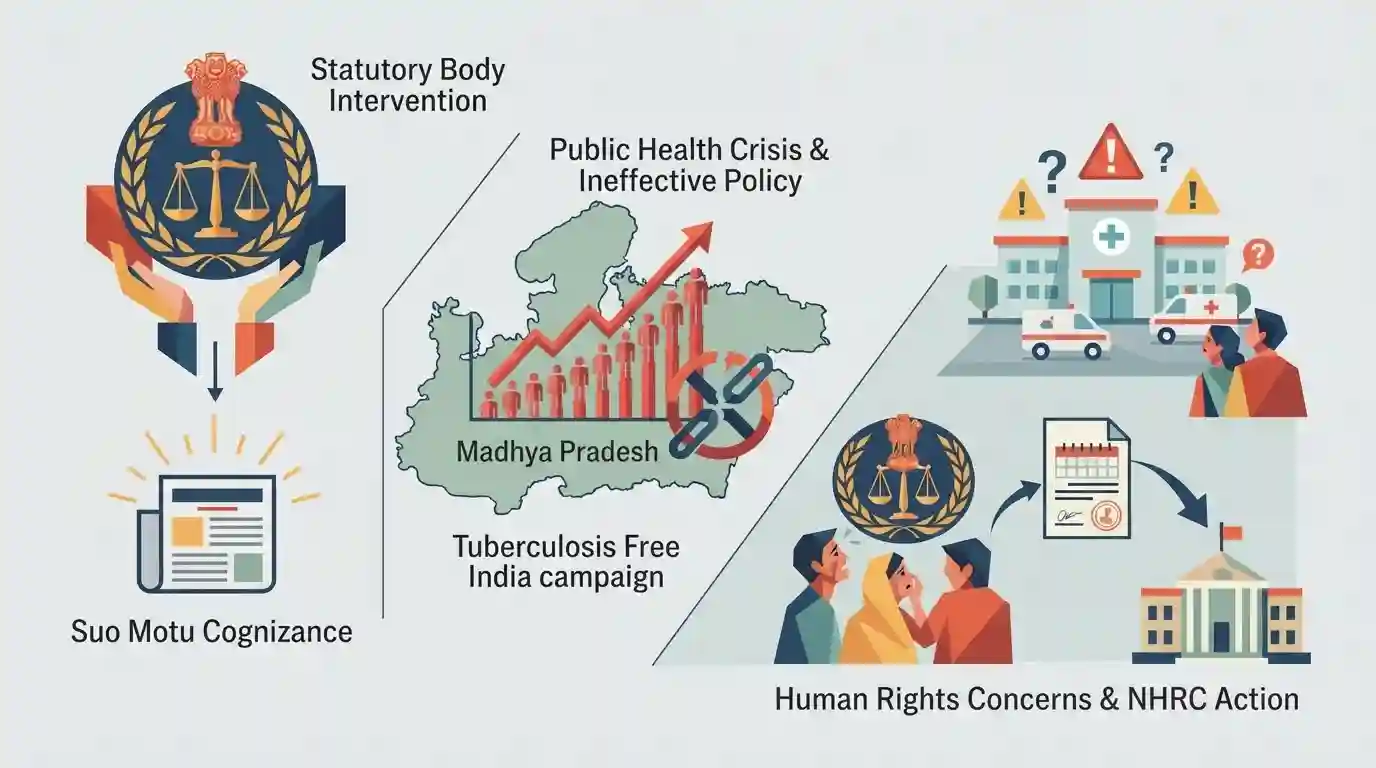
The National Human Rights Commission (NHRC) has taken suo motu cognizance of media reports concerning a continuous rise in Tuberculosis (TB) cases in Bhopal, Madhya Pradesh, despite the implementation of the Tuberculosis Free India campaign. Highlighting concerns over public health infrastructure and human rights implications, the NHRC has sought a detailed report from the state government authorities within four weeks.
Key Points
- The National Human Rights Commission NHRC took suo motu cognizance of a media report regarding a continuous rise in Tuberculosis TB cases in Bhopal, Madhya Pradesh.
- The report highlighted concerns over rising TB rates despite the ongoing national campaign and government healthcare measures.
- NHRC issued notices to the Chief Secretary and Secretary of the Health Department of Madhya Pradesh, calling for a detailed report within four weeks.
- The case brings to light issues regarding healthcare delivery gaps, implementation of the National Tuberculosis Elimination Programme NTEP, and socio-economic vulnerabilities linked to communicable diseases.
Important Terms
National Human Rights Commission NHRC

A statutory body established in 1993 under the Protection of Human Rights Act to protect and promote human rights, possessing powers to inquire into human rights violations or negligence by public servants.
UPSC context
UPSC GS Paper II (Polity & Governance - Statutory Bodies), testing institutional roles, human rights enforcement, and accountability.
Tuberculosis Free India campaign
India's flagship national campaign operating under the NTEP to eliminate tuberculosis nationwide through rigorous screening, treatment support, and community engagement initiatives like Ni-kshay Mitra.
UPSC context
UPSC GS Paper II (Health Policy & Public Healthcare Delivery), testing government health interventions and disease eradication targets.
National Tuberculosis Elimination Programme NTEP
A centrally sponsored public health program under the Ministry of Health and Family Welfare aimed at eliminating tuberculosis in India by providing early diagnosis, free drugs, and nutritional support.
UPSC context
UPSC GS Paper II (Social Justice - Health Infrastructure), testing programmatic implementation and welfare schemes.
Static Concepts Connected
What are the composition, appointment mechanism, and powers of the National Human Rights Commission (NHRC) under the Protection of Human Rights Act, 1993?
- Composition: Chaired by a retired Chief Justice of India or Supreme Court judge, appointed by the President on the recommendation of a high-powered 6-member committee.
- Powers & Nature: Empowered to suo motu or on petition inquire into human rights violations, recommend compensation, and inspect jails, but its findings are purely recommendatory.
- Jurisdiction Limit: Can examine constitutional and statutory safeguards for human rights and recommend remedial measures, but cannot investigate complaints older than one year.
Cross-Topic Patterns
NHRC Suo Motu Powers + Right to Health
The NHRC's intervention on public health delivery bridges statutory human rights accountability with Directive Principles of State Policy regarding public health under Article 47.

Expect a statement-based prelims question combining NHRC's statutory powers of suo motu inquiry with NTEP's 2025 elimination targets.
Linked PYQs · 3
Linked PYQs · 3
- 2021MainsGS2
Though the Human Rights Commissions have contributed immensely to the protection of human rights in India, yet they have failed to assert themselves against the mighty and powerful. Analyzing their structural and practical limitations, suggest remedial measures.
- 2014MainsGS2
National Human Rights Commission (NHRC) in India can be most effective when its tasks are adequately supported by other mechanisms that ensure the accountability of a government. In light of the above observation assess the role of NHRC as an effective complement to the judiciary and other institutions in promoting and protecting human rights standards.
- 2024MainsGS2
Poverty and malnutrition create a vicious cycle, adversely affecting human capital formation. What steps can be taken to break the cycle ?
