Bal Vivah Mukt Bharat Campaign Two Years Progress
Source:PIB ↗
Why It Matters
Evaluates government initiatives and policy frameworks targeting child marriage eradication and child rights protection, aligning with GS2 syllabus requirements on welfare schemes for vulnerable sections.
Summary
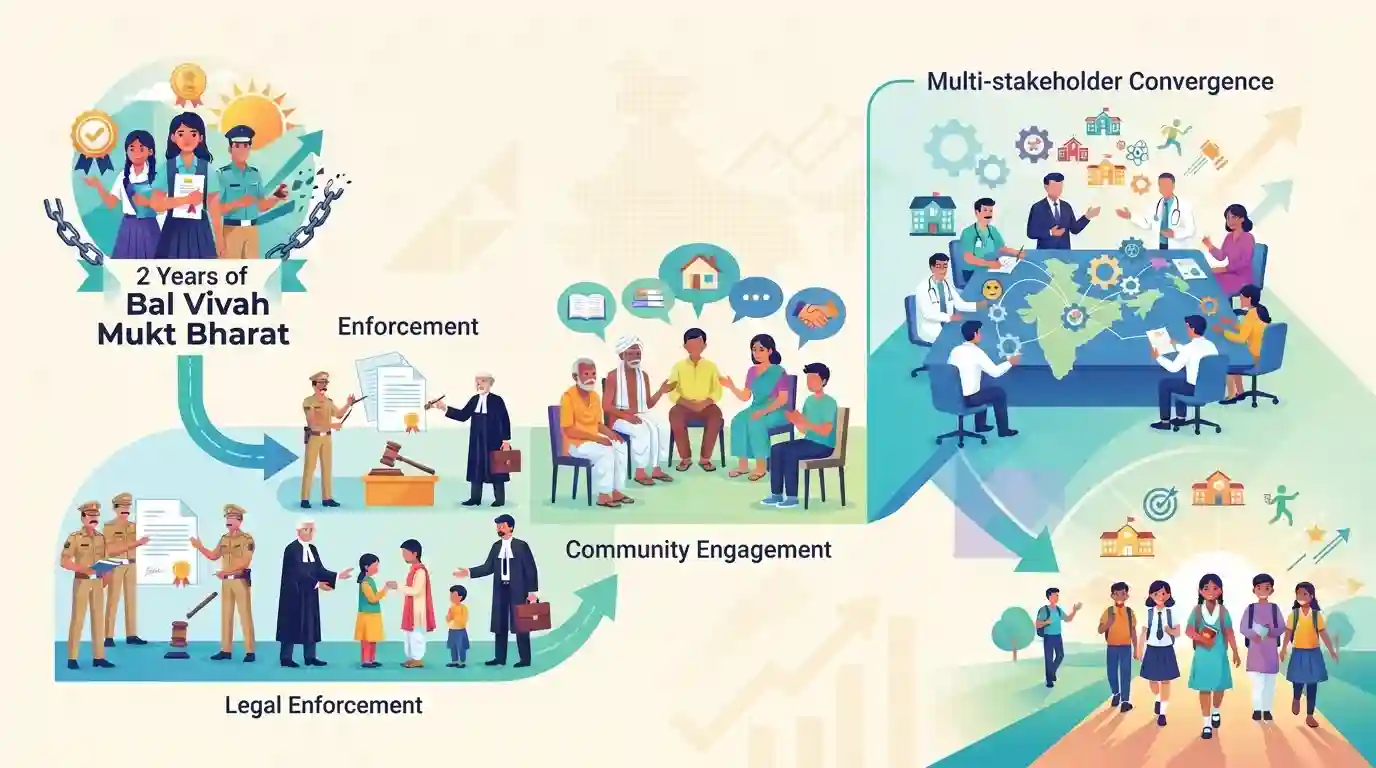
The Ministry of Women and Child Development celebrated two years of the 'Bal Vivah Mukt Bharat' campaign, highlighting ongoing efforts to eliminate child marriage through legal enforcement, community engagement, and multi-stakeholder convergence across India.
Key Points
- The Ministry of Women and Child Development marked two years of the 'Bal Vivah Mukt Bharat' campaign aimed at eradicating child marriage.
- The campaign focuses on a whole-of-society approach, community mobilization, strict enforcement of the Prohibition of Child Marriage Act (PCMA), and empowering adolescent girls.
- Child marriage remains a critical social challenge affecting health, education, and overall human capital development among vulnerable sections, particularly young girls.
- Intensive nationwide awareness drives and convergence among various ministries and local bodies are central to the strategy.
Important Terms
Bal Vivah Mukt Bharat Campaign

A nationwide campaign launched by the Ministry of Women and Child Development to eliminate child marriage in India through legal enforcement, community engagement, digital portals, and multi-stakeholder convergence.
UPSC context
UPSC Mains Paper II (Social Justice - Welfare Schemes for Vulnerable Sections, Child Rights). Important for evaluating government initiatives against social evils.
Prohibition of Child Marriage Act
The primary Indian legislation that prohibits child marriages, protects minor victims, and prescribes penal consequences for solemnizing or promoting marriages below the legal age of 18 for females and 21 for males.
UPSC context
UPSC Prelims and Mains Paper II (Governance / Social Justice). Tests statutory frameworks protecting children's rights and combating social vulnerabilities.
Ministry of Women and Child Development
The nodal Union ministry responsible for formulating policies, legislations, and implementing welfare programs for the holistic development, protection, and empowerment of women and children in India.
UPSC context
UPSC Mains Paper II (Governance / Welfare Schemes). Essential for understanding institutional mechanisms governing child protection and gender justice.
Prelims Trap
Child marriages are automatically void ab initio under Indian civil law without requiring a petition from the affected minor.
Under the PCMA, child marriages are not automatically illegal and void *ab initio* (from the beginning); rather, they are legally voidable at the option of the minor party within a specified window after attaining majority.
Static Concepts Connected
What are the key legal provisions and institutional mechanisms under the Prohibition of Child Marriage Act (PCMA), 2006?
- Voidable Nature: Legal Status: Marriages where either party is a minor (male under 21, female under 18) are voidable at the option of the contracting party who was a child, filed within a specified period of attaining majority.
- CMPO Mandate: Key Functionary: State governments are mandated to appoint Child Marriage Prohibition Officers (CMPOs) to prevent solemnization, collect evidence, and prosecute offenders.
- Penal Provisions: Punishment: Imprisonment up to two years and fine up to one lakh rupees for men contracting child marriages, parents, guardians, and those who solemnize them.
Cross-Topic Patterns
Child Marriage and Demographic Dividend Risks
Child marriage directly impedes female workforce participation by cutting short education and increasing maternal mortality, directly colliding with SDG 5 and India's demographic dividend goals.
Grassroots Governance and Local Body Accountability
The decentralized monitoring via CMPOs down to Gram Panchayats connects women's welfare schemes with grassroots administrative accountability under Panchayati Raj institutions.

PCMA provisions (voidable status, CMPO roles) combined with SDG targets are high-yield for both Prelims statements and Mains GS-1/GS-2.
Linked PYQs · 2
Linked PYQs · 2
- 2023MainsGS2
“Development and welfare schemes for the vulnerable, by its nature, are discriminatory in approach.” Do you agree? Give reasons for your answer.
- 2019MainsGS2
Performance of welfare schemes that are implemented for vulnerable sections is not so effective due to absence of their awareness and active involvement at all stages of policy process. Discuss.
