Dr Ambedkar Medical Aid Scheme for SC and ST Patients
Source:PIB ↗
Why It Matters
Important for understanding targeted government welfare mechanisms and financial support structures for SC and ST populations facing major health crises.
Summary
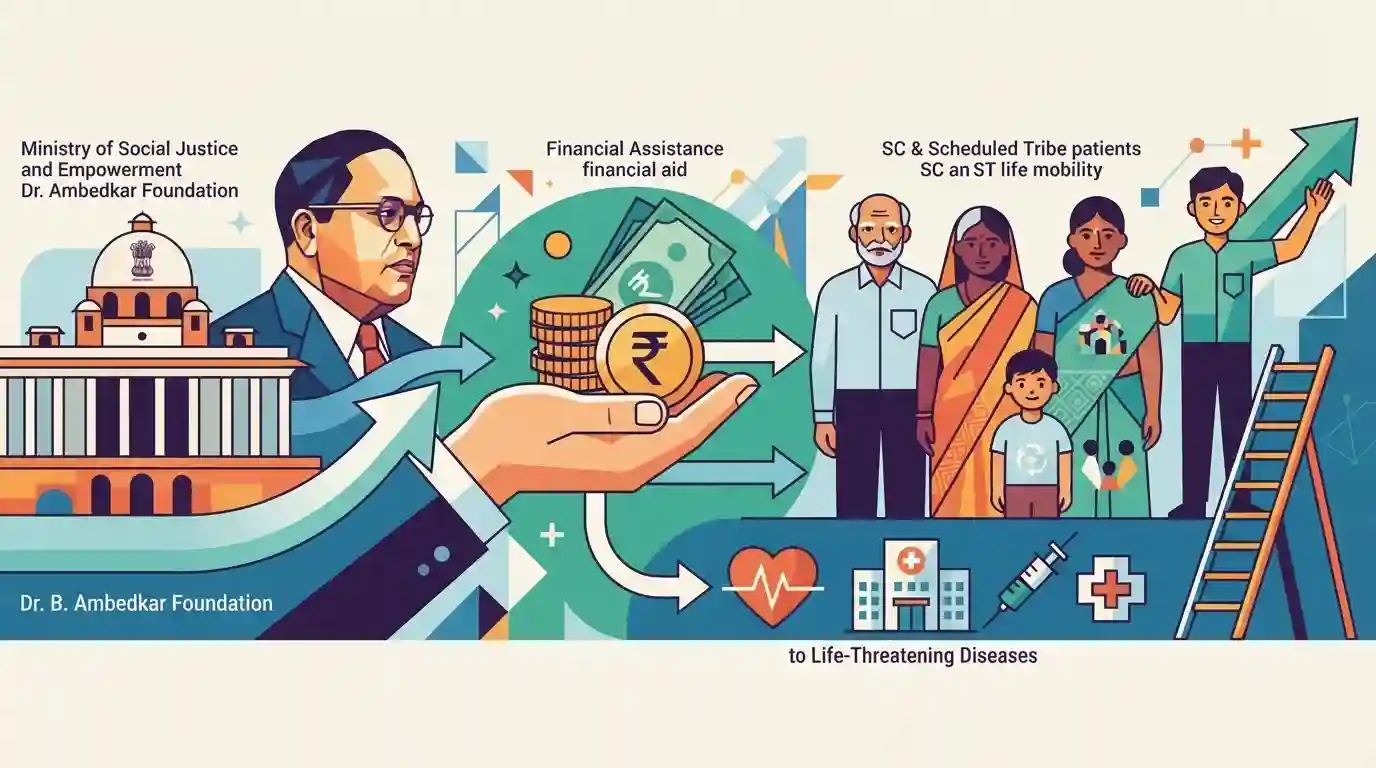
The Dr. Ambedkar Medical Aid Scheme, managed by the Dr. Ambedkar Foundation under the Ministry of Social Justice and Empowerment, offers up to ₹3.50 lakh in financial assistance to Scheduled Caste (SC) and Scheduled Tribe (ST) patients for treating life-threatening diseases, helping economically vulnerable sections access quality medical care.
Key Points
- The Dr. Ambedkar Medical Aid Scheme provides financial assistance of up to ₹3.50 lakh to SC and ST patients suffering from life-threatening diseases.
- The scheme is implemented by the Dr. Ambedkar Foundation under the Ministry of Social Justice and Empowerment.
- It aims to assist poor SC and ST families who cannot afford specialized medical treatment for major illnesses.
Important Terms
Dr. Ambedkar Medical Aid Scheme

A centrally sponsored or assisted welfare scheme providing financial assistance up to ₹3.50 lakh (or revised limits) to economically vulnerable SC and ST patients suffering from life-threatening medical conditions.
UPSC context
UPSC GS Paper II (Social Justice/Welfare Schemes): Tests knowledge of government safety nets and healthcare access for vulnerable sections like SC/ST.
Dr. Ambedkar Foundation
An autonomous body established under the aegis of the Ministry of Social Justice and Empowerment to implement welfare schemes and propagate the ideology of Dr. B.R. Ambedkar.
UPSC context
UPSC GS Paper II (Governance): Important for questions on statutory/autonomous bodies working towards social upliftment and marginalized empowerment.
Ministry of Social Justice and Empowerment
The nodal central ministry responsible for formulating policies, welfare schemes, and legislation for the empowerment of marginalized groups, including SCs, STs, OBCs, and minorities.
UPSC context
UPSC GS Paper II (Polity/Governance): Essential institutional framework for understanding ministries tasked with social justice and welfare administration.
Prelims Trap
Dr. Ambedkar Medical Aid Scheme is implemented by the Ministry of Health and Family Welfare.
Aspirants often assume central health schemes like PM-JAY cover all specific targeted demographic foundations, but this is a distinct scheme managed by the Dr. Ambedkar Foundation under the Ministry of Social Justice, not the Ministry of Health.
Static Concepts Connected
What are the constitutional safeguards and institutional mechanisms for Scheduled Castes and Scheduled Tribes in India?
- Constitutional Mandate: Article 46 directs the State to promote with special care the educational and economic interests of the weaker sections, and protect them from social injustice.
- Statutory Commissions: The National Commission for SCs (Article 338) and National Commission for STs (Article 338A) investigate and monitor matters relating to constitutional safeguards.
- DAF Oversight: The Dr. Ambedkar Foundation is an autonomous body under the Ministry of Social Justice and Empowerment promoting Ambedkar's ideology and welfare.
Cross-Topic Patterns
Medical Welfare Schemes and Directive Principles
Targeted medical aid schemes for vulnerable communities intersect with constitutional provisions under Article 46 for the educational and economic advancement of SCs and STs.

Ministry, implementing foundation, income ceiling, and financial cap are frequent targets in matching-type welfare scheme questions.
Linked PYQs · 3
Linked PYQs · 3
- 2026PrelimsGS1
Consider the following statements about the provisions pertaining to the Scheduled Castes and the Scheduled Tribes in India : 1. Provisions regarding the administration of the Tribal Areas in the States of Assam, Meghalaya, Tripura and Mizoram are given in the Fifth Schedule of the Constitution of India. 2. Some tribes of India are entitled to exemption from paying Income Tax on certain incomes. 3. The Constitution of India provides for reservation of seats in Panchayats for women belonging to the Scheduled Castes and the Scheduled Tribes. Which one of the following conclusions based on the above statements is correct ?
- 2026PrelimsGS1
Consider the following statements about the Committee on the Welfare of Scheduled Castes and Scheduled Tribes of the Parliament of India : 1. Although members of this Committee are elected from both Houses of Parliament, the Chairperson of this Committee is appointed by the Chairman of the Rajya Sabha. 2. Twenty members are elected by the Rajya Sabha and ten members by the Lok Sabha. 3. No Minister, except for the Union Minister of Social Justice and Empowerment, is eligible to be a member of this Committee. 4. Members are elected for a fixed term of two years from the date they enter their office. Which one of the following conclusions based on the above statements is correct ?
- 2026PrelimsGS1
Which of the following statements with regard to the persons with disabilities in India is/are correct ? 1. The Rights of Persons with Disabilities Act, an Act passed by the Parliament of India in 2018, mandates reservation in education and employment, places a legal duty on Governments to ensure accessibility and non-discrimination. 2. The Sugamya Bharat Abhiyan focuses on achieving universal accessibility for Persons with Disabilities across three key domains — built infrastructure, transport systems and information and communication technology. 3. The National Divyangjan Finance and Development Corporation (NDFDC) is a public sector organisation set up by the Ministry of Corporate Affairs as a not-for-profit company to promote entrepreneurship among Persons with Disabilities (PwDs). Select the answer using the code given below :
