Jal Jeevan Mission 2.0 and Gram Panchayat Water Governance
Source:PIB ↗
Why It Matters
The conference highlights the strategic shift of the Jal Jeevan Mission towards decentralized rural water governance, grassroots institution building, and long-term asset sustainability through Gram Panchayats.
Summary
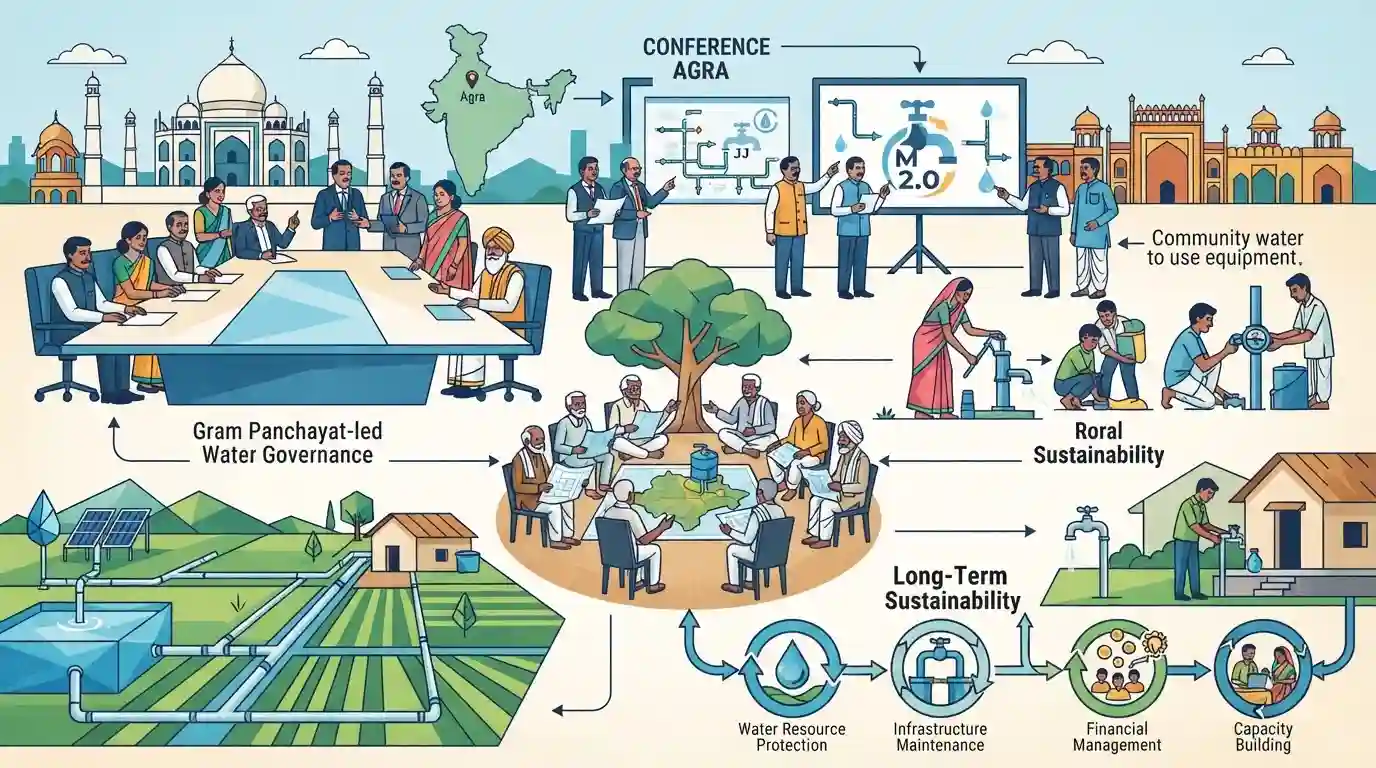
The Second Regional Conference on Jal Jeevan Mission 2.0 concluded in Agra, emphasizing community ownership, Gram Panchayat-led water governance, and the long-term sustainability of rural drinking water supply systems.
Key Points
- The Second Regional Conference on Jal Jeevan Mission 2.0 was held in Agra, focusing on long-term sustainability and community ownership.
- Emphasis was laid on Gram Panchayat-led water governance to ensure effective local management and maintenance of water supply assets.
- Discussions highlighted the transition from infrastructure creation to operational functionality, water quality surveillance, and financial viability of rural water schemes.
Important Terms
Jal Jeevan Mission

A flagship central scheme under the Ministry of Jal Shakti aimed at providing safe and adequate drinking water through individual household tap connections to all rural households in India.
UPSC context
GS Paper II (Government Policies & Interventions). Tests understanding of social sector schemes, public health, and basic infrastructure delivery in rural India.
Jal Jeevan Mission 2.0
An upgraded phase of the Jal Jeevan Mission focusing on long-term sustainability, community ownership, operation and maintenance, and Gram Panchayat-led water governance for rural drinking water systems.
UPSC context
GS Paper II / III (Governance & Rural Development). Tests policy evolution, decentralized water governance, and grassroots rural local bodies.
Ministry of Jal Shakti
The nodal Union ministry formed in 2019 by merging the Ministry of Water Resources and Ministry of Drinking Water and Sanitation, responsible for policy and management of India's water resources.
UPSC context
GS Paper II (Governance / Statutory Bodies). Tests institutional arrangements and administrative frameworks for managing water security in India.
Static Concepts Connected
What are the core institutional mechanisms and funding patterns under the Jal Jeevan Mission (JJM)?
- Objective: Aimed at providing Functional Household Tap Connections (FHTCs) to every rural household (Har Ghar Jal).
- Funding Pattern: Implemented by the Ministry of Jal Shakti with a Centre-State funding sharing pattern (90:10 for Himalayan/North-Eastern states, 50:50 for others, 100% for UTs).
- Governance: Pani Samitis (VWSCs) and Gram Panchayats act as local key agencies for planning, implementation, and O&M.
Cross-Topic Patterns
Jal Jeevan Mission + 73rd Constitutional Amendment
Decentralized water governance under JJM relies heavily on 73rd Constitutional Amendment provisions (Schedule 11, item 11: drinking water).

JJM 2.0 shift from infrastructure creation to community-led operational sustainability is a prime target for mains governance questions.
Linked PYQs · 4
Linked PYQs · 4
- 2022MainsGS2
To what extent, in your opinion, has the decentralisation of power in India changed the governance landscape at the grassroots?
- 2024MainsGS2
Analyse the role of local bodies in providing good governance at local level and bring out the pros and cons merging the rural local bodies with the urban local bodies.
- 2020MainsGS2
The strength and sustenance of local institutions in India has shifted from their formative phase of 'Functions, Functionaries and Funds' to the contemporary stage of 'Functionality'. Highlight the critical challenges faced by local institutions in terms of their functionality in recent times.
- 2020MainsGS3
What are the salient features of the Jal Shakti Abhiyan launched by the Government of India for water conservation and water security?
