India Post Modernization and Digital Transformation Outlay
Source:PIB ↗
Why It Matters
Crucial for understanding government investments in critical physical and digital infrastructure, enhancing last-mile logistics, and driving inclusive economic growth through public sector networks.
Summary
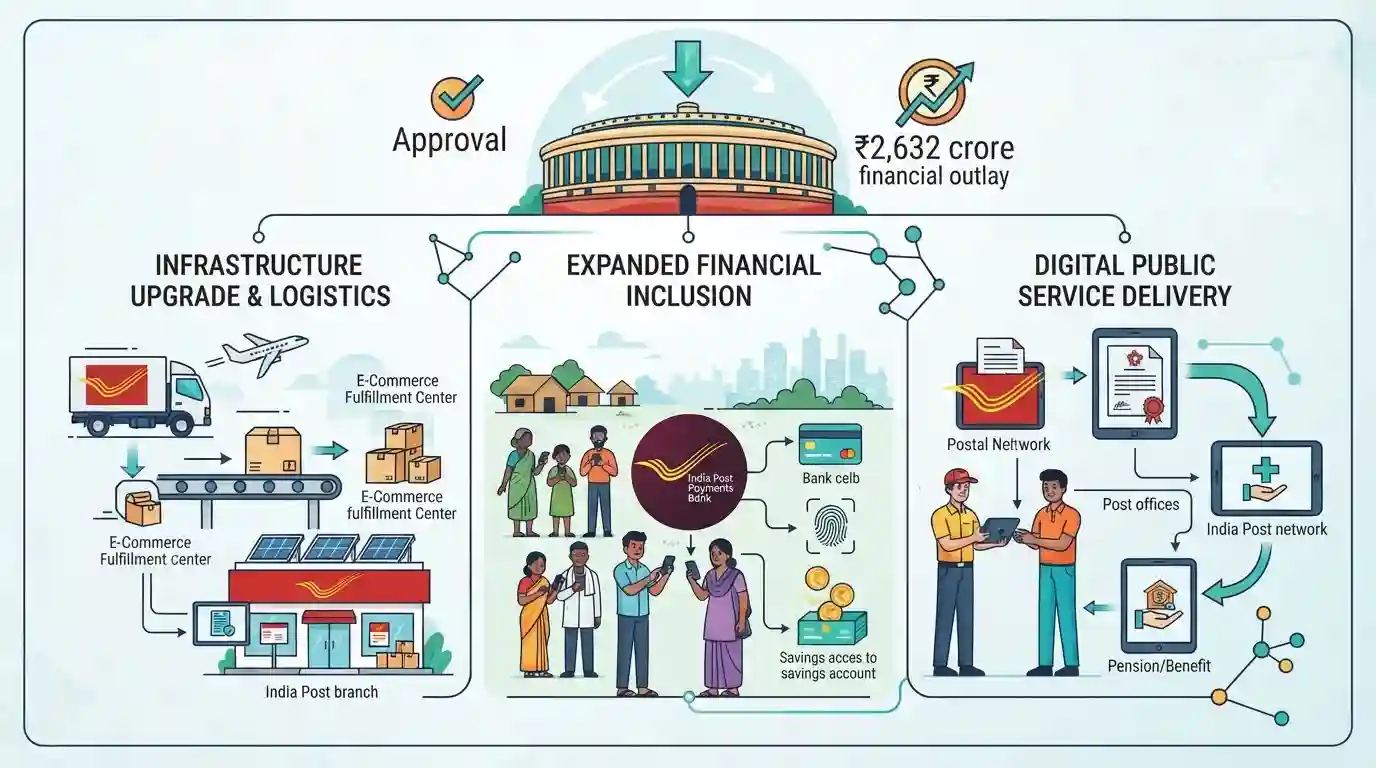
The Union Cabinet has approved a financial outlay of ₹2,632 crore for the modernization and digital transformation of India Post. This initiative aims to upgrade infrastructure, improve supply chain and logistics for e-commerce, expand financial inclusion, and leverage the postal network for digital public service delivery across rural and urban India.
Key Points
- The Union Cabinet approved a financial outlay of Rs 2,632 crore for the modernization and digital transformation of India Post.
- The project focuses on upgrading postal infrastructure, technological integration, and enhancing service delivery across urban and rural networks.
- Aims to leverage India Post's extensive reach for e-commerce logistics, financial inclusion, and citizen-centric digital public services.
Important Terms
Cabinet Committee on Economic Affairs

A key cabinet committee chaired by the Prime Minister that directs and coordinates economic policy, reviews major infrastructure proposals, and approves large financial outlays for government schemes.
UPSC context
UPSC CSE Prelims & Mains (Polity & Governance / Economy): Tests knowledge of executive decision-making bodies, cabinet committees, and institutional mechanisms for economic policy.
Department of Posts
The department under the Ministry of Communications responsible for operating India Post, providing postal, financial, and digital public services across the country.
UPSC context
UPSC CSE Prelims & Mains (Governance / Infrastructure): Important for questions on public service delivery, departmental administration, and rural infrastructure.
India Post
The national postal system of India, currently undergoing modernization to enhance e-commerce logistics, financial inclusion, and digital public service delivery.
UPSC context
UPSC CSE Prelims & Mains (Economy / Inclusive Growth): Tests understanding of logistics networks, financial inclusion, and last-mile public service delivery mechanisms.
Prelims Trap
India Post's modernization through public-private partnerships implies its complete privatization and withdrawal from public postal obligations.
Aspirants often confuse India Post's commercial diversification (e.g., e-commerce logistics, PLI) with complete privatization, whereas it remains a wholly government-owned public service vehicle.
Static Concepts Connected
What is the institutional structure and evolution of the Department of Posts in India?
- Vast Reach: Oldest network: Operates over 1.65 lakh post offices, with more than 89% located in rural areas, making it the most expansive physical outreach network.
- Governance: Statutory basis: Governed by the Indian Post Office Act (historically 1898, amended recently), functioning as a department under the Ministry of Communications.
- Diversification: Beyond mail: Diversified into banking (India Post Payments Bank - IPPB), insurance (PLI/RPLI), retail services, and e-commerce parcel delivery.
Cross-Topic Patterns
Postal Network + Digital Public Infrastructure (DPI)
India Post's 1.65 lakh network bridges the digital divide, acting as a direct delivery channel for rural DBT, Jan Dhan banking, and e-governance schemes.
Logistics Infrastructure + Rural MSME Growth
Parcel network optimization directly aids D2C brands and rural MSMEs in tier-2/3 cities by competing with private logistics players.

India Post modernization + rural financial inclusion + DPI integration is high-yield for both Prelims statements and Mains governance questions.
Linked PYQs · 2
Linked PYQs · 2
- 2021MainsGS3
“Investment in infrastructure is essential for more rapid and inclusive economic growth.” Discuss in the light of India's experience.
- 2026PrelimsGS1
Which one of the following correctly represents the three key sub-indices of the Financial Inclusion Index (FI-Index) of the Reserve Bank of India (RBI) ?
