Technology Dialogue on Emerging Technologies and Convergence
Source:PIB ↗
Why It Matters
The Technology Dialogue highlights India's growing focus on critical and emerging technologies, fostering cross-sectoral convergence and science diplomacy, which are key pillars for future economic growth and strategic autonomy.
Summary
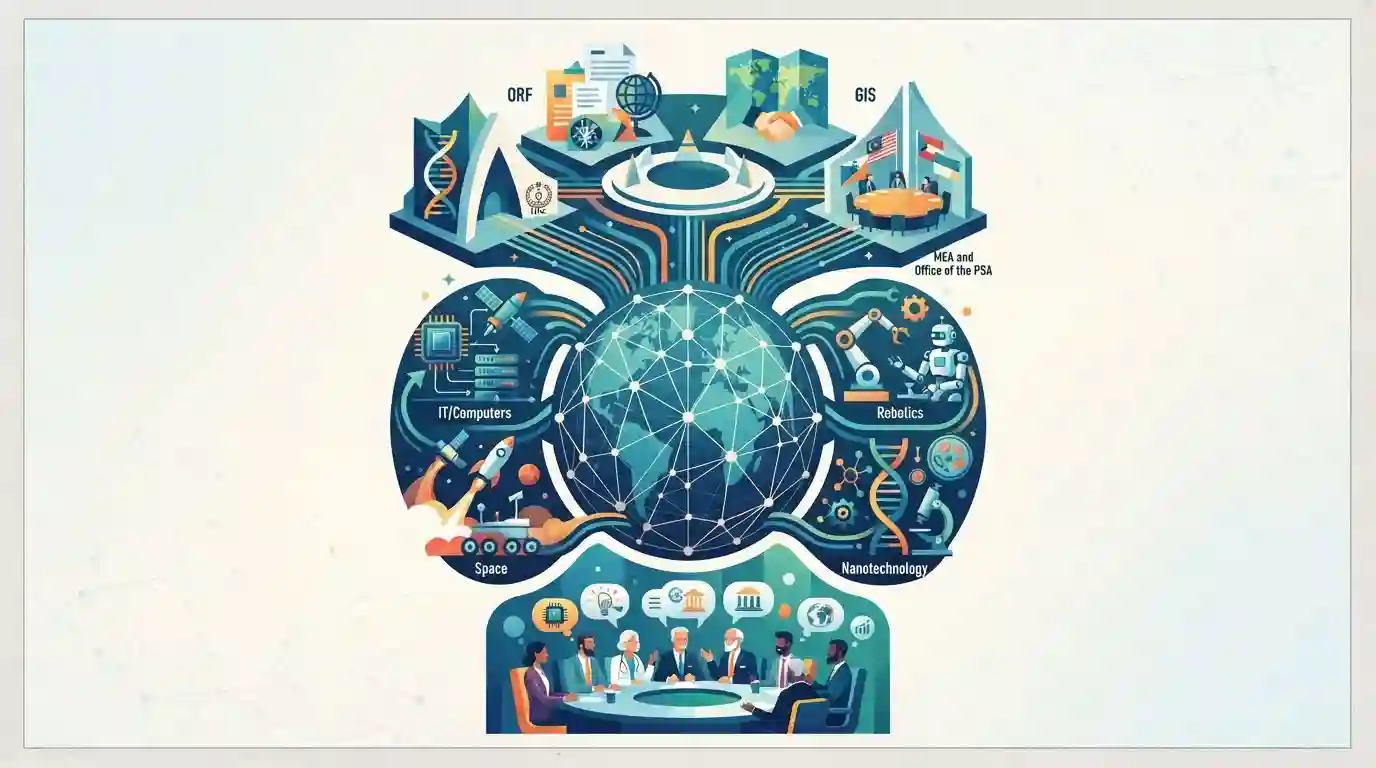
The Office of the Principal Scientific Adviser, in collaboration with the Ministry of External Affairs, IISc, ORF, and GIS, is organizing the 3rd edition of the Technology Dialogue focusing on 'Charting Technological Convergence'. The event brings together global stakeholders to discuss the convergence of critical and emerging technologies and its implications for governance, innovation, and international relations.
Key Points
- The 3rd edition of the Technology Dialogue focuses on 'Charting Technological Convergence'.
- Jointly organized by the Office of the PSA, MEA, IISc, ORF, and GIS.
- Brings together global experts to deliberate on critical and emerging technologies like AI, quantum computing, and biotechnology.
- Highlights the intersection of science, technology policy, and international diplomacy (science diplomacy).
Important Terms
Office of the Principal Scientific Adviser

The nodal governmental body in India providing pragmatic, objective advice to the Prime Minister and Cabinet on science, technology, and innovation policies and driving inter-ministerial technology missions.
UPSC context
UPSC Prelims/Mains GS Paper III: Science & Technology - Policy-making, institutional framework, and coordination of emerging technologies in India.
Observer Research Foundation
An independent, nonpartisan policy research think tank based in New Delhi that convenes major international forums like the Raisina Dialogue and conducts research on governance, technology, and foreign policy.
UPSC context
UPSC Mains GS Paper II & III: Role of think tanks in shaping India's foreign policy, science diplomacy, and global technology governance.
Indian Institute of Science
A premier public research university for higher education and scientific research in Bengaluru, serving as a key hub for indigenous technology innovation and deep-tech incubation in India.
UPSC context
UPSC Prelims/Mains GS Paper III: Achievements of Indians in science & technology; indigenous R&D infrastructure and frontier research institutions.
Static Concepts Connected
What is the institutional mandate of the Office of the Principal Scientific Adviser (PSA) in India?
- Apex Role: Apex advisory body providing scientific advice to the Cabinet and PM on critical S&T matters.
- PM-STIAC: Chairs the Prime Minister’s Science, Technology and Innovation Advisory Council (PM-STIAC).
- Coordination: Coordinates national technology missions, R&D priorities, and inter-ministerial science diplomacy efforts.
Cross-Topic Patterns
Science Diplomacy & Tech Governance
Science diplomacy bridges domestic R&D bodies like the Office of the PSA with the Ministry of External Affairs, shaping international tech standards and plurilateral governance.
Critical Tech & Strategic Autonomy
As critical technologies (AI, quantum, biotech) converge, national capability mapping (like India's Critical Tech Atlas) intersects directly with strategic autonomy debates.

Expect a match-the-column or statement-based question linking the Office of the PSA, MEA, and Track 1.5 dialogues to science diplomacy.
Linked PYQs · 3
Linked PYQs · 3
- 2025MainsGS3
How can India achieve energy independence through clean technology by 2047? How can biotechnology can play a crucial role in this endeavour?
- 2025MainsGS3
India aims to become a semiconductor manufacturing hub. What are the challenges faced by the semiconductor industry in India? Mention the salient features of the India Semiconductor Mission.
- 2022MainsGS2
How will I2U2 (India, Israel, UAE and USA) grouping transform India's position in global politics?
