Regional Conference on Rural Water and Sanitation Governance
Source:PIB ↗
Why It Matters
This conference highlights institutional mechanisms, policy reviews, and cooperative federalism strategies employed by the Ministry of Jal Shakti for implementing critical flagship schemes like the Jal Jeevan Mission and Swachh Bharat Mission Grameen at the grassroots level.
Summary
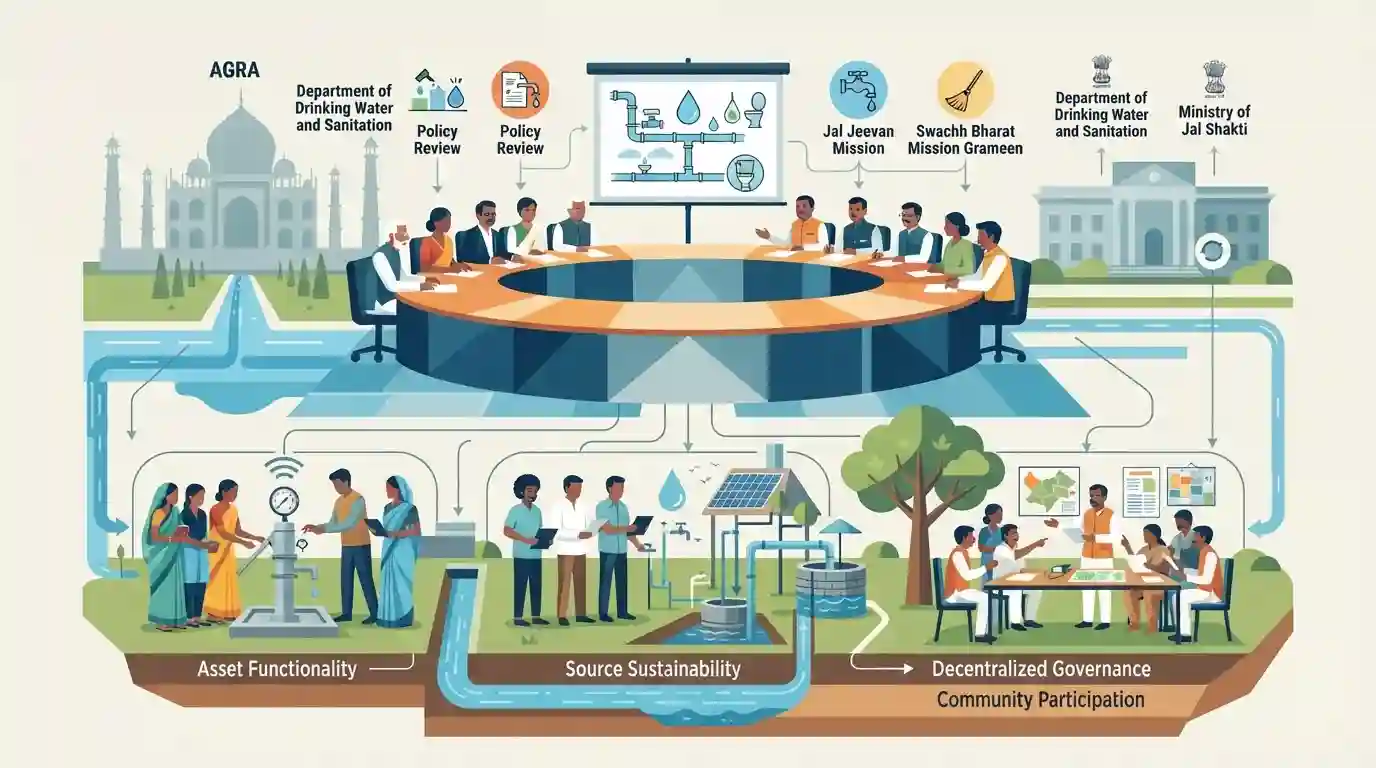
The Department of Drinking Water and Sanitation, Ministry of Jal Shakti, organized a regional conference in Agra to review the implementation of rural water supply and sanitation programs, specifically the Jal Jeevan Mission and Swachh Bharat Mission Grameen. The deliberations focused on decentralized governance, asset functionality, source sustainability, and community participation through local bodies.
Key Points
- The Department of Drinking Water and Sanitation, Ministry of Jal Shakti, organized the second regional conference in Agra.
- The conference focused on reviewing the progress and sharing best practices regarding the implementation of Jal Jeevan Mission (JJM) and Swachh Bharat Mission Grameen (SBM-G).
- Discussions emphasized decentralized water governance, rural sanitation, source sustainability, and community ownership through Village Water and Sanitation Committees (VWSCs).
Important Terms
Jal Jeevan Mission

A flagship central government program aiming to provide safe and adequate drinking water through individual household tap connections to all rural households in India.
UPSC context
UPSC GS Paper II (Government Policies & Interventions, Social Sector). Tests knowledge of welfare schemes, rural infrastructure, and public health delivery.
Swachh Bharat Mission Grameen
A nationwide flagship campaign under the Ministry of Jal Shakti focused on sustaining open defecation free status and managing solid and liquid waste in rural areas.
UPSC context
UPSC GS Paper II (Development Processes & Social Sector). Tests sanitation initiatives, behavioral change campaigns, and rural development goals.
Department of Drinking Water and Sanitation
The central government department under the Ministry of Jal Shakti responsible for formulating and implementing national policies on rural drinking water supply and sanitation.
UPSC context
UPSC GS Paper II (Governance). Evaluates institutional frameworks, administrative machinery, and execution of central welfare schemes.
Ministry of Jal Shakti
The nodal ministry of the Government of India formed in 2019 to consolidate water resource management, drinking water supply, and sanitation programs under a single umbrella.
UPSC context
UPSC GS Paper II (Government Policies & Governance). Tests understanding of ministerial restructuring, water security, and resource governance in India.
Prelims Trap
Village Water and Sanitation Committees (VWSCs) operate entirely independently of Gram Panchayats for rural water management.
Aspirants often assume Village Water and Sanitation Committees (VWSCs) are independent corporate bodies rather than standing sub-committees operating under the umbrella of Gram Panchayats.
Static Concepts Connected
What are the institutional mandates and funding mechanisms of the Jal Jeevan Mission?
- Primary Objective: Guarantees every rural household a functional household tap connection (FHTC) providing adequate potable water of prescribed quality.
- Funding Pattern: Funded through a Centre-State sharing pattern (90:10 for Himalayan/North-Eastern states, 50:50 for others, and 100% for UTs without legislature).
- Decentralized Delivery: Institutionalized through Gram Panchayats and Village Water and Sanitation Committees (VWSCs) for decentralized planning, operation, and maintenance.
Cross-Topic Patterns
Rural Water Supply & Grassroots Decentralisation
JJM implementation heavily relies on 73rd Constitutional Amendment structures, linking flagship infrastructure delivery directly to Panchayati Raj institutional capacities and grassroots devolution.
Water Security & Climate Adaptation
Transition from mere physical pipe laying to source sustainability connects water security discourse directly to climate adaptation and watershed management.

JJM implementation, VWSC roles, and the shift toward source sustainability will likely feature in a multi-statement prelims question.
Linked PYQs · 3
Linked PYQs · 3
- 2025PrelimsGS1
Consider the following statements about 'PM Surya Ghar Muft Bijli Yojana': I. It targets installation of one crore solar rooftop panels in the residential sector. II. The Ministry of New and Renewable Energy aims to impart training on installation, operation, maintenance and repairs of solar rooftop systems at grassroot levels. III. It aims to create more than three lakhs skilled manpower through fresh skilling, and up-skilling, under scheme component of capacity building. Which of the statements given above are correct?
- 2022MainsGS2
To what extent, in your opinion, has the decentralisation of power in India changed the governance landscape at the grassroots?
- 2025MainsGS3
Examine the factors responsible for depleting groundwater in India. What are the steps taken by the government to mitigate such depletion of groundwater?
