Public Sector Banks Growth Asset Quality and Banking Reforms
Source:PIB ↗
Why It Matters
Crucial for understanding the structural health, governance, and asset quality turnaround of India's Public Sector Banks, which form the backbone of credit delivery and economic growth.
Summary
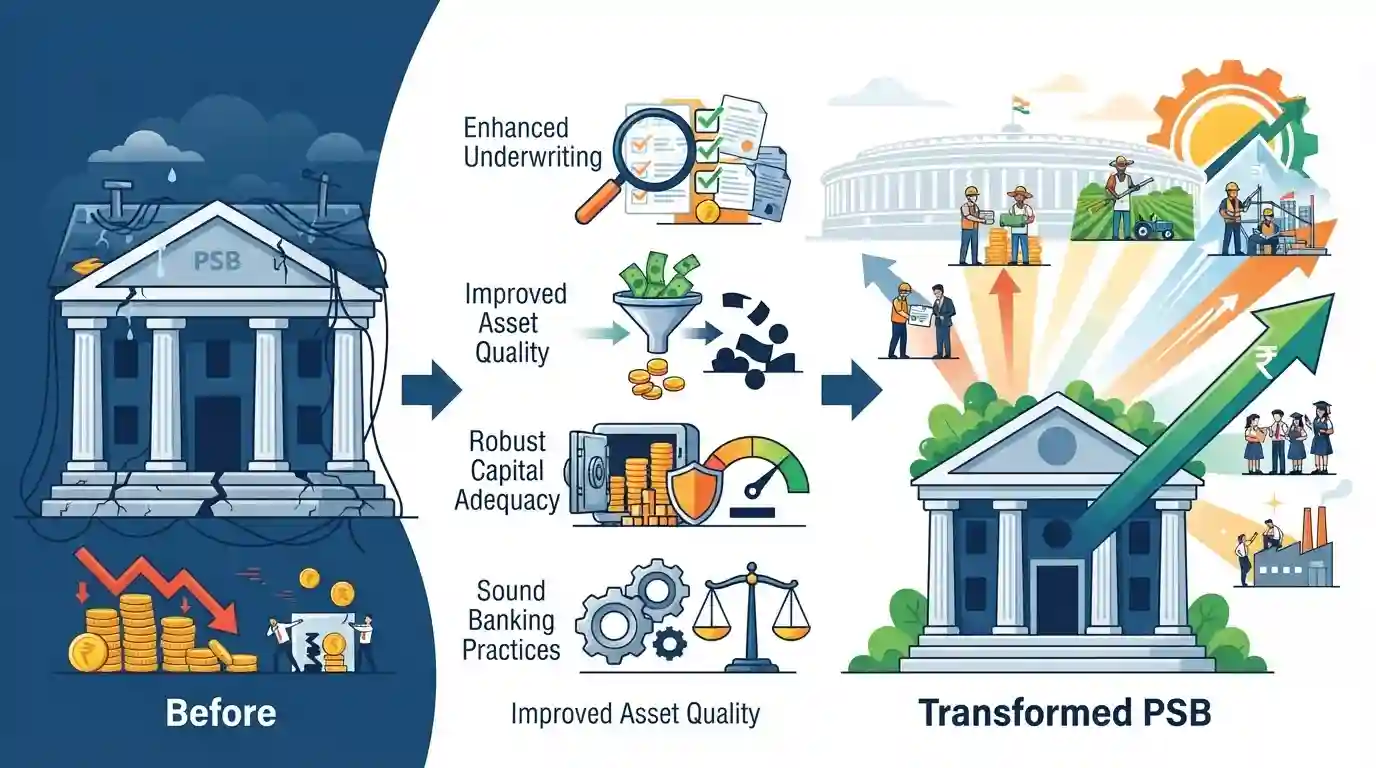
The article outlines the strengthening of Public Sector Banks (PSBs) in India through sound banking practices, enhanced underwriting standards, improved asset quality, and robust capital adequacy. These reforms and prudent management strategies have transformed PSBs into resilient institutions supporting inclusive economic growth.
Key Points
- Public Sector Banks (PSBs) in India have demonstrated robust financial health, marked by prudent banking practices and improved underwriting capabilities.
- Asset quality has substantially improved with a decline in Non-Performing Assets (NPAs) and strengthened balance sheets.
- Enhanced credit growth and capital adequacy ratios reflect greater resilience and risk management in the banking sector.
Important Terms
Public Sector Banks

Banks where the Government of India holds a majority stake exceeding 50 percent, functioning as key instruments for financial inclusion, credit delivery, and socio-economic development across the country.
UPSC context
UPSC GS Paper III: Indian Economy - Banking Sector Reforms, NPAs, financial inclusion, and mobilization of resources.
Reserve Bank of India
India's central banking institution responsible for regulating the monetary policy, issuing currency, supervising commercial banks and NBFCs, and maintaining financial stability.
UPSC context
UPSC GS Paper III: Indian Economy - Monetary policy, banking regulation, and central banking functions.
Ministry of Finance
A central government ministry responsible for economic policy, fiscal administration, public revenue, budgeting, and the overall regulation of financial markets and public sector financial institutions.
UPSC context
UPSC GS Paper III: Indian Economy - Government budgeting, fiscal policy, and governance of public financial institutions.
Prelims Trap
decline in Non-Performing Assets to multi-year lows implies complete elimination of credit risk and bad loans in the banking system.
Aspirants often confuse Gross NPA reduction with total elimination of credit risk, overlooking that provisioning and write-offs also contribute to lower reported GNPA ratios.
Static Concepts Connected
What are the key pillars of the Prompt Corrective Action (PCA) framework for banks?
- Threshold parameters: Trigger points are based on capital adequacy ratios, net NPAs, and leverage ratios.
- Corrective actions: Mandatory restrictions include dividend distribution, branch expansion, and promoter/owner stake adjustments.
- Discretionary steps: Discretionary actions involve asset restructuring, specialized supervisory monitoring, and strategic management changes.
Cross-Topic Patterns
NPAs Resolution + Credit Growth & Infrastructure
The clean-up of public sector balance sheets through IBC and recapitalization directly enabled a resurgence in productive infrastructure and MSME credit deployment.
Basel III Norms + RBI Regulatory Oversight
The convergence of RBI regulatory tightening, Prompt Corrective Action (PCA) frameworks, and Basel III norms illustrates how macroprudential tools protect financial stability.

Expect a statement-based prelims question pairing NPA recovery trends with IBC implementation and Capital Adequacy Ratio requirements.
Linked PYQs · 2
Linked PYQs · 2
- 2023MainsGS3
Faster economic growth requires increased share of the manufacturing sector in GDP, particularly of MSMEs. Comment on the present policies of the Government in this regard.
- 2018PrelimsGS1
Consider the following statements: 1. Capital Adequacy Ratio (CAR) is the amount that banks have to maintain in the form of their own funds to offset any loss that banks incur if the account-holders fail to repay dues. 2. CAR is decided by each individual bank. Which of the statements given above is/are correct?
