Agricultural crop production estimates and kharif outlook
Source:PIB ↗
Why It Matters
Crop production estimates form the backbone of India's agricultural policy, food management, buffer stocking, and price stabilization strategies.
Summary
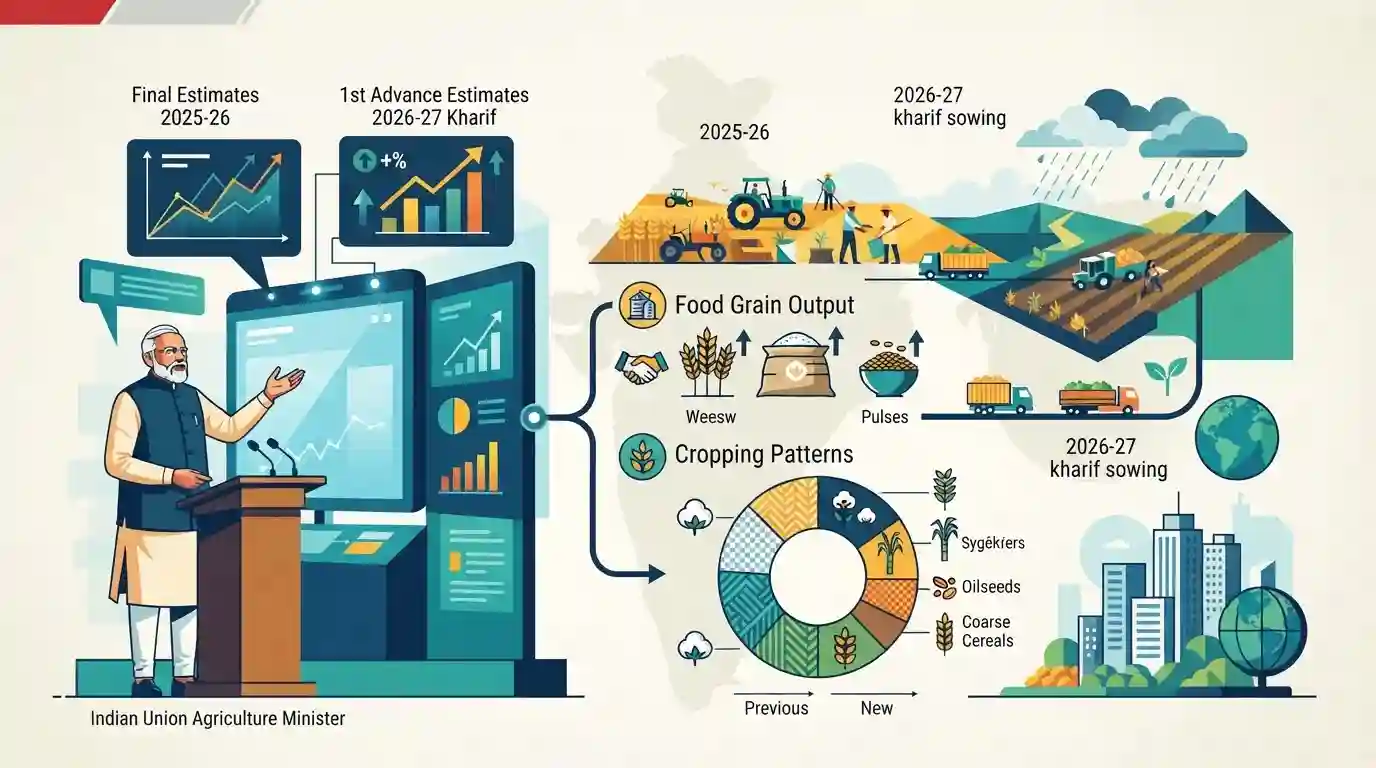
Union Agriculture Minister released the final agricultural crop production estimates for 2025-26 along with the first advance estimates for the 2026-27 kharif season, providing vital statistics for tracking food grain output, cropping patterns, and agricultural planning in India.
Key Points
- The Ministry of Agriculture and Farmers Welfare released the final production estimates of major agricultural crops for 2025-26 and the first advance estimates for the 2026-27 kharif season.
- These estimates provide crucial data on food grain production, horticulture, and cropping trends, aiding policy formulation and food security management.
- Advance estimates assist the government in planning inputs, minimum support price (MSP) strategies, and trade policies for upcoming seasons.
Important Terms
Ministry of Agriculture and Farmers Welfare

Central government ministry responsible for formulating policies, administering programs, and compiling agricultural statistics, crop production estimates, and food security frameworks across India.
UPSC context
UPSC Prelims/Mains (GS Paper II & III): Important ministries, governance structures, and agricultural policy frameworks in India.
Kharif Season
The agricultural season in India spanning the monsoon months (July to October), characterized by the cultivation of rain-fed crops like paddy, maize, and pulses.
UPSC context
UPSC Prelims/Mains (GS Paper III - Agriculture): Cropping patterns, monsoon dependency, and agricultural geography of India.
Advance Estimates of Crop Production
Official statistical projections released sequentially by the Ministry of Agriculture to track output of major food grains and commercial crops for planning and food security.
UPSC context
UPSC Prelims/Mains (GS Paper III - Economics/Agriculture): Agricultural statistics, food security, and state policy planning.
Prelims Trap
First advance estimates are treated as the definitive final production figures for the agricultural year.
Aspirants often confuse 'Advance Estimates' with 'Final Production Estimates'. Advance estimates are predictive projections released sequentially throughout the crop year, whereas final estimates incorporate post-harvest crop cutting experiment data.
Static Concepts Connected
What are the stages of crop production estimation released by the Ministry of Agriculture and Farmers Welfare in India?
- First Advance:: First Advance Estimates are released during the Kharif conference (September) when monsoon is drawing to a close.
- Second Advance:: Second Advance Estimates incorporate Rabi sowing data and are released in February.
- Subsequent Estimates:: Third and Fourth Advance Estimates follow in April and June as harvesting progresses.
- Final Estimates:: Final Estimates are published after complete compilation of all state-level crop cutting experiments (CCEs).
Cross-Topic Patterns
Crop Production Estimates + Food Security (NFSA)
Advance estimates of crop output directly feed into buffer stock norms, open-market sale schemes (OMSS), and food subsidy management under the National Food Security Act (NFSA).
Monsoon Variability + Inflation & Fiscal Deficit
Fluctuations in kharif output due to El Niño conditions highlight the vulnerability of rainfed agriculture, linking meteorological data directly to fiscal management and inflation targeting.

Crop production advance estimates + MSP procurement trends likely to be tested in a multi-statement Prelims question.
Linked PYQs · 3
Linked PYQs · 3
- 2025PrelimsGS1
Consider the following statements about turmeric during the year 2022-23: I. India is the largest producer and exporter of turmeric in the world. II. More than 30 varieties of turmeric are grown in India. III. Maharashtra, Telangana, Karnataka and Tamil Nadu are major turmeric producing States in India. Which of the statements given above are correct?
- 2024MainsGS3
Elucidate the importance of buffer stocks for stabilizing agricultural prices in India. What are the challenges associated with the storage of buffer stock? Discuss.
- 2025MainsGS3
Explain the factors influencing the decision of the farmers on the selection of high value crops in India.
