USTR Section 301 Determination and India Trade Impact
Source:PIB ↗
Why It Matters
This topic is critical for understanding the friction between unilateral trade measures (like US Section 301) and multilateral trading frameworks governed by the WTO, directly impacting India's trade policy and economic sovereignty.
Summary
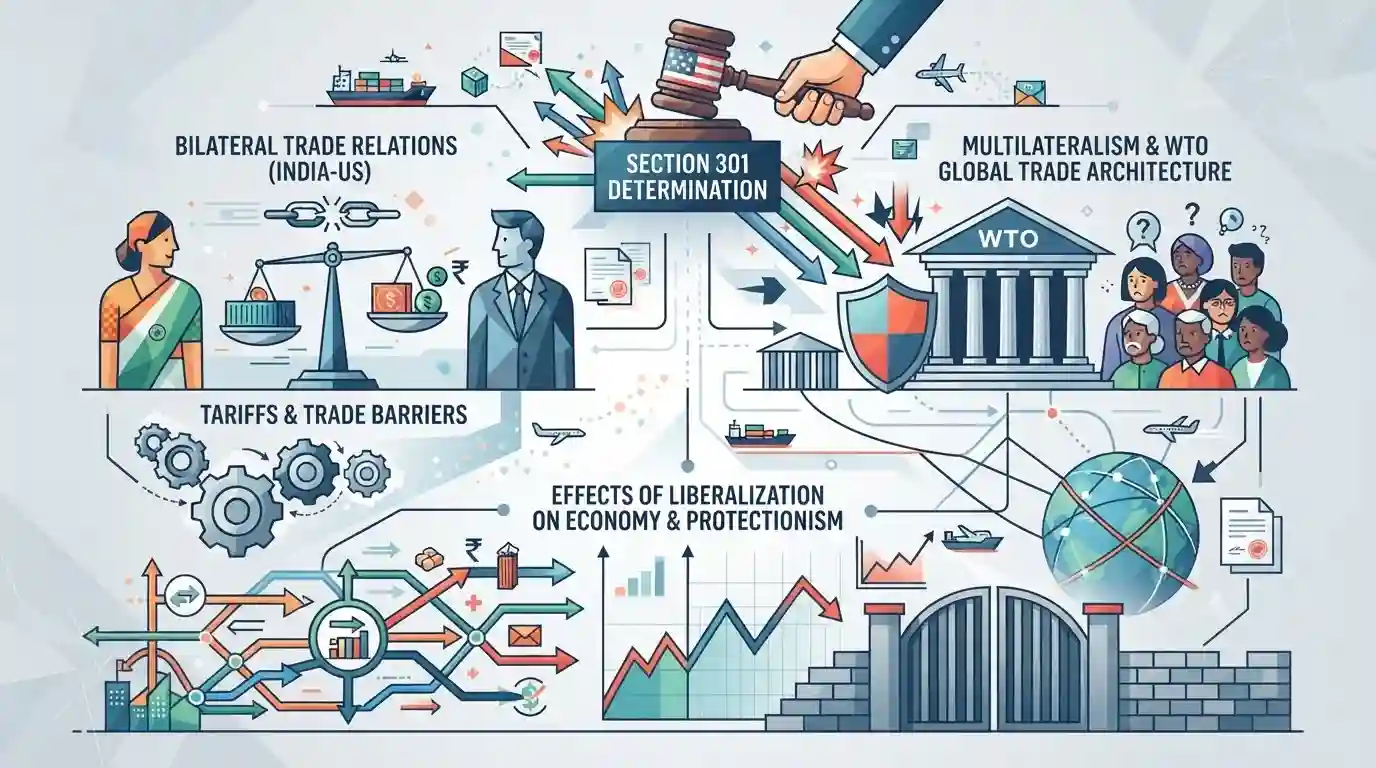
Official response and analysis regarding the United States Trade Representative (USTR) Section 301 determination, addressing its implications for India-US bilateral trade relations, multilateralism, and protectionism.
Key Points
- The United States Trade Representative (USTR) announced findings and determinations under Section 301 regarding certain trade practices or digital/services taxes.
- India responded to the USTR Section 301 determination, emphasizing its sovereign right to frame economic and taxation policies.
- Unilateral trade actions under laws like Section 301 raise concerns over multilateral trading rules and WTO dispute settlement mechanisms.
- India-US bilateral trade relations face friction points concerning digital services, market access, and trade protectionism.
Important Terms
Section 301 Determination

A provision of the U.S. Trade Act of 1974 allowing the USTR to investigate and retaliate against foreign trade practices deemed unreasonable, unjustifiable, or restrictive to U.S. commerce.
UPSC context
UPSC GS Paper II (IR) and GS Paper III (Economy - Global Trade): Tests understanding of unilateral trade barriers and protectionism.
Office of the United States Trade Representative
An agency of the United States federal government responsible for developing and coordinating international trade policy and conducting trade negotiations.
UPSC context
UPSC GS Paper II (Bilateral Relations & International Institutions): Evaluates mechanisms driving major nation trade policies impacting emerging economies.
World Trade Organization (WTO)
A global international organization established in 1995 to oversee rules of international trade between nations and resolve trade disputes.
UPSC context
UPSC GS Paper III (Indian Economy & Global Trade): Essential for analyzing multilateralism versus unilateral tariff actions.
Government of India
The sovereign administrative authority of India, responsible for framing domestic economic policies, manufacturing incentives, and conducting bilateral trade negotiations.
UPSC context
UPSC GS Paper II (Governance & International Relations): Focuses on national policy responses to external economic pressures.
Prelims Trap
Section 301 is an authorized investigative tool under the WTO dispute settlement framework.
Aspirants often confuse Section 301 as a WTO-sanctioned retaliatory mechanism, whereas it is a purely domestic US statutory provision allowing unilateral action.
Static Concepts Connected
What are the key trade remedy measures recognized under WTO agreements?
- Anti-Dumping Duties: Used to offset injurious dumping of goods below normal value in export markets.
- Countervailing Duties: Imposed to neutralize specific foreign government subsidies conferring an unfair trade advantage.
- Safeguard Measures: Temporary restrictions applied when a sudden surge in imports causes serious injury to domestic industry.
Cross-Topic Patterns
Digital Taxation vs. WTO Rules
Domestic tax policies like equalization levies face pushback under US Section 301, clashing directly with WTO non-discrimination principles and sovereign digital sovereignty claims.
Unilateral Trade Sanctions & WTO Paralysis
US unilateral trade retaliation tools bypass multilateral dispute settlement, challenging the foundational architecture of the WTO appellate body.

Section 301 domestic trade tools vs WTO multilateralism is a high-yield conceptual pair for International Trade Prelims/Mains.
Linked PYQs · 4
Linked PYQs · 4
- 2025MainsGS3
What are the challenges before the Indian economy when the world is moving away from free trade and multilateralism to protectionism and bilateralism? How can these challenges be met?
- 2018MainsGS2
What are the key areas of reform if the WTO has to survive in the present context of "Trade War', especially keeping in mind the interest of India?
- 2019MainsGS2
‘What introduces friction into the ties between India and the United States is that Washington is still unable to find for India a position in its global strategy, which would satisfy India's national self-esteem and ambitions.’ Explain with suitable examples.
- 2018MainsGS3
How would the recent phenomena of protectionism and currency manipulations in world trade affect macroeconomic stability of India?
