SHRESHTA Scheme for Scheduled Castes Education
Source:PIB ↗
Why It Matters
SHRESHTA is a key central sector scheme aimed at inclusive growth and educational upliftment of Scheduled Caste students through public-private partnerships with high-performing residential schools.
Summary
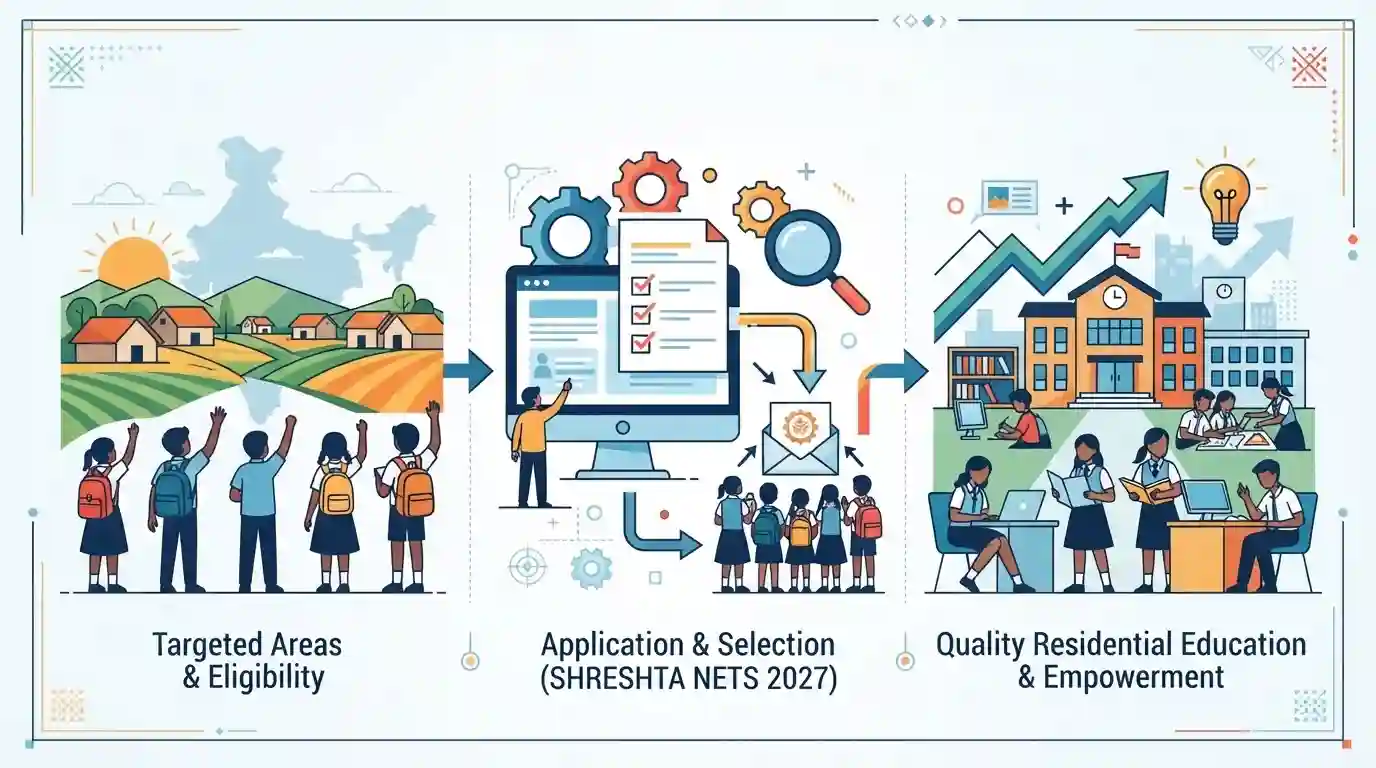
The Ministry of Social Justice and Empowerment is encouraging eligible Scheduled Caste students to apply for SHRESHTA (NETS) 2027, a scheme designed to provide quality residential education in top-tier private schools to meritorious students from targeted areas.
Key Points
- The Ministry of Social Justice and Empowerment is inviting applications for the Scheme for Residential Education for Students in High Schools in Targeted Areas (SHRESHTA) NETS 2027.
- The scheme aims to provide high-quality residential education to meritorious students belonging to Scheduled Castes (SCs) in reputed private residential schools.
- It bridges educational gaps and promotes socio-economic development by supporting students whose parental income falls below specified thresholds.
Important Terms
SHRESHTA NETS

A central scheme by the Ministry of Social Justice and Empowerment offering quality residential education in top-tier private schools to meritorious Scheduled Caste (SC) and De-notified Tribe (DNT) students.
UPSC context
GS Paper II: Government Policies & Interventions, Welfare Schemes for Vulnerable Sections (Scheduled Castes). Tests awareness of targeted educational empowerment initiatives.
Ministry of Social Justice and Empowerment
The nodal central ministry responsible for welfare, social justice, and empowerment of disadvantaged and marginalized groups, including Scheduled Castes, OBCs, senior citizens, and persons with disabilities.
UPSC context
GS Paper II: Governance & Social Justice. Tests knowledge of ministerial portfolios and institutional mechanisms for marginalized sections.
Prelims Trap
SHRESHTA scheme provides residential education exclusively through government-run residential institutions similar to EMRS.
Aspirants often confuse SHRESHTA with general minority or tribal schemes like Eklavya Model Residential Schools (EMRS), whereas SHRESHTA specifically targets Scheduled Caste students in top-tier private schools.
Static Concepts Connected
What are the key constitutional provisions and institutional mechanisms for the educational empowerment of Scheduled Castes in India?
- Constitutional Mandate: Article 15(4) and Article 46 mandate the State to promote the educational and economic interests of weaker sections, particularly SCs and STs.
- NCSC Role: National Commission for Scheduled Castes (Article 338) monitors constitutional safeguards and welfare schemes for SCs.
- Welfare Framework: Central Sector and Centrally Sponsored Schemes focus on pre-matric, post-matric scholarships, and top-class education to bridge systemic gaps.
Cross-Topic Patterns
Targeted Welfare Schemes and Federal Education Delivery
SHRESHTA pairs central educational financing with targeted entrance testing (NETS via NTA), intersecting both Article 46 directive principles and administrative centralization trends in welfare schemes.

Expect a matching or statement-based question pairing SHRESHTA's Mode 1/Mode 2 implementation details with parental income and grade criteria.
Linked PYQs · 1
Linked PYQs · 1
- 2023MainsGS2
“Development and welfare schemes for the vulnerable, by its nature, are discriminatory in approach.” Do you agree? Give reasons for your answer.
