India Space Economy Growth and Private Sector Participation
Source:PIB ↗
Why It Matters
Understanding the commercialization of India's space sector, the role of private actors, and the evolution of space policy is crucial for GS3 Science & Technology and Economic Development questions.
Summary
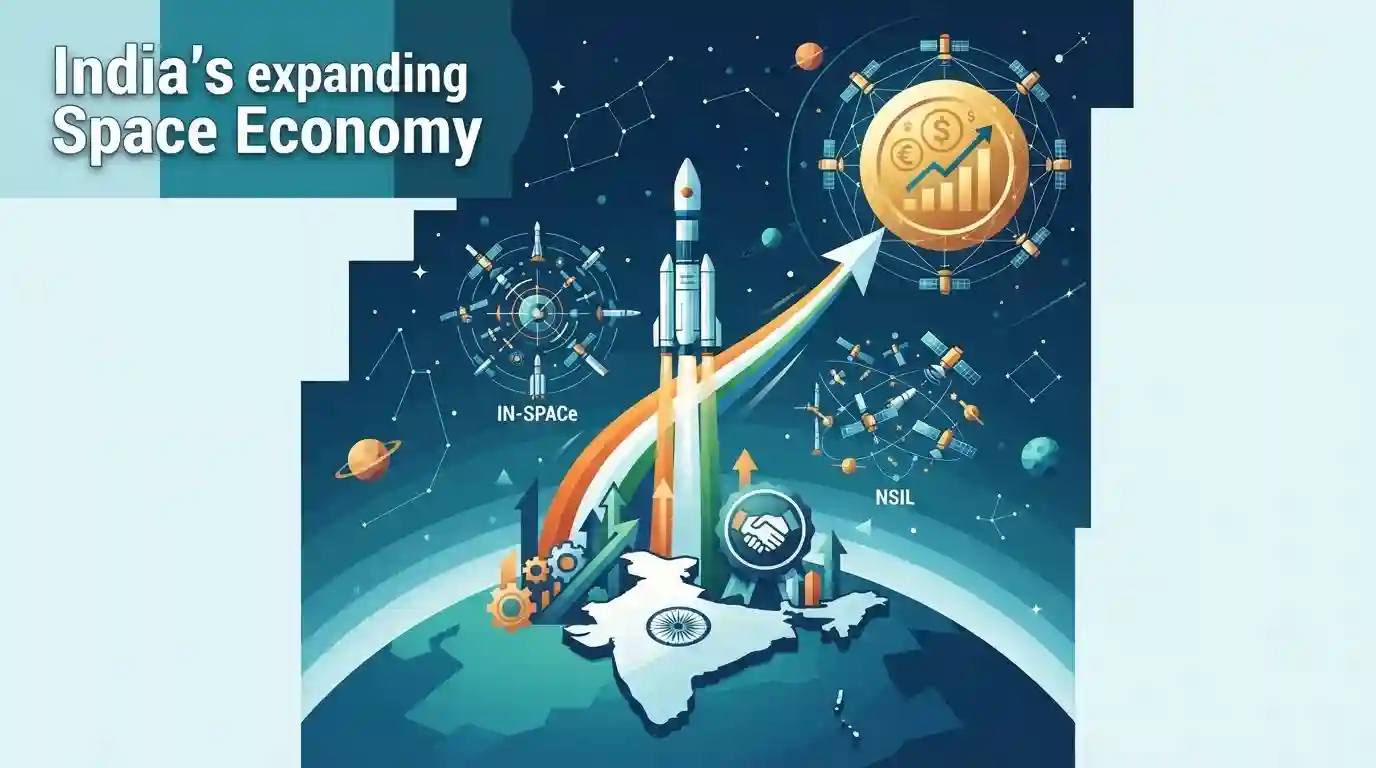
Union Minister Dr. Jitendra Singh highlighted that India's space economy is poised for a massive leap to USD 40-45 billion, powered by private sector growth, structural policy reforms, and bodies like IN-SPACe and NSIL, transforming India into a major global space hub.
Key Points
- India's space economy is projected to grow to USD 40-45 billion by 2040, driven heavily by private sector participation.
- Reforms such as the creation of IN-SPACe and NSIL have decentralized the space sector, moving away from a government-exclusive model.
- The private space industry is expanding across diverse verticals including launch vehicles, satellite manufacturing, and space-based applications.
- India's share in the global space economy is targeted to increase significantly through commercialization and startup ecosystems.
Important Terms
Indian Space Policy 2023

A comprehensive framework launched in 2023 to institutionalize private sector participation in India's space sector, demarcating roles for ISRO, IN-SPACe, and NSIL to boost India's global space market share.
UPSC context
GS Paper III (Science & Technology): Tests understanding of policy reforms, commercialization of space, and private sector integration in national development.
ISRO
The national space agency of India responsible for research, development, and execution of space exploration missions, planetary research, and advanced aerospace technologies.
UPSC context
GS Paper III (Science & Technology): Essential for questions on indigenous space capabilities, institutional evolution, and technological achievements.
IN-SPACe
An autonomous single-window nodal agency under the Department of Space created to promote, authorize, and supervise private sector non-government entities in undertaking space activities.
UPSC context
GS Paper III (Science & Technology): Important for studying governance reforms, public-private partnerships, and regulatory bodies in high-tech sectors.
NewSpace India Limited (NSIL)
The commercial arm of ISRO incorporated under the Department of Space to commercially exploit research and development outputs, build launch vehicles, and market satellite services.
UPSC context
GS Paper III (Science & Technology / Economy): Relevant for testing commercialization of public sector enterprises and India's space economy growth.
Static Concepts Connected
What are the distinct institutional roles defined under the Indian Space Policy 2023 for ISRO, IN-SPACe, and NSIL?
- ISRO Mandate: ISRO focuses on research and development, deep space missions, and building advanced national space infrastructure.
- IN-SPACe Role: IN-SPACe functions as an autonomous single-window nodal agency to authorize, promote, and supervise private sector space activities.
- NSIL Function: NSIL acts as the commercial arm responsible for commercializing space assets, launch services, and tech transfers.
Cross-Topic Patterns
Space Commercialization + Regulatory State Reforms
The shift of IN-SPACe as an autonomous regulator parallels structural reforms in telecom (TRAI) and civil aviation (DGCA), illustrating India's transition from operator to regulator across high-tech domains.

Expect match-the-following or statement-based questions pairing bodies like IN-SPACe, NSIL, and ISRO with their respective statutory/policy mandates.
Linked PYQs · 1
Linked PYQs · 1
- 2019MainsGS3
What is India's plan to have its own space station and how will it benefit our space programme?
