Skill Development and Career Pathways in India
Source:PIB ↗
Why It Matters
It addresses the core structural challenges of India's demographic dividend, employability mismatch, and the integration of vocational training with formal education, making it vital for GS3 (Economy and Human Resource Development).
Summary
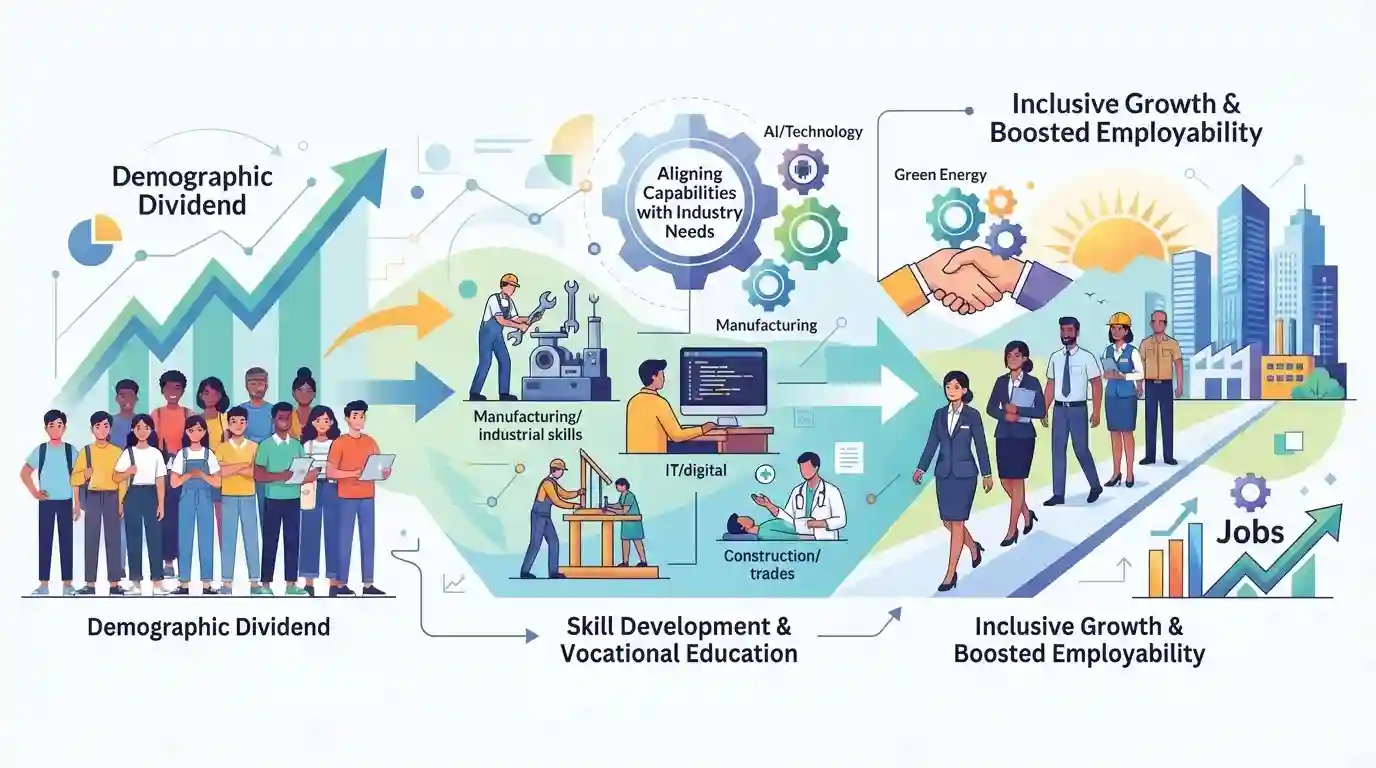
The Prime Minister shared an article emphasizing India's growing strategic focus on skill development, vocational education, and aligning the workforce's capabilities with industry requirements to leverage the demographic dividend and boost employability.
Key Points
- The Prime Minister highlighted India's strategic transformation toward making skill development a preferred career pathway rather than a fallback option.
- Emphasized aligning the education system with industrial needs through vocational training, apprenticeships, and contemporary skilling initiatives.
- Addressed the challenge of matching India's demographic dividend with high employability by bridging the skill gap.
- Stressed the integration of skilling across formal education channels under the framework of recent educational reforms.
Important Terms
Skill India Mission

The flagship government initiative launched to enhance employability and entrepreneurial capabilities of youth through extensive vocational training, aiming to transform India into the global skill capital.
UPSC context
UPSC Mains GS Paper II/III: Critical for questions on human resource development, employment generation, and leveraging the demographic dividend.
National Education Policy (NEP)
Comprehensive educational framework replacing the 1986 policy, emphasizing vocational integration from school levels, competency-based learning, and aligning academic output with industry requirements.
UPSC context
UPSC Mains GS Paper II (Education, Social Sector) and Prelims: Tests knowledge on educational reforms and human capital creation.
Prelims Trap
integration of vocational training exclusively at the tertiary or higher education level
Aspirants often assume vocational education under NEP 2020 is restricted to higher education or post-schooling, whereas reforms mandate its integration right from school education levels.
Static Concepts Connected
What are the core institutional pillars of India's Skill India Mission and vocational education framework?
- NSDC Mandate: National Skill Development Corporation (NSDC) acts as a Public-Private Partnership (PPP) model to catalyze skill development.
- Credit Framework: National Credit Framework (NCF) integrates academic and vocational learning to enable seamless credit transfer and mobility.
- Implementation Channels: Industrial Training Institutes (ITIs) and Pradhan Mantri Kaushal Vikas Yojana (PMKVY) serve as implementation channels for short and long-term training.
Cross-Topic Patterns
Skill Development + Demographic Dividend + Manufacturing Push
Integrating vocational streams into secondary education directly operationalizes the demographic dividend framework, connecting human capital formation with manufacturing push like PLI schemes.

NEP 2020 vocational integration + Skill India targets likely paired in a statement-based Prelims question on human capital.
Linked PYQs · 2
Linked PYQs · 2
- 2014MainsGS3
While we flaunt India's demographic dividend, we ignore the dropping rates of employability. What are we missing while doing so? Where will the jobs that India desperately needs come from? Explain.
- 2015MainsGS3
Success of 'Make in India' programme depends on the success of 'Skill India' programme and radical labour reforms." Discuss with logical arguments.
