Delivery of ASW Shallow Water Craft Ashank to Indian Navy
Source:PIB ↗
Why It Matters
This development highlights India's progress in indigenous shipbuilding and defence manufacturing under Aatmanirbhar Bharat, directly linking to maritime security and coastal defence preparedness.
Summary
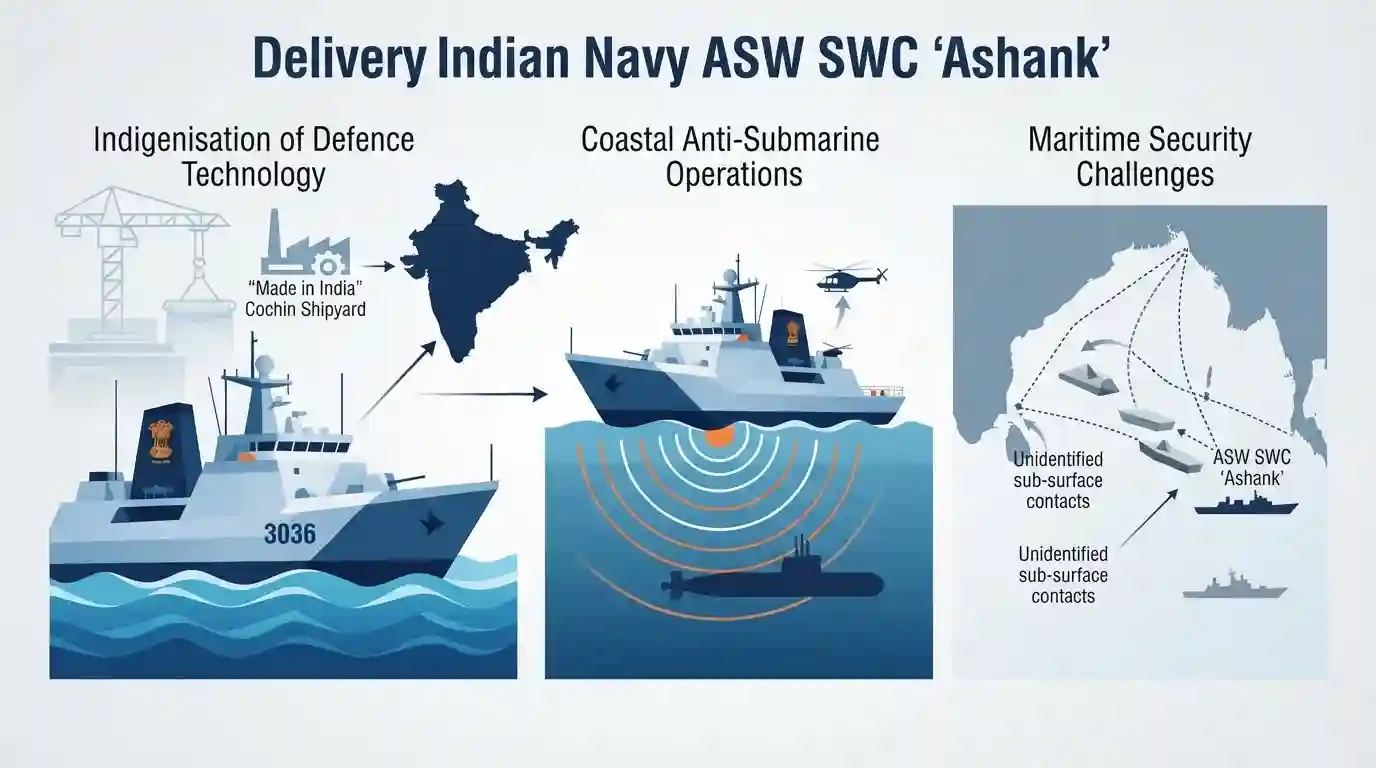
The Indian Navy has taken delivery of 'Ashank' (Yard 3036), an Anti-Submarine Warfare Shallow Water Craft (ASW SWC) built by Cochin Shipyard Limited. Designed for coastal anti-submarine operations and subsurface surveillance, the vessel underscores India's strategic push towards indigenous defence production and maritime self-reliance.
Key Points
- Delivery of 'Ashank', the Anti-Submarine Warfare Shallow Water Craft (ASW SWC) built by Cochin Shipyard Limited for the Indian Navy.
- Designed for subsurface surveillance in coastal waters, low-intensity maritime operations, and anti-submarine operations in shallow waters.
- Reflects India's push towards indigenous defence manufacturing and self-reliance (Aatmanirbhar Bharat) in naval platforms.
Important Terms
Aatmanirbhar Bharat

India's policy goal of achieving self-reliance and reducing import dependency by fostering domestic design, development, and manufacturing capabilities across strategic sectors like defence.
UPSC context
UPSC Paper III (Security/Economy): Tests knowledge of indigenous defence production, strategic autonomy, and domestic manufacturing initiatives.
Cochin Shipyard Limited
The premier shipbuilding public sector undertaking under the Ministry of Defence, located in Kochi, known for building complex naval warships and commercial vessels.
UPSC context
UPSC Paper III (Security/Internal Security): Evaluates institutional capacity for indigenous naval shipbuilding and public sector manufacturing.
Anti-Submarine Warfare Shallow Water Craft (ASW SWC)
Specialised naval warships designed for anti-submarine operations, subsurface surveillance, and shallow-water coastal defence tasks.
UPSC context
UPSC Paper III (Security): Tests awareness of maritime security capabilities, naval modernization, and coastal defence strategies.
Ministry of Defence
The executive branch of the Union Government responsible for formulating and executing defence policy and administering all matters relating to the Indian Armed Forces.
UPSC context
UPSC Paper II (Polity/Governance) and Paper III (Security): Tests institutional frameworks governing national security and defence policy formulation.
Static Concepts Connected
What are the key classes of Anti-Submarine Warfare vessels and naval projects currently executed for the Indian Navy?
- ASW SWC Project: ASW SWC Project: 16 shallow-water vessels (Mahe and Arnala classes) replacing Abhay-class corvettes with over 80-90% indigenous content.
- Project 28 Corvettes: Project 28 (Kamorta-class): Advanced anti-submarine corvettes featuring high indigenous content and advanced stealth features.
- Destroyers & Frigates: Project 15B / 17A: Guided-missile destroyers (Visakhapatnam-class) and stealth frigates (Nilgiri-class) incorporating comprehensive ASW suites.
Cross-Topic Patterns
Naval Indigenisation & Public Sector Restructuring
The ASW SWC project split between Cochin Shipyard and GRSE mirrors defense public sector restructuring and the corporatization of Ordnance Factories into 7 DPSUs.
Shallow-water ASW and Coastal Security Architecture
Coastal anti-submarine warfare directly interfaces with coastal security architecture revamped post-2008 Mumbai attacks, linking naval platforms to multi-agency coastal grids.

Expect statement-based questions combining ASW SWC vessel specifications (displacement, role, replacement class) with indigenous content thresholds.
Linked PYQs · 2
Linked PYQs · 2
- 2025MainsGS3
Why is maritime security vital to protect India's sea trade? Discuss maritime and coastal security challenges and the way forward.
- 2022MainsGS3
What are the maritime security challenges in India ? Discuss the organisational, technical and procedural initiatives taken to improve the maritime security.
