Mineral Concession Rules Amended to Boost Mining Ease
Source:PIB ↗
Why It Matters
Understanding regulatory amendments in the mining and coal sector is crucial for analyzing India's ease of doing business, mineral exploration, and resource management policies.
Summary
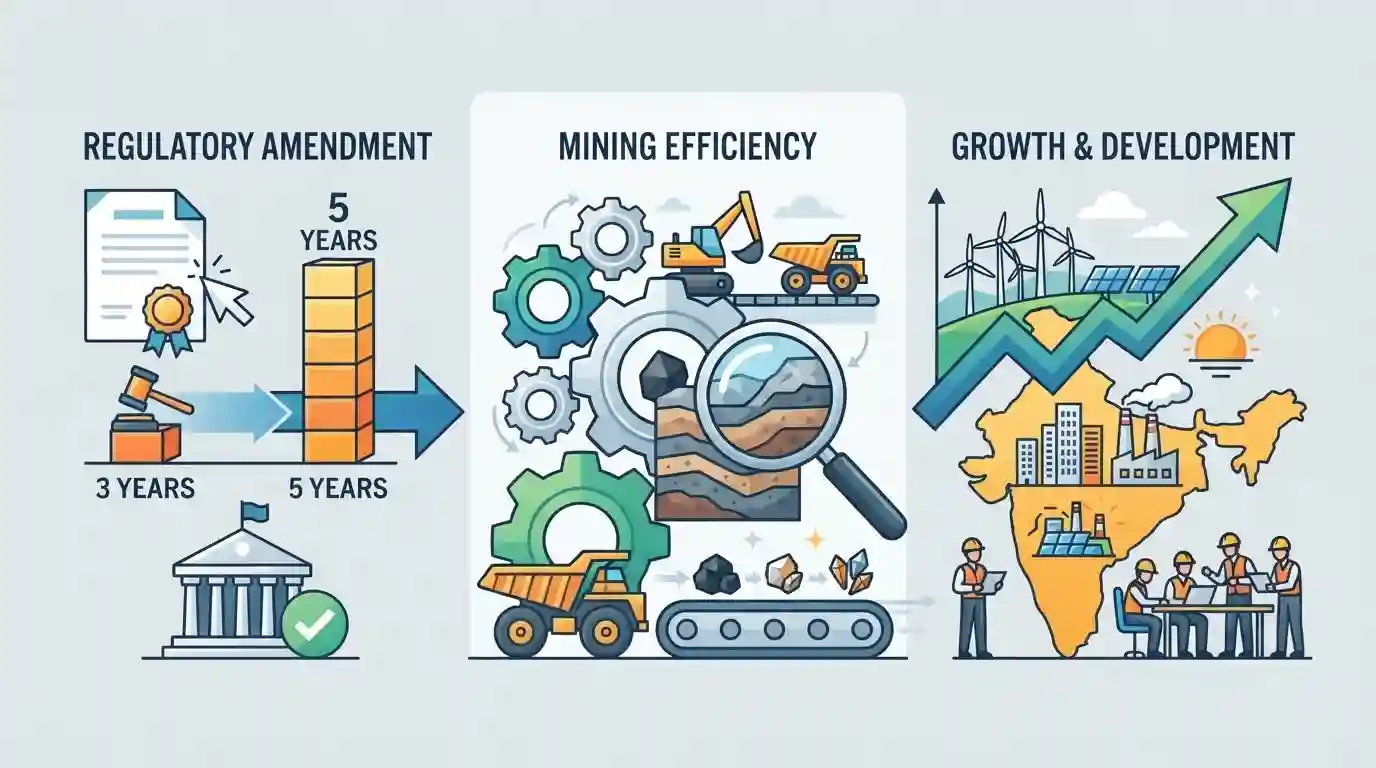
The Ministry of Coal amended the Mineral Concession Rules, 1960, to extend the accreditation validity period for Accredited Prospecting Agencies (APAs) and Mining Plan Preparing Agencies (MPPAs) from three to five years. This policy change is intended to streamline regulatory compliance, reduce administrative burden, and boost exploration and mining efficiency in India.
Key Points
- The Ministry of Coal has amended the Mineral Concession Rules, 1960 to improve ease of doing business in the mining sector.
- The accreditation period for Accredited Prospecting Agencies (APAs) has been extended from three years to five years.
- The accreditation period for Mining Plan Preparing Agencies (MPPAs) has also been extended from three to five years.
- This extension aims to reduce compliance burden, provide stability to agencies, and streamline exploration and mining plan preparation processes.
Important Terms
Mineral Concession Rules 1960

Rules framed under Section 13 of the Mines and Minerals (Development and Regulation) Act, 1957, that govern the application and grant of mineral concessions, prospecting licenses, and mining leases in India.
UPSC context
UPSC GS Paper III (Economy/Mining Sector): Important for questions on mineral resource regulation, ease of doing business, and regulatory compliance.
Ministry of Coal
The apex governmental body in India responsible for formulating policies, planning, and regulating the exploration, development, and production of coal and lignite resources.
UPSC context
UPSC GS Paper II (Governance) and Paper III (Infrastructure, Energy & Economic Development): Tests institutional framework of the energy and mining sector.
Prelims Trap
Mineral Concession Rules, 1960 govern the grant of reconnaissance permits and mining leases for all minerals, including atomic minerals.
The Mineral Concession Rules, 1960 are framed under the MMRD Act, 1957, but many aspirants confuse them with the MMDR Act itself or think they apply to atomic minerals.
Static Concepts Connected
What are the statutory frameworks governing mineral concessions and mining operations in India?
- Parent Legislation:: The Mines and Minerals (Development and Regulation) Act, 1957 (MMRD Act) is the overarching central legislation governing the mining sector and mineral development in India.
- Concession Rules:: Mineral Concession Rules, 1960 regulate the grant of reconnaissance permits, prospecting licences, and mining leases for minerals other than atomic minerals and minor minerals.
- Conservation Rules:: Mineral Conservation and Development Rules, 2017 focus on systematic and scientific mining, environmental protection, and conservation of minerals during operations.
Cross-Topic Patterns
Mining Reforms and Critical Mineral Security
Regulatory streamlining in mineral prospecting directly supports India's clean energy transition by accelerating critical mineral exploration needed for EV batteries and solar manufacturing.
MMRD Act and Federal Mineral Governance
Amendments to the MMRD Act framework highlight the ongoing tension between federal mineral ownership, state-level revenue, and private sector ease of doing business.

MMRD Act amendments + Mineral Concession Rules often appear in matching or statement-based Prelims questions on regulatory frameworks.
Linked PYQs · 2
Linked PYQs · 2
- 2025MainsGS3
Mineral resources are fundamental to the country's economy and these are exploited by mining. Why is mining considered an environmental hazard? Explain the remedial measures required to reduce the environmental hazard due to mining.
- 2013MainsGS3
What are the consequences of Illegal mining ? Discuss the Ministry of Environment and Forests' concept of GO AND NO GO zones for coal mining sector.
