National HPV Vaccine Campaign Crosses One Crore Doses Milestone
Source:PIB ↗
Why It Matters
This milestone highlights India's progress in preventive healthcare, immunization governance, and targeted public health campaigns against non-communicable diseases like cervical cancer, which is highly relevant for GS Paper II governance and health sector questions.
Summary
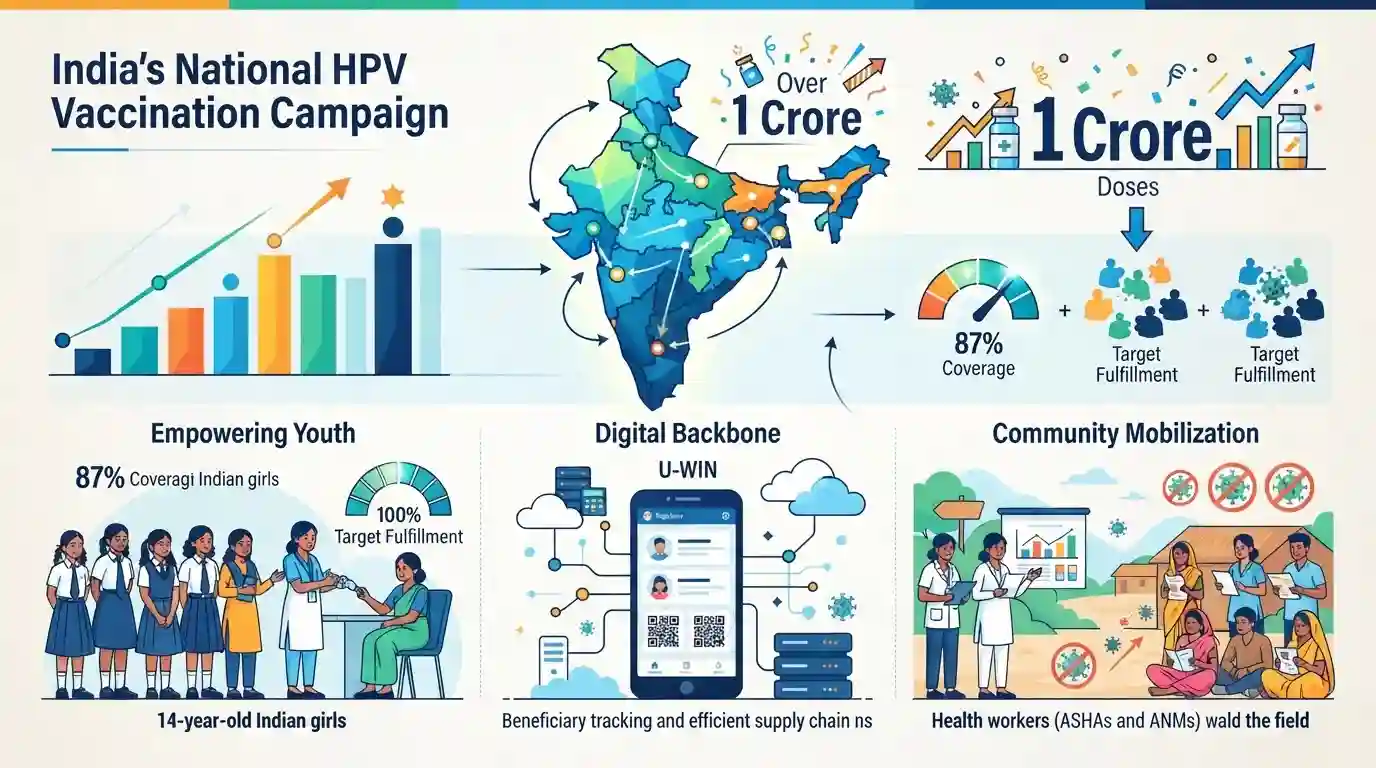
India's National HPV Vaccination Campaign crossed the milestone of administering over 1 crore single-dose HPV vaccine doses to 14-year-old girls in under nine months. Aimed at preventing cervical cancer, the campaign achieved 87% coverage nationally, with several states recording 100% target fulfillment. The rollout leverages the digital U-WIN platform for beneficiary tracking and robust community engagement through frontline health workers.
Key Points
- India administered over 1 crore HPV vaccine doses to 14-year-old girls in less than nine months under the National HPV Vaccination Campaign.
- The campaign achieved nearly 87% coverage of the annual target cohort of approximately 1.2 crore adolescent girls, with six states achieving 100% coverage.
- The initiative utilizes the U-WIN digital platform for real-time monitoring, beneficiary tracking, and digital vaccination certification.
- Human Papillomavirus (HPV) vaccination serves as a critical preventive healthcare intervention against cervical cancer.
Important Terms
National HPV Vaccination Campaign

A national health initiative launched to administer single-dose HPV vaccines to 14-year-old girls to prevent cervical cancer, leveraging digital tracking and community mobilization.
UPSC context
UPSC GS Paper II: Issues related to development and management of social sector/services relating to health. Tests knowledge of public health interventions.
U-WIN platform
A digital platform used in India for real-time beneficiary tracking, registration, and monitoring of vaccination drives, including the nationwide HPV immunization program.
UPSC context
UPSC GS Paper II: Government policies and interventions for development in health sector and e-governance applications.
Ministry of Health and Family Welfare
The central government ministry responsible for formulating health policies, funding national health programs, and overseeing public health initiatives like universal immunization campaigns in India.
UPSC context
UPSC GS Paper II: Structure, organization, and functioning of the Executive and implementation of welfare schemes.
Prelims Trap
The HPV vaccination campaign requires adolescent girls to complete a mandatory three-dose schedule over a six-month period.
Aspirants often confuse multi-dose vaccination schedules with the newly adopted single-dose regimen recommended by WHO and NTAGI for adolescent girls.
Static Concepts Connected
What is the National Technical Advisory Group on Immunization (NTAGI) and the Universal Immunisation Programme?
- NTAGI Role: Apex body providing evidence-based advice on immunization policies, vaccine preventable diseases, and introduction of new vaccines into public health programs.
- UIP Scope: One of the largest public health programs globally, providing free vaccination against 12 vaccine-preventable diseases nationally and sub-nationally.
- Advisory Nature: Statutory or advisory status: It functions as an independent advisory body to the Ministry of Health and Family Welfare.
Cross-Topic Patterns
Digital Public Infrastructure in Public Health
The integration of U-WIN for adolescent immunization tracking links digital public infrastructure (DPI) with health equity goals under the social sector syllabus.
NTAGI and Evidence-Based Health Policy
NTAGI recommendations bridging evidence-based policy with population-level disease burdens connect scientific advisory frameworks directly to governance and policy evaluation questions.

HPV vaccination campaign + U-WIN digital tracking likely to feature as a statement-based question in Prelims 2026.
Linked PYQs · 3
Linked PYQs · 3
- 2023PrelimsGS1
Consider the following statements in relation to Janani Suraksha Yojana: 1. It is a safe motherhood intervention of the State Health Departments. 2. Its objective is to reduce maternal and neonatal mortality among poor pregnant women. 3. It aims to promote institutional delivery among poor pregnant women. 4. Its objective includes providing public health facilities to sick infants up to one year of age. How many of the statements given above are correct?
- 2024PrelimsGS1
With reference to the 'Pradhan Mantri Surakshit Matritva Abhiyan', consider the following statements : 1. This scheme guarantees a minimum package of antenatal care services to women in their second and third trimesters of pregnancy and six months post-delivery health care service in any government health facility. 2. Under this scheme, private sector health care providers of certain specialities can volunteer to provide services at nearby government health facilities. Which of the statements given above is/are correct?
- 2023PrelimsGS1
Consider the following statements: Statement-I: India's public sector health care system largely focuses on curative care with limited preventive, promotive and rehabilitative care. Statement-II: Under India's decentralized approach to health care delivery, the States are primarily responsible for organizing health services. Which one of the following is correct in respect of the above statements?
