Yamuna River Conservation and Public Participation Movement
Source:PIB ↗
Why It Matters
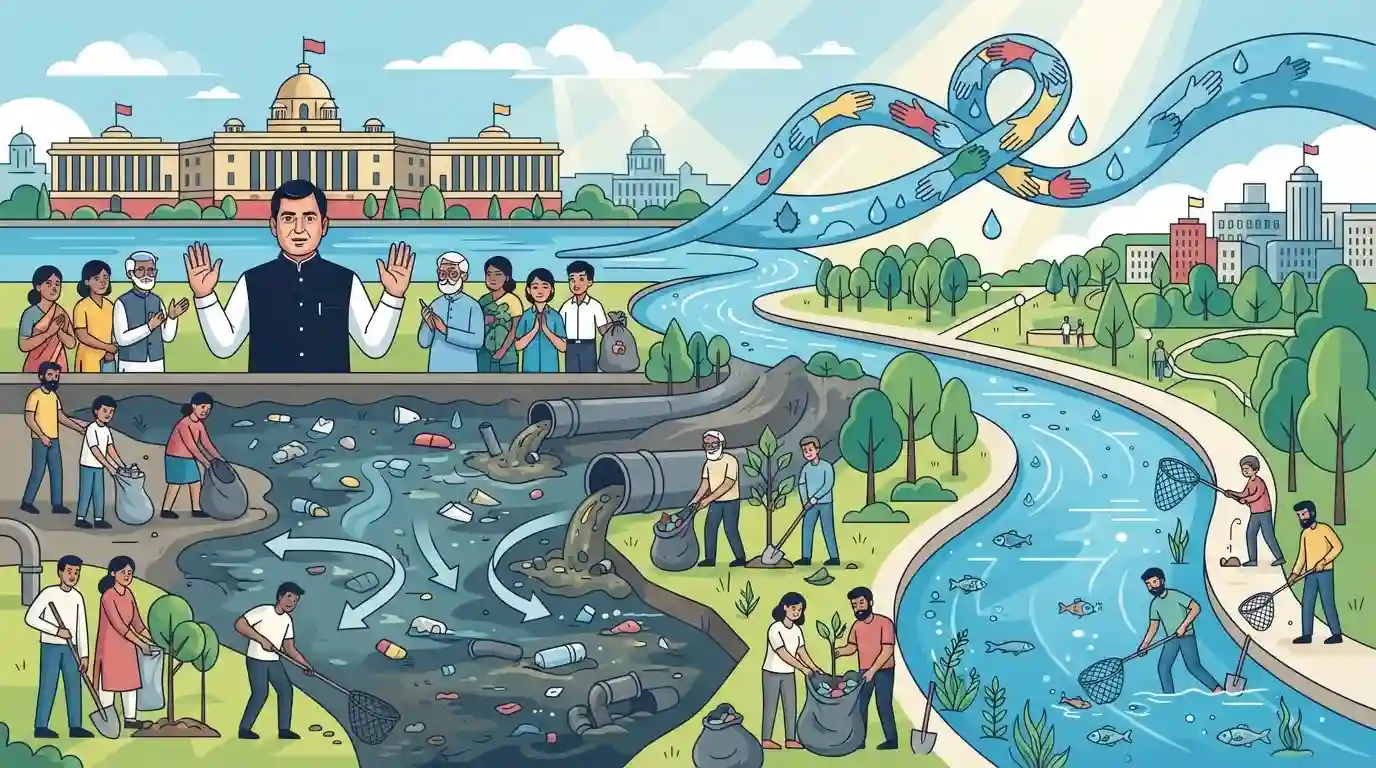
It highlights the policy shift toward community-led environmental governance and public participation (Jan Andolan) in river rejuvenation efforts like cleaning the Yamuna.
Summary
Lok Sabha Speaker Om Birla called for a nationwide public movement (Jan Andolan) to clean the Yamuna River and maintain its uninterrupted flow, emphasizing that community engagement is crucial alongside government initiatives for river conservation.
Key Points
- Lok Sabha Speaker Om Birla emphasized transforming Yamuna's rejuvenation into a Jan Andolan (people's movement) to ensure cleanliness and uninterrupted flow.
- Highlighted the cultural and ecological significance of the Yamuna River and the collective societal responsibility toward water body conservation.
- Stressed that bureaucratic or governmental efforts alone are insufficient without active community participation and behavioral changes regarding waste disposal.
Important Terms
Lok Sabha

The Lok Sabha is the lower house of India's bicameral Parliament, composed of directly elected representatives chosen through universal adult suffrage by the citizens of India.
UPSC context
UPSC Prelims/Mains: Polity & Governance. Tests structural knowledge of the Parliament, constitutional offices, and legislative representation.
Parliament of India
The supreme legislative body of India, comprising the President, the Rajya Sabha (Council of States), and the Lok Sabha (House of the People), responsible for lawmaking and national policymaking.
UPSC context
UPSC GS Paper II: Indian Constitution and Polity. Tests understanding of legislative structures, parliamentary control over the executive, and lawmaking processes.
Prelims Trap
River cleaning and flow restoration are exclusively techno-bureaucratic central government responsibilities requiring no behavioral change or community mobilization.
Aspirants often assume river rejuvenation schemes like Namami Gange or Yamuna action plans are solely Central sector schemes executed without state or local community involvement.
Static Concepts Connected
What are the key ecological and hydrological features of the Yamuna River basin?
- Origin & Route: Originates from Yamunotri glacier in the lower Himalayas, flowing through Uttarakhand, Himachal Pradesh, Haryana, Delhi, and Uttar Pradesh before joining the Ganga at Prayagraj.
- Tributaries: Major tributaries include the Tons, Chambal, Hindon, Betwa, and Ken, serving as a critical water source for the Indo-Gangetic plains.
- Ecological Challenge: Faces severe ecological bottleneck in the Delhi stretch, where untreated domestic and industrial sewage turns a large portion of the river into a biological desert.
Cross-Topic Patterns
Yamuna Conservation & Interstate Water Disputes
River rejuvenation intersects with federal governance when downstream states dispute pollution loads and environmental flows, testing the limits of interstate water tribunals under Article 262.

River conservation + Jan Andolan models will likely be framed as a statement-based question in Prelims or Ethics case study.
Linked PYQs · 2
Linked PYQs · 2
- 2024MainsGS3
Industrial pollution of river water is a significant environmental issue in India. Discuss the various mitigation measures to deal with this problem and also the government's initiatives in this regard.
- 2015MainsGS3
Discuss the Namami Gange and National Mission for Clean Ganga (NMCG) programmes and causes of mixed results from the previous schemes. What quantum leaps can help preserve the river Ganga better than incremental inputs?
