IIT Madras Health Facilities and Medical Tech Innovation
Source:PIB ↗
Why It Matters
This development exemplifies the convergence of premier technical institutions like IITs with the public health sector to foster indigenous medical technology, address neurodevelopmental disorders like autism, and improve emergency healthcare delivery systems.
Summary
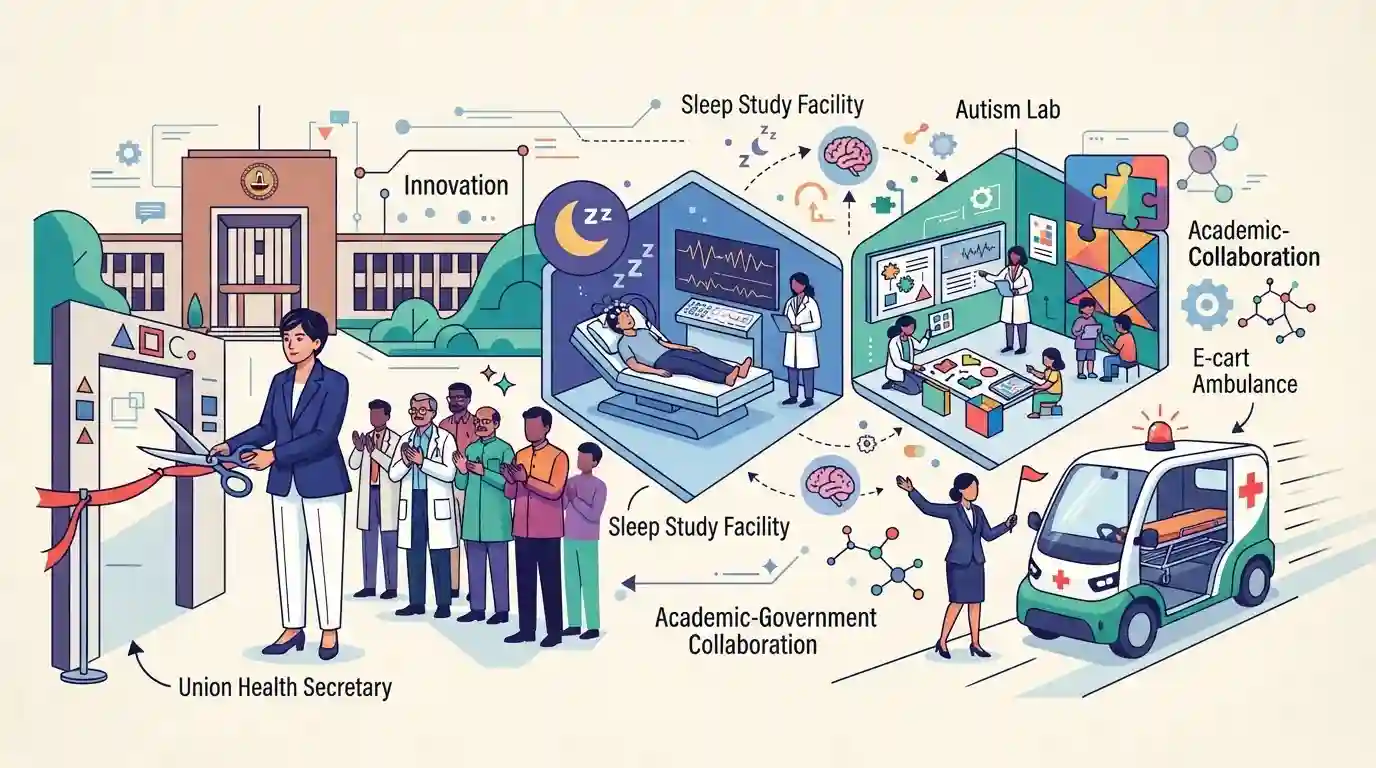
Union Health Secretary Smt. Punya Salila Srivastava inaugurated a Sleep Study Facility and Autism Lab, and flagged off an E-cart Ambulance at IIT Madras. The development marks a strategic push toward merging technical innovation with healthcare delivery, specifically tackling neurodevelopmental conditions like autism and modern lifestyle-related health concerns through academic-government collaboration.
Key Points
- Union Health Secretary inaugurated a Sleep Study Facility and Autism Lab at IIT Madras.
- An E-cart Ambulance was also flagged off to enhance campus mobility and emergency medical response.
- The initiative highlights the integration of engineering, technology, and medical research to address lifestyle and neurodevelopmental disorders.
- Emphasized collaborative efforts between technical institutions and public health machinery for affordable healthcare solutions.
Important Terms
IIT Madras

A premier public technical and research university in India that increasingly integrates engineering, technology, and medical sciences to address critical public health challenges.
UPSC context
UPSC GS Paper III (Science & Technology - Indigenous Tech & Applications). Tests institutional R&D contributions to healthcare delivery and indigenous medical innovations.
Ministry of Health and Family Welfare
The central government ministry responsible for formulating health policies, overseeing public health infrastructure, and implementing national health programs across India.
UPSC context
UPSC GS Paper II (Governance - Social Sector/Health). Tests policy implementation, government initiatives, and administrative framework of public health.
Prelims Trap
Specialized clinical research facilities such as Autism Labs and Sleep Study units can exclusively be established within dedicated medical universities and hospitals.
Aspirants often assume specialized medical labs like Autism Labs can only be established inside traditional medical universities (AIIMS, etc.), missing the growing cross-disciplinary role of IITs in clinical and assistive technology.
Static Concepts Connected
What are the key national initiatives and legislative frameworks addressing Autism Spectrum Disorder (ASD) in India?
- National Trust Act (1999):: National legislation providing legal capacity, guardianship, and welfare provisions for persons with autism, cerebral palsy, mental retardation, and multiple disabilities.
- RPwD Act (2016):: Comprehensive law replacing the PWD Act, increasing reservation in higher education and government jobs, and recognizing autism as a specified disability.
- National Policy for Rare Diseases:: Ministry of Health initiative providing financial assistance up to Rs. 50 lakhs for rare diseases and neurodevelopmental disorders at designated centres of excellence.
Cross-Topic Patterns
IIT R&D + Assistive Tech + Social Justice
Institutions like IIT Madras leverage premier technical engineering expertise to build indigenous assistive devices, directly aiding vulnerable populations under social justice mandates.
Health Infrastructure + Academic R&D Collaboration
Merging public health ministry initiatives with premier technical institutions bridges the historic valley of death between lab-scale engineering and field deployment in India.

Academic R&D + Public Health convergence (e.g. IIT medical labs) will feature as a matching list or multi-statement prelims item.
Linked PYQs · 2
Linked PYQs · 2
- 2023MainsGS3
Introduce the concept of Artificial Intelligence (AI). How does Al help clinical diagnosis? Do you perceive any threat to privacy of the individual in the use of Al in healthcare?
- 2024MainsGS2
In a crucial domain like the public healthcare system the Indian State should play a vital role to contain the adverse impact of marketisation of the system. Suggest some measures through which the State can enhance the reach of public healthcare at the grassroots level.
