Arunachal Pradesh Cooperative Vision 2047 and Development Projects
Source:PIB ↗
Why It Matters
This initiative reflects India's broader policy push toward cooperative federalism, grassroots economic empowerment through cooperatives, and strategic infrastructure development in northeastern border states.
Summary
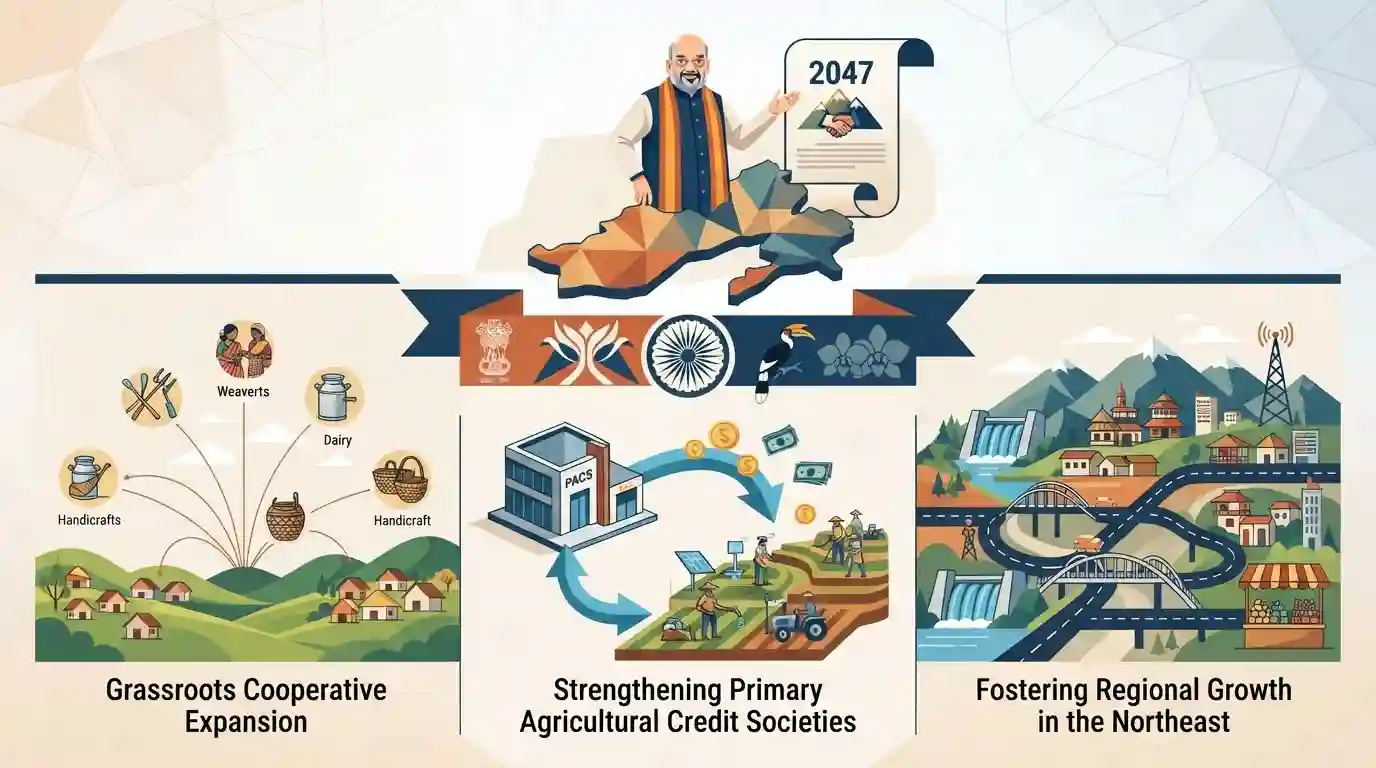
Union Home and Cooperation Minister Amit Shah unveiled the 'Arunachal Pradesh Cooperative Vision 2047' and launched critical infrastructure and development projects in Itanagar, focusing on grassroots cooperative expansion, strengthening primary agricultural credit societies, and fostering regional growth in the northeast.
Key Points
- Union Home and Cooperation Minister unveiled the 'Arunachal Pradesh Cooperative Vision 2047' in Itanagar.
- Various development projects including infrastructure initiatives were launched to boost the northeastern state's growth.
- Emphasized strengthening the cooperative movement down to the grassroots and primary agricultural credit societies (PACS) level.
- Highlighted the strategic importance of developing border regions and integrating northeastern economic infrastructure with national goals.
Important Terms
Arunachal Pradesh Cooperative Vision 2047

A strategic roadmap launched by the Union Ministry of Cooperation to strengthen grassroots cooperative institutions, enhance rural infrastructure, and drive economic growth in Arunachal Pradesh in alignment with 'Sahkar se Samriddhi'.
UPSC context
GS Paper III (Economy / Government Policies). Tests knowledge of regional cooperative reforms, financial inclusion, and developmental planning in the North-East.
Ministry of Cooperation
Created in July 2021 to provide a separate administrative, legal, and policy framework to deepen the cooperative movement in India under the vision of 'Sahkar se Samriddhi'.
UPSC context
GS Paper II / III (Polity / Economy). Tests governance structures, institutional reforms, and administrative interventions for rural and agricultural development.
Arunachal Pradesh State Cooperative Union
The apex or representative cooperative body in Arunachal Pradesh that coordinates, promotes, and guides cooperative societies across sectors like agriculture, dairy, and fisheries in the state.
UPSC context
GS Paper III (Economy - Cooperatives). Tests understanding of decentralized cooperative governance and state-level institutional mechanisms in peripheral states.
Prelims Trap
Cooperatives are exclusively a Union Subject under the Constitution of India.
The Ministry of Cooperation is a relatively new ministry (created in 2021) and cooperative societies fall under the State List of the Seventh Schedule, though multi-state cooperatives fall under the Union List.
Static Concepts Connected
What are the constitutional provisions and institutional frameworks governing cooperatives in India?
- Constitutional Status: 97th Constitutional Amendment Act of 2011 added Part IX-B to the Constitution, giving constitutional status to cooperative societies and making the right to form cooperatives a fundamental right (Article 19(1)(c)).
- Legislative Jurisdiction: Cooperative societies is a subject under Entry 32 of the State List in the Seventh Schedule of the Constitution.
- NCDC Role: National Cooperative Development Corporation (NCDC) operates under the Ministry of Cooperation to plan and promote programmes through cooperative societies.
Cross-Topic Patterns
Border Area Development & Cooperative Federalism
Integrating border areas into national economic planning through cooperatives links interior security with participatory federalism.
Financial Inclusion & Rural Credit Architecture
PACS computerization and multi-purpose cooperative expansion connect financial inclusion directly to rural livelihood schemes.

PACS computerization and Arunachal Vision 2047 likely to appear in a multi-statement question on cooperative sector reforms.
Linked PYQs · 1
Linked PYQs · 1
- 2019MainsGS2
The need for cooperation among various service sectors has been an inherent component of development discourse. Partnership bridges the gap among the sectors. It also sets in motion a culture of 'collaboration' and 'team spirit'. In the light of statements above examine India's development process.
