PC and PNDT Act Implementation Reviewed by Central Board
Source:PIB ↗
Why It Matters
It evaluates the regulatory framework addressing female foeticide and declining child sex ratios in India, crucial for governance and social justice syllabus coverage.
Summary
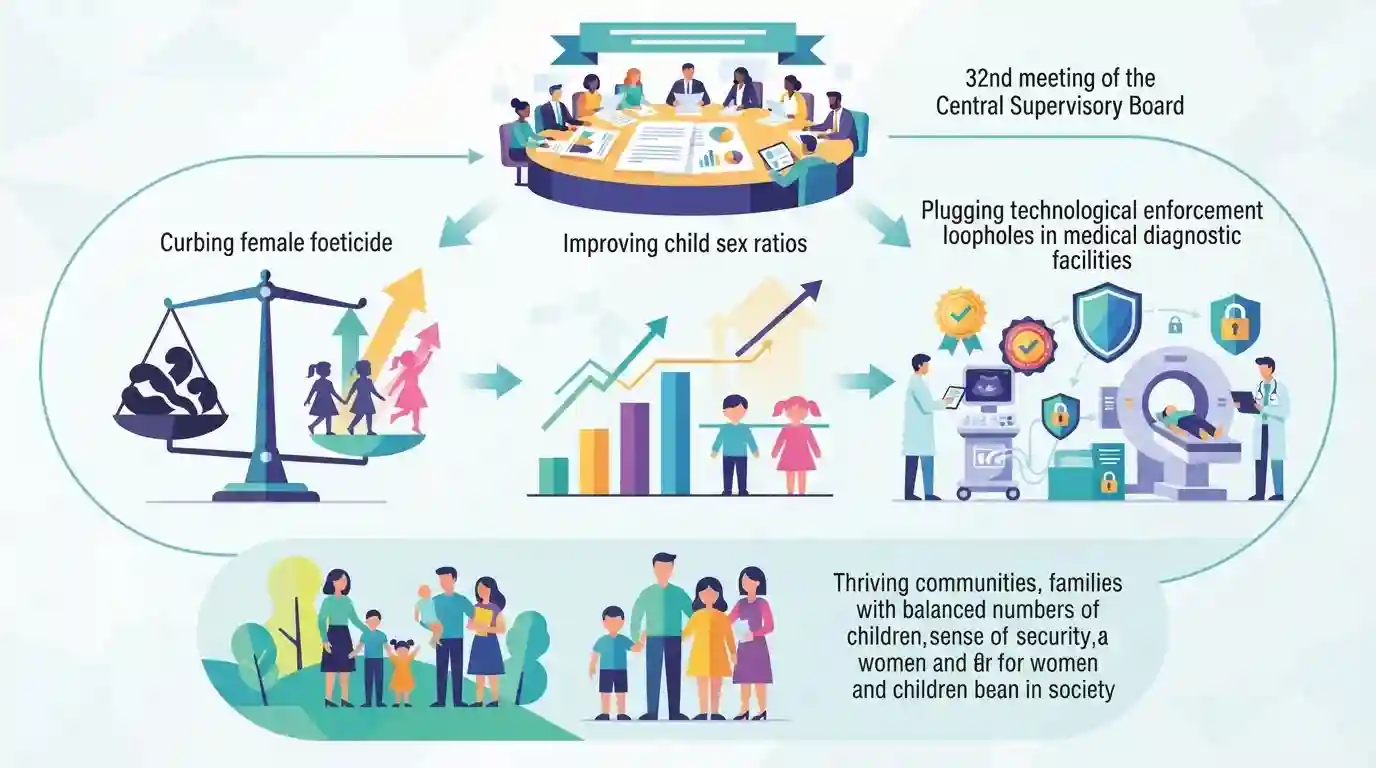
The 32nd meeting of the Central Supervisory Board reviewed the implementation of the PC&PNDT Act, 1994, focusing on curbing female foeticide, improving child sex ratios, and plugging technological enforcement loopholes in medical diagnostic facilities.
Key Points
- The 32nd meeting of the Central Supervisory Board reviewed the implementation of the Pre-Conception and Pre-Natal Diagnostic Techniques (PC&PNDT) Act, 1994.
- Discussions focused on strengthening enforcement, leveraging technology like ultrasound tracking, and addressing skewed child sex ratios.
- Emphasized better coordination between central and state authorities to plug regulatory loopholes in diagnostic clinics.
Important Terms
PC and PNDT Act 1994

An Indian legislation enacted to stop female foeticide and curb declining child sex ratios by prohibiting pre-natal sex determination and regulating diagnostic techniques.
UPSC context
GS Paper II / Government Policies & Interventions. Tests understanding of legal frameworks protecting women and vulnerable sections against social evils.
Central Supervisory Board
A statutory apex body constituted under the PC&PNDT Act to advise the central government on policy matters, review implementation, and monitor anti-sex selection measures.
UPSC context
GS Paper II / Statutory Bodies. Evaluates institutional mechanisms and administrative oversight for health governance and legal enforcement.
Ministry of Health and Family Welfare
The nodal union ministry responsible for implementing public health policies, family welfare schemes, and regulating medical diagnostics and statutory bodies like the CSB.
UPSC context
GS Paper II / Governance & Health. Important for questions on executive ministries, institutional responsibilities, and nationwide health interventions.
Prelims Trap
The PC&PNDT Act exclusively regulates post-conception ultrasound scanning and does not cover pre-conception or assisted reproductive techniques.
The 2003 amendment brought pre-conception sex selection AND assisted reproductive technologies (ART/IVF misuse) under the statute; many mistakenly assume it only covers post-conception ultrasound.
Static Concepts Connected
What are the key statutory bodies, enforcement mechanisms, and scope of the PC&PNDT Act, 1994?
- Central Supervisory Board: Apex statutory policy body chaired by the Union Minister for Health and Family Welfare, responsible for reviewing Act implementation.
- Appropriate Authorities: Multi-member bodies at district and sub-district levels vested with civil court powers to search, seize, and seal defaulting facilities.
- 2003 Amendment Scope: Expanded in 2003 to include pre-conception sex selection and misuse of ART/IVF to prevent female foeticide.
- Statutory Restrictions: Absolute ban on sex disclosure; techniques permitted only for detecting specific genetic, metabolic, or chromosomal abnormalities.
Cross-Topic Patterns
Health Governance meets Federal Administrative Capacity
While the PC&PNDT Act regulates technological misuse in medical science, its enforcement failures highlight broader administrative bottlenecks in federal-state cooperative governance and decentralized district-level magistracy.
PC&PNDT implementation intersecting with gender sociology
Skewed child sex ratios directly distort the Juvenile Justice framework and compound long-term socio-demographic vulnerabilities addressed under GS Paper I (Society).

Expect a statement-based prelims question testing statutory powers of Appropriate Authorities vs. Central Supervisory Board under PC&PNDT.
Linked PYQs · 5
Linked PYQs · 5
- 2023PrelimsGS1
Consider the following statements in the context of interventions being undertaken under Anaemia Mukt Bharat Strategy: 1. It provides prophylactic calcium supplementation for pre-school children, adolescents and pregnant women. 2. It runs a campaign for delayed cord clamping at the time of child-birth. 3. It provides for periodic deworming to children and adolescents. 4. It addresses non-nutritional causes of anaemia in endemic pockets with special focus on malaria, hemoglobinopathies and fluorosis. How many of the statements given above are correct?
- 2024PrelimsGS1
Consider the following countries : 1. Italy 2. Japan 3. Nigeria 4. South Korea 5. South Africa Which of the above countries are frequently mentioned in the media for their low birth rates, or ageing population or declining population?
- 2024PrelimsGS1
With reference to the 'Pradhan Mantri Surakshit Matritva Abhiyan', consider the following statements : 1. This scheme guarantees a minimum package of antenatal care services to women in their second and third trimesters of pregnancy and six months post-delivery health care service in any government health facility. 2. Under this scheme, private sector health care providers of certain specialities can volunteer to provide services at nearby government health facilities. Which of the statements given above is/are correct?
- 2023MainsGS2
Discuss the contribution of civil society groups for women's effective and meaningful participation and representation in state legislatures in India.
- 2021MainsGS2
Can the vicious cycle of gender inequality, poverty and malnutrition be broken through microfinancing of women SHGs? Explain with examples.
