Rehabilitation and Livelihood Support under NAPDDR
Source:PIB ↗
Why It Matters
Substance abuse is a critical socio-economic and public health challenge in India. Understanding the framework of NAPDDR, its rehabilitation mechanisms, and livelihood linkages is vital for questions relating to social justice, governance, and vulnerable sections under GS Paper II.
Summary
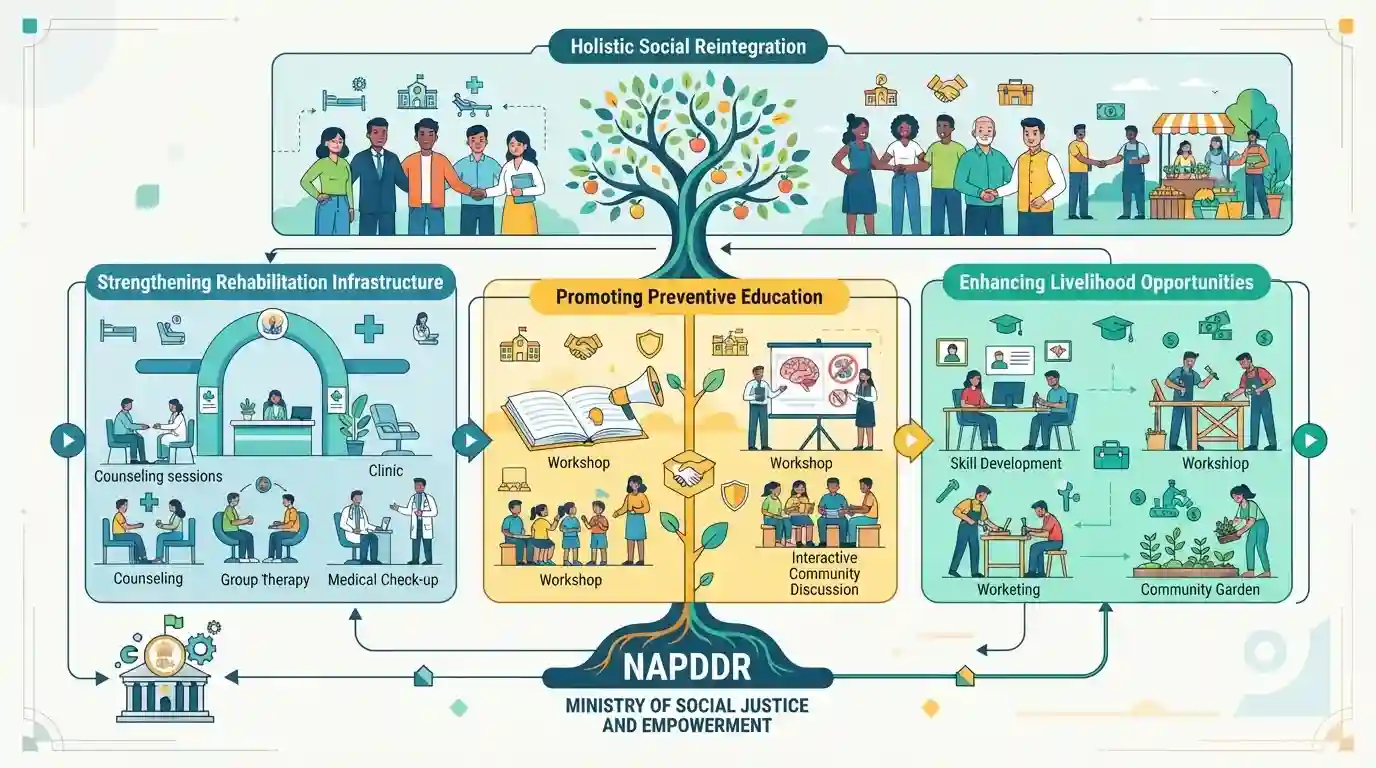
The article highlights the ongoing initiatives under the National Action Plan for Drug Demand Reduction (NAPDDR) implemented by the Ministry of Social Justice and Empowerment. It focuses on strengthening rehabilitation infrastructure, promoting preventive education, and enhancing livelihood opportunities for individuals recovering from substance abuse to ensure holistic social reintegration.
Key Points
- The Ministry of Social Justice and Empowerment implements the National Action Plan for Drug Demand Reduction (NAPDDR) to tackle substance abuse through prevention, treatment, and rehabilitation.
- The initiative emphasizes integrating livelihood opportunities and skill development into rehabilitation frameworks to ensure social re-integration of recovering individuals.
- Comprehensive institutional support includes running Integrated Rehabilitation Centres for Addicts (IRCAs), Outreach and Drop In Centres (ODICs), and Addiction Treatment Facilities (ATFs).
Important Terms
National Action Plan for Drug Demand Reduction (NAPDDR)

An umbrella scheme by the Ministry of Social Justice and Empowerment aimed at drug demand reduction, focusing on preventive education, awareness generation, treatment, and rehabilitation of substance-dependent individuals.
UPSC context
UPSC GS Paper II (Social Justice - Vulnerable Sections & Health): Tests understanding of welfare policies and government initiatives addressing substance abuse.
Ministry of Social Justice and Empowerment
The nodal ministry responsible for formulating and implementing policies, schemes, and programs for the welfare, social defense, and empowerment of marginalized, vulnerable, and disadvantaged sections of society.
UPSC context
UPSC GS Paper II (Governance and Social Justice): Important for questions on institutional frameworks and ministries implementing welfare schemes for vulnerable groups.
Static Concepts Connected
What are the core institutional tiers under India's National Action Plan for Drug Demand Reduction (NAPDDR)?
- Scheme Mandate:: Centrally Sponsored Scheme implemented by the Ministry of Social Justice and Empowerment for drug prevention and rehabilitation.
- IRCAs:: Integrated Rehabilitation Centres for Addicts (IRCAs) provide medical treatment, counseling, and residential rehabilitation support.
- ODICs:: Outreach and Drop In Centres (ODICs) offer early intervention, peer counseling, and safe spaces in community settings.
- ATFs:: Addiction Treatment Facilities (ATFs) established in government hospitals to provide specialized outpatient and inpatient care.
Cross-Topic Patterns
Substance Abuse Rehabilitation + Vocational Skill Ecosystems
NAPDDR intersects with Skill India missions (MSDE) and DAY-NULM to ensure sustainable livelihood pathways for recovering substance users, bridging health governance and economic inclusion.

NAPDDR institutional pillars (IRCAs, ODICs, ATFs) + NMBA convergence frequently appear in matching-type welfare scheme questions.
Linked PYQs · 3
Linked PYQs · 3
- 2019MainsGS2
Performance of welfare schemes that are implemented for vulnerable sections is not so effective due to absence of their awareness and active involvement at all stages of policy process. Discuss.
- 2026PrelimsGS1
Which of the following statements with regard to the persons with disabilities in India is/are correct ? 1. The Rights of Persons with Disabilities Act, an Act passed by the Parliament of India in 2018, mandates reservation in education and employment, places a legal duty on Governments to ensure accessibility and non-discrimination. 2. The Sugamya Bharat Abhiyan focuses on achieving universal accessibility for Persons with Disabilities across three key domains — built infrastructure, transport systems and information and communication technology. 3. The National Divyangjan Finance and Development Corporation (NDFDC) is a public sector organisation set up by the Ministry of Corporate Affairs as a not-for-profit company to promote entrepreneurship among Persons with Disabilities (PwDs). Select the answer using the code given below :
- 2023PrelimsGS1
Consider the following statements in relation to Janani Suraksha Yojana: 1. It is a safe motherhood intervention of the State Health Departments. 2. Its objective is to reduce maternal and neonatal mortality among poor pregnant women. 3. It aims to promote institutional delivery among poor pregnant women. 4. Its objective includes providing public health facilities to sick infants up to one year of age. How many of the statements given above are correct?
