Community Seed Banks Mapping and Capacity Building in India
Source:PIB ↗
Why It Matters
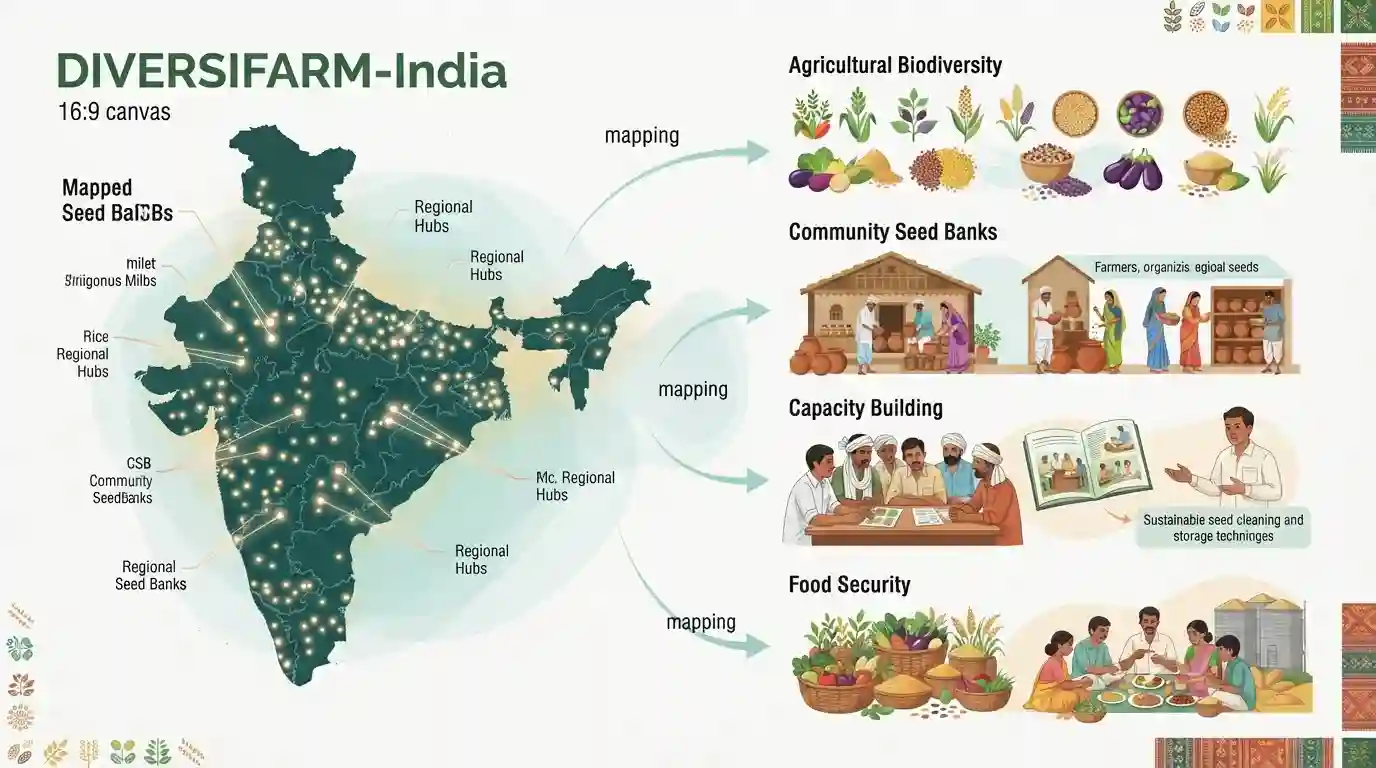
Community Seed Banks are vital instruments for agricultural biodiversity, climate-resilient farming, and the protection of traditional crop landraces. This initiative is highly relevant for GS3 questions focusing on sustainable agriculture, farmers' welfare, and conservation.
Summary
DIVERSIFARM-India has successfully mapped 652 Community Seed Banks (CSBs) across India and introduced a comprehensive capacity-building manual. This initiative aims to bolster agricultural biodiversity, protect indigenous crop varieties, enhance local food security, and empower rural farming communities through sustainable seed management and in-situ conservation practices.
Key Points
- DIVERSIFARM-India mapped 652 Community Seed Banks (CSBs) across the country to strengthen agricultural biodiversity and resilience.
- A new capacity-building manual was released to standardize and improve the management practices of CSBs.
- CSBs play a crucial role in in-situ conservation of traditional crop landraces, climate adaptation, and safeguarding farmers' rights over seed access.
- The initiative supports sustainable agriculture and food security by integrating community-led seed systems with formal agricultural frameworks.
Important Terms
DIVERSIFARM-India

A collaborative project between the M.S. Swaminathan Research Foundation and the Fridtjof Nansen Institute (Norway) aimed at mapping, strengthening, and enhancing the sustainability of Community Seed Banks across India to safeguard farmers' rights and agrobiodiversity.
UPSC context
UPSC Prelims/Mains (GS Paper III - Agriculture & Environment): Tests knowledge of biodiversity conservation initiatives, farmer-managed seed systems, and institutional partnerships.
Community Seed Banks
Local institutions or initiatives—managed by rural farming communities—that collect, conserve, multiply, and distribute indigenous seeds and traditional crop varieties to ensure local food security and agrobiodiversity.
UPSC context
UPSC GS Paper III (Agriculture & Biodiversity): Tests understanding of in-situ conservation, traditional knowledge, genetic resource management, and rural food security measures.
Static Concepts Connected
What is the difference between In-situ and Ex-situ agricultural biodiversity conservation?
- In-situ conservation: On-farm maintenance of crop landraces and traditional varieties by farming communities, preserving evolutionary adaptation in natural environments.
- Ex-situ conservation: Conservation of genetic material outside its natural habitat, such as gene banks, seed vaults, and botanical gardens (e.g., National Bureau of Plant Genetic Resources).
- Key CSB Role: Empowers local communities, maintains dynamic adaptation to climate change, and ensures traditional knowledge is preserved alongside genetic material.
Cross-Topic Patterns
Agri-Biodiversity Conservation meets PPVFRA Frameworks
Community seed banks protect indigenous landraces, directly complementing the legal framework of the Protection of Plant Varieties and Farmers' Rights (PPVFRA) Act, 2001, which recognizes farmers as both cultivators and conserver-breeders.

Expect UPSC to test the distinction between in-situ (on-farm CSBs) and ex-situ (gene banks like NBPGR) agricultural conservation methods.
Linked PYQs · 4
Linked PYQs · 4
- 2026PrelimsGS1
Which one of the following is the first Plan Vivo certified Reducing Emissions from Deforestation and Forest Degradation (REDD+) project in India ?
- 2024PrelimsGS1
Which one of the following is the correct description of “100 Million Farmers”?
- 2023PrelimsGS1
Which one of the following best describes the concept of 'Small Farmer Large Field'?
- 2025MainsGS3
How does nanotechnology offer significant advancements in the field of agriculture? How can this technology help to uplift the socio-economic status of farmers?
