Karmayogi Sankalpa and Civil Services Leadership Reform
Source:PIB ↗
Why It Matters
It highlights ongoing capacity-building initiatives under Mission Karmayogi aimed at transforming the Indian bureaucracy into a dynamic, citizen-centric, and outcome-oriented institution.
Summary
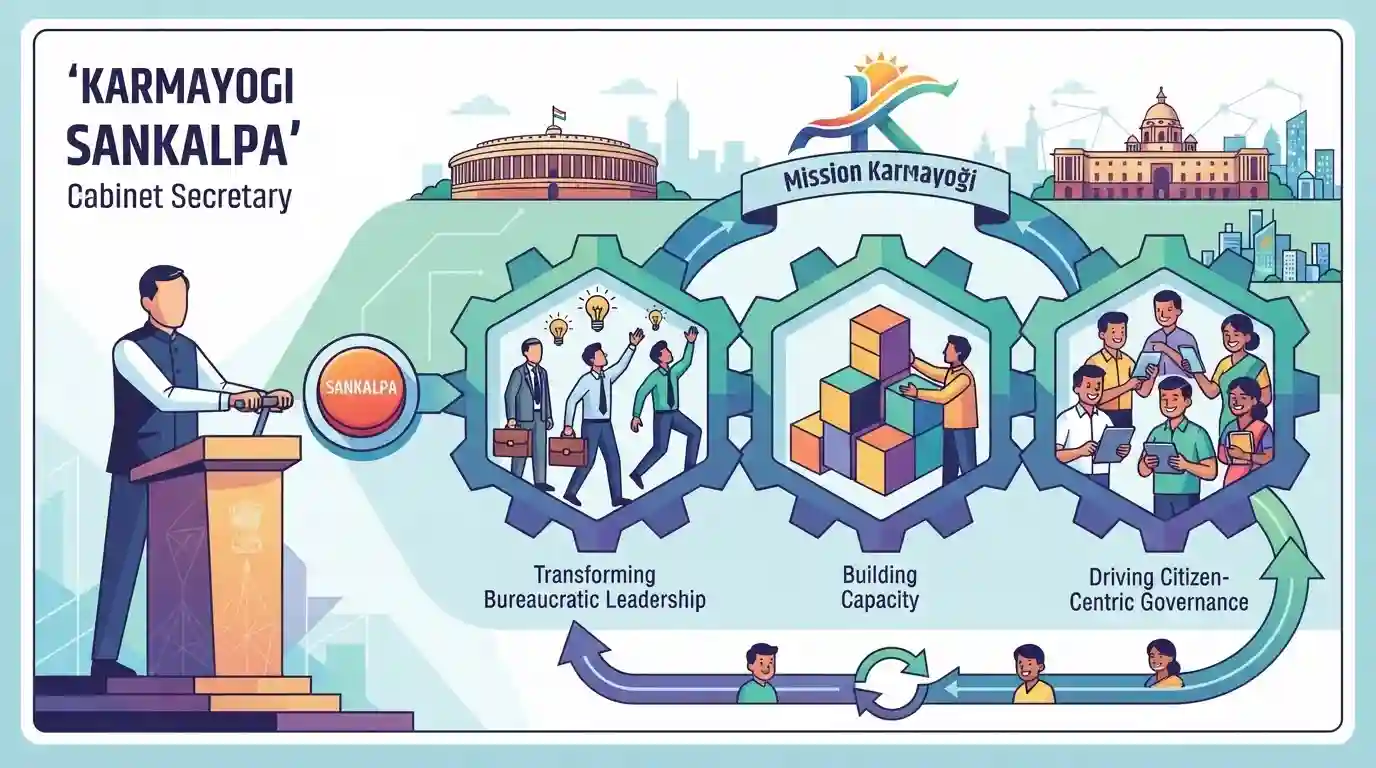
The Cabinet Secretary launched 'Karmayogi Sankalpa' during NITI Aayog's national workshop on 'Leadership as a Mission', aiming to transform bureaucratic leadership, build capacity, and drive citizen-centric governance under Mission Karmayogi.
Key Points
- Cabinet Secretary launched 'Karmayogi Sankalpa' at a national workshop titled “Leadership as a Mission” organized by NITI Aayog.
- Karmayogi Sankalpa is designed to foster a citizen-centric, future-ready, and empathetic bureaucracy through targeted leadership development.
- The workshop focused on shifting civil service orientation from rule-bound administration to outcome-oriented governance under Mission Karmayogi.
- Emphasized leadership as a mission rather than just a position, encouraging collaborative governance and peer learning among senior officials.
Important Terms
Karmayogi Sankalpa

An initiative launched on the iGOT Karmayogi platform where civil servants commit to specific leadership improvements, actions, and citizen impacts, tracked toward Good Governance Day.
UPSC context
UPSC GS Paper II (Civil Services Reforms, Governance). Tests understanding of contemporary capacity-building tools and bureaucratic leadership frameworks.
Mission Karmayogi
National Programme for Civil Services Capacity Building (NPCSCB) shifting civil servants from a rule-based to a role-based, competency-driven approach via digital platforms like iGOT Karmayogi.
UPSC context
UPSC GS Paper II (Government Policies & Interventions, Role of Bureaucracy). Critical for questions on administrative reforms and civil service training.
NITI Aayog
The premier public policy think tank of the Government of India providing cooperative federalism, strategic policy advice, and hosting national capacity workshops.
UPSC context
UPSC GS Paper II (Governance, Statutory and Non-Constitutional Bodies). Important for questions on economic planning, cooperative federalism, and policy design.
Cabinet Secretariat
The supreme executive agency providing secretarial assistance to the Union Cabinet, headed by the Cabinet Secretary to coordinate major governance initiatives and civil service reforms.
UPSC context
UPSC GS Paper II (Structure of Government, Executive). Tests knowledge of top-level administrative machinery and policy execution in India.
Prelims Trap
Mission Karmayogi is merely an online learning management system for government employees without structural leadership transformation goals.
Aspirants often assume Mission Karmayogi is exclusively a digital training portal (iGOT), missing its broader structural mandate of shifting from 'rule-bound' to 'role-based' governance and personal leadership pledges.
Static Concepts Connected
What are the core architectural pillars and institutional bodies under Mission Karmayogi (National Programme for Civil Services Capacity Building)?
- Apex Body: PMHRSC (Prime Minister's Public Human Resources Council) acts as the apex body providing strategic direction under the PM.
- Regulatory Body: Capacity Building Commission (CBC) coordinates shared learning, harmonizes standards, and oversees training institutions.
- Digital Platform: Special Purpose Vehicle (SPV) 'Karmayogi Bharat' owns and operates the iGOT-Karmayogi digital learning platform.
Cross-Topic Patterns
Civil Services Reform + 2nd ARC Recommendations
Mission Karmayogi operationalizes the 2nd ARC's core recommendation on replacing rigid rule-bound civil services with domain-specific, citizen-centric competency frameworks.
NITI Aayog + Bureaucratic Capacity Building
NITI Aayog acts as the premier institutional think tank driving administrative capacity transformation, mirroring cooperative federalism mandates in policy implementation.

Mission Karmayogi's shift from rule-bound to role-based governance will likely be tested via a statement-based Mains/Prelims combo.
Linked PYQs · 2
Linked PYQs · 2
- 2024MainsGS2
The Doctrine of Democratic Governance makes it necessary that the public perception of the integrity and commitment of civil servants becomes absolutely positive. Discuss.
- 2017MainsGS2
Initially Civil Services in India were designed to achieve the goals of neutrality and effectiveness, which seems to be lacking in the present context. Do you agree with the view that drastic reforms are required in Civil Services? Comment.
