Janjatiya Gaurav Diwas and Tribal Heritage in Freedom Struggle
Source:PIB ↗
Why It Matters
Important for understanding the role of tribal leaders and communities in India's independence movement, as well as current government initiatives for tribal welfare and cultural preservation.
Summary
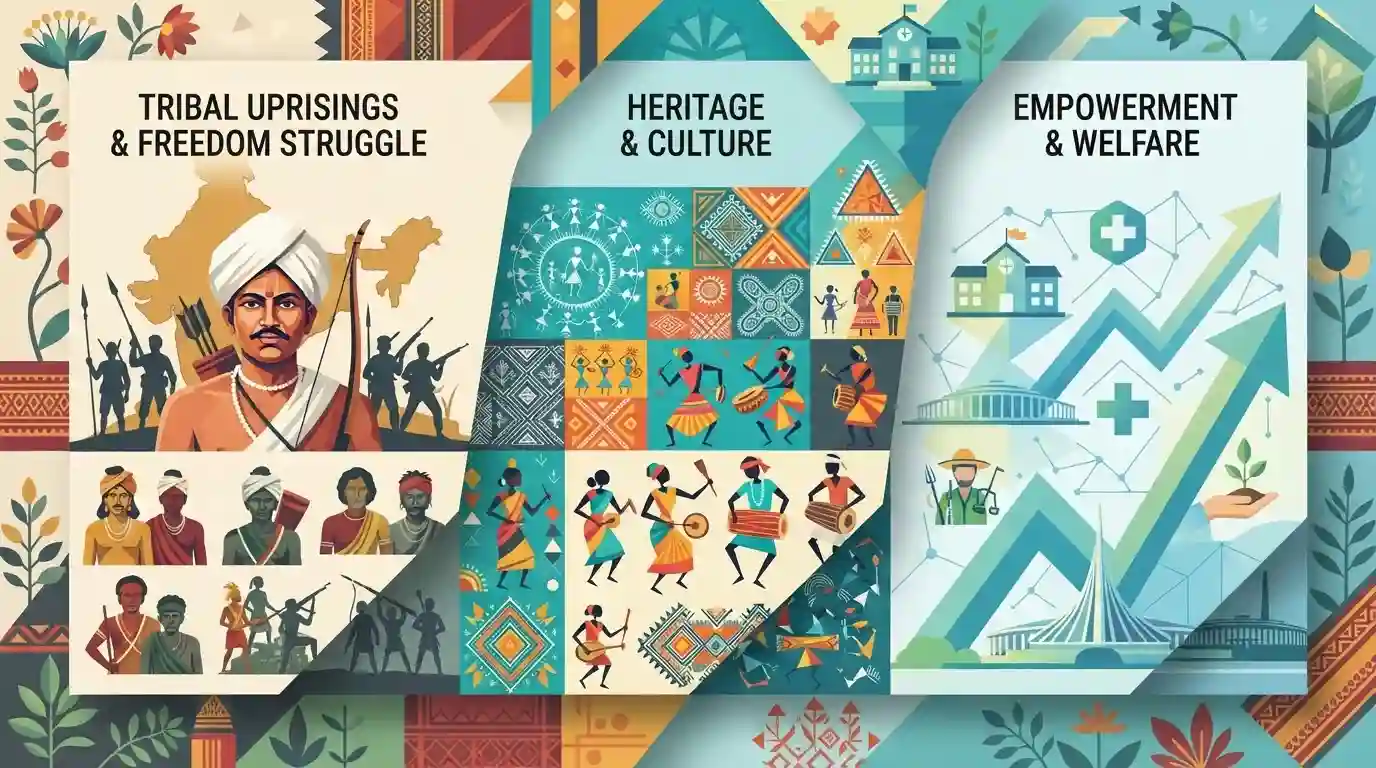
The article highlights the nationwide celebration of Janjatiya Gaurav Diwas, observed on the birth anniversary of tribal icon Bhagwan Birsa Munda. The commemoration honors the sacrifices and historical contributions of tribal freedom fighters to India's national movement, while focusing on tribal heritage, empowerment, and welfare policies.
Key Points
- Janjatiya Gaurav Diwas is observed annually on November 15 to commemorate the birth anniversary of Bhagwan Birsa Munda and honor the contributions of tribal communities to India's freedom struggle.
- The day highlights tribal heritage, cultural identity, and historical resistance against colonial oppression (such as the Ulgulan movement).
- Various welfare initiatives, cultural programs, and developmental milestones for Scheduled Tribes (STs) are highlighted nationally during the celebrations.
Important Terms
Janjatiya Gaurav Diwas

Observed annually on November 15 to commemorate the birth anniversary of tribal icon Bhagwan Birsa Munda, celebrating the rich heritage, history, and sacrifices of tribal freedom fighters in India's national movement.
UPSC context
Important for GS Paper I (Indian Culture, Modern Indian History - Tribal Uprisings) and GS Paper II (Scheduled Tribes Welfare).
Ministry of Tribal Affairs
The nodal ministry of the Government of India responsible for the overall policy, planning, and coordination of development programs and welfare policies for Scheduled Tribes.
UPSC context
Relevant for GS Paper II (Governance, Welfare Schemes for Vulnerable Sections) and institutional frameworks concerning Scheduled Tribes.
Prelims Trap
Ulgulan or the Great Tumult was a 20th-century national freedom movement against British colonial oppression.
Janjatiya Gaurav Diwas commemorates tribal resistance nationally, but aspirants often mistake Ulgulan as a 20th-century freedom struggle movement rather than a late 19th-century Chotanagpur agrarian uprising.
Static Concepts Connected
What are the key historical tribal uprisings in British India and their leaders?
- Santhal Rebellion: Santhal Hul (1855-56) led by Sidhu and Kanhu Murmu against zamindari and British extortion in Damin-i-Koh.
- Munda Ulgulan: Ulgulan (1895-1900) led by Birsa Munda in Chotanagpur against diku landlords and the dismantling of Khuntkatti system.
- Rampa Rebellion: Rampa Rebellion (1922-24) led by Alluri Sitarama Raju in the Godavari agency against forest exploitation and forced labor.
- Naga Uprising: Rani Gaidinliu (Naga movement) led spiritual and political resistance against British rule in the Northeast.
Cross-Topic Patterns
Tribal Uprisings + Scheduled Areas Governance
Tribal freedom fighters and localized anti-colonial movements frequently intersect with questions on Art 342, Fifth/Sixth Schedules, and forest rights governance.
PVTG Schemes + Inclusive Growth Paradigms
Special welfare schemes for Particularly Vulnerable Tribal Groups link historical marginalization directly to modern developmental federalism.

Janjatiya Gaurav Diwas, Birsa Munda's Ulgulan, and PM-JANMAN features will anchor a multi-statement match-the-column prelims question.
Linked PYQs · 3
Linked PYQs · 3
- 2020PrelimsGS1
With reference to the history of India, "Ulgulan" or the Great Tumult is the description of which of the following events?
- 2021PrelimsGS1
At the national level, which ministry is the nodal agency to ensure effective implementation of the Scheduled Tribes and Other Traditional Forest Dwellers (Recognition of Forest Rights) Act, 2006?
- 2023MainsGS1
How did the colonial rule affect the tribals in India and what was the tribal response to the colonial oppression?
