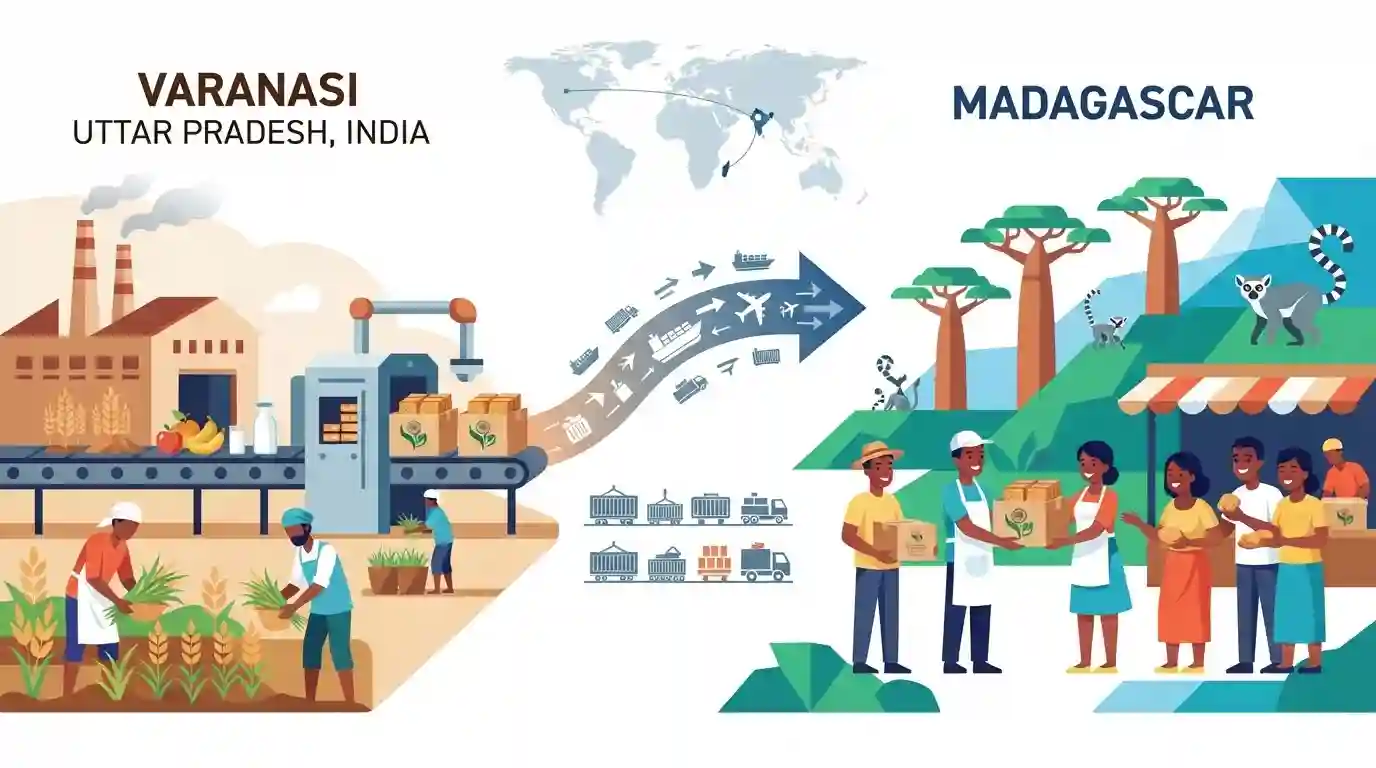
APEDA facilitates biscuit exports from Varanasi to Madagascar
Source:PIB ↗
Why It Matters
Illustrates India's strategic push to diversify agricultural and processed food exports to non-traditional markets like Africa, highlighting the role of institutional bodies like APEDA in promoting local export clusters.
Summary
APEDA facilitated the maiden export of processed biscuits from Varanasi, Uttar Pradesh, to Madagascar. This initiative underscores India's push towards diversifying agricultural and processed food exports, boosting value-added manufacturing, and tapping into emerging markets in Africa.
Key Points
- APEDA facilitated the first-ever export of processed biscuits from Varanasi to Madagascar.
- This highlights India's focus on promoting value-added processed food exports and expanding market access to non-traditional destinations like Africa.
- Varanasi region's agricultural and processed food exports are gaining global footprints through institutional support.
- APEDA plays a crucial role in promoting export of scheduled products, encouraging value addition, and connecting local clusters to global markets.
Important Terms
APEDA

A statutory body under the Ministry of Commerce and Industry established in 1985 to promote the export of scheduled agricultural and processed food products from India.
UPSC context
UPSC GS Paper III (Agriculture/Economy): Tests institutional frameworks for export promotion, food processing, and agricultural marketing.
Ministry of Commerce and Industry
The central government ministry responsible for formulating and implementing foreign trade policy, export promotion, and commercial regulation in India.
UPSC context
UPSC GS Paper II & III: Tests governance, foreign trade policy, and administrative structures handling India's international commerce.
Prelims Trap
APEDA's mandate is strictly confined to raw agricultural commodities and it has no jurisdiction over processed food items like biscuits.
Aspirants often assume APEDA deals exclusively with raw agricultural produce, missing that its mandate explicitly covers processed foods like biscuits and confectionery.
Static Concepts Connected
What are the key statutory functions and scheduled products under the APEDA Act, 1986?
- Establishment: Statutory Body: Established in 1985 (enacted 1986) under the Ministry of Commerce and Industry.
- Mandate: Scheduled Products: Covers fruits, vegetables, meat, poultry, dairy products, confectionery, biscuits, and honey, among others.
- Functions: Key Role: Promotion of export of scheduled products, registration of exporters via RCMC, and setting standards.
Cross-Topic Patterns
Agriculture Exports & Food Processing Linkages
APEDA's mandate under the 1986 Act extends beyond raw agriculture to value-added processed items, directly linking food processing policies with export promotion schemes.
India-Africa Trade & South-South Cooperation
Expanding trade to Madagascar reflects India's broader diplomatic strategy of deepening economic engagement with the Global South alongside traditional partners.

APEDA statutory powers, scheduled products list, and RCMC requirements are evergreen Prelims targets for export-related governance.
Linked PYQs · 5
Linked PYQs · 5
- 2024PrelimsGS1
Consider the following statements : Statement-I : India does not import apples from the United States of America. Statement-II : In India, the law prohibits the import of Genetically Modified food without the approval of the competent authority. Which one of the following is correct in respect of the above statements ?
- 2024PrelimsGS1
Consider the following statements : 1. India is a member of the International Grains Council. 2. A country needs to be a member of the International Grains Council for exporting or importing rice and wheat. Which of the statements given above is/are correct?
- 2025PrelimsGS1
Consider the following statements about turmeric during the year 2022-23: I. India is the largest producer and exporter of turmeric in the world. II. More than 30 varieties of turmeric are grown in India. III. Maharashtra, Telangana, Karnataka and Tamil Nadu are major turmeric producing States in India. Which of the statements given above are correct?
- 2025MainsGS3
Explain the factors influencing the decision of the farmers on the selection of high value crops in India.
- 2021MainsGS3
What are the present challenges before crop diversification? How do emerging technologies provide an opportunity for crop diversification?
