CAQM Downgrades Delhi NCR Air Pollution Restrictions to GRAP II
Source:PIB ↗
Why It Matters
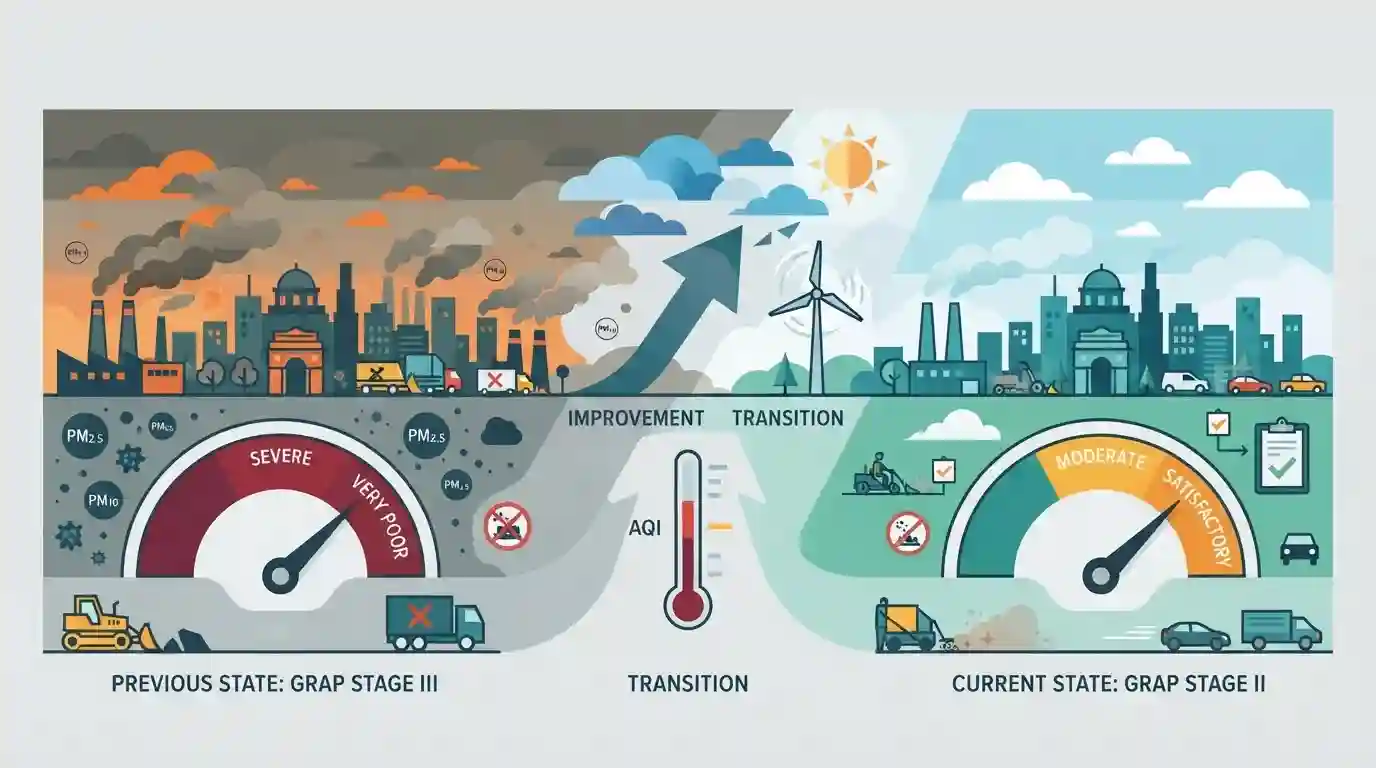
It illustrates the dynamic implementation of emergency pollution response mechanisms like the Graded Response Action Plan (GRAP) by environmental governance bodies in urban-industrial clusters like Delhi-NCR.
Summary
The Commission for Air Quality Management (CAQM) revoked GRAP Stage III measures in the Delhi-NCR region, transitioning to GRAP Stage II following an observed improvement in the Air Quality Index (AQI).
Key Points
- The Commission for Air Quality Management (CAQM) revoked GRAP Stage III in Delhi-NCR and downgraded restrictions to GRAP Stage II.
- The decision followed an improvement in the overall Air Quality Index (AQI) of the region.
- GRAP Stage II entails restrictions targeted at specific sources of air pollution, moving away from the more severe emergency measures of Stage III.
Important Terms
Graded Response Action Plan (GRAP)

A set of emergency-response measures implemented incrementally in the Delhi-NCR region based on varying levels of the Air Quality Index (AQI) to combat severe air pollution episodes.
UPSC context
UPSC Paper III (Environment and Pollution): Tests knowledge of statutory response mechanisms, air pollution management, and institutional strategies for urban air quality.
Commission for Air Quality Management (CAQM)
A statutory body established under the CAQM Act 2021 responsible for planning, coordinating, and monitoring air quality management policies in the National Capital Region and adjoining areas.
UPSC context
UPSC Paper II/III (Governance and Environment): Tests understanding of environmental statutory bodies, federal coordination, and institutional frameworks for pollution control.
Prelims Trap
CAQM is an executive body established by the Ministry of Environment through an executive resolution.
Aspirants often confuse CAQM as an executive body under the MoEFCC or an ad-hoc Supreme Court committee. It is a statutory body created by an Act of Parliament (2021).
Static Concepts Connected
What are the key statutory powers and composition of the Commission for Air Quality Management (CAQM)?
- Statutory Basis: Statutory Status: Established under the CAQM Act, 2021, superseding the Environment Pollution (Prevention and Control) Authority (EPCA).
- Territorial Scope: Jurisdiction: Covers Delhi-NCR and adjoining areas in Haryana, Punjab, Rajasthan, and Uttar Pradesh.
- Regulatory Powers: Powers: Has the power to issue directions, entertain complaints, penalize violators with environmental compensation, and supersede state pollution control boards on air quality matters.
Cross-Topic Patterns
CAQM Statutory Authority vs. Federal Governance
CAQM statutory powers under the 2021 Act override state-level pollution boards in Delhi, Haryana, UP, and Rajasthan, raising questions on federalism versus environmental emergency management.
GRAP Stages and BS Emission Norms
Air pollution management directly intersects with urban transport policy, phasing out older diesel/petrol vehicles under BS norms to curb particulate emissions.

CAQM statutory backing + GRAP stages (AQI thresholds) are high-yield for Prelims matching or statement-based questions.
Linked PYQs · 3
Linked PYQs · 3
- 2022PrelimsGS1
In the context of WHO Air Quality Guidelines, consider the following statements: 1. The 24-hour mean of PM2.5 should not exceed 15 µg/m³ and annual mean of PM2.5 should not exceed 5 µg/m³. 2. In a year, the highest levels of ozone pollution occur during the periods of inclement weather. 3. PM10 can penetrate the lung barrier and enter the bloodstream. 4. Excessive ozone in the air can trigger asthma. Which of the statements given above are correct?
- 2020MainsGS3
What are the key features of the National Clean Air Programme (NCAP) initiated by the Government of India?
- 2021MainsGS3
Describe the key points of the revised Global Air Quality Guidelines (AQGs) recently released by the World Health Organisation (WHO). How are these different from its last update in 2005? What changes in India's National Clean Air Programme are required to achieve these revised standards?
