India Japan Joint Crediting Mechanism for Low Carbon Transition
Source:PIB ↗
Why It Matters
The adoption of bilateral carbon market mechanisms like the Joint Crediting Mechanism (JCM) with Japan is critical for India's green growth strategy, fulfilling its Paris Agreement commitments, and securing foreign investments and clean technology transfer.
Summary
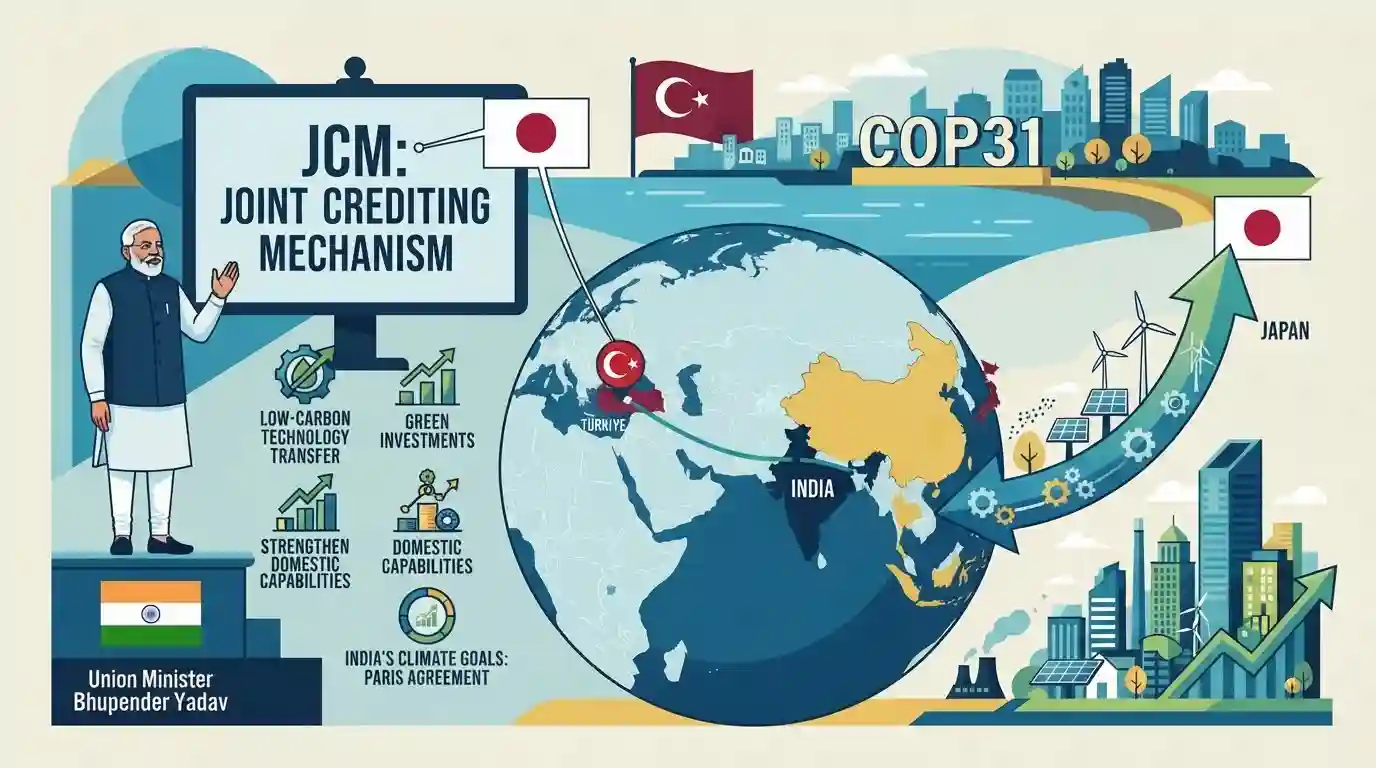
At COP31 in Antalya, Türkiye, Union Minister Bhupender Yadav announced India's strategic push to leverage the Joint Crediting Mechanism (JCM) with Japan. This bilateral framework will facilitate low-carbon technology transfer, attract green investments, and strengthen domestic capabilities while contributing to India's climate goals under the Paris Agreement.
Key Points
- India highlighted its commitment to leverage the Joint Crediting Mechanism (JCM) with Japan during COP31 in Antalya, Türkiye.
- The mechanism aims to accelerate India's low-carbon transition, attract green investments, and strengthen domestic manufacturing and technological capabilities.
- Aligns with global carbon market mechanisms under Article 6 of the Paris Agreement for cooperative approaches and sustainable development.
- Emphasizes bilateral technology transfer, capacity building, and meeting Nationally Determined Contributions (NDCs).
Important Terms
Joint Crediting Mechanism (JCM)

A bilateral framework established between Japan and partner countries (such as India) to facilitate low-carbon technology transfer, green investments, and emission reductions, aligning with Article 6.2 of the Paris Agreement.
UPSC context
Important for UPSC GS Paper III (Environment & Climate Change) and international bilateral relations involving green energy transitions and carbon markets.
Paris Agreement
A landmark legally binding international treaty on climate change adopted at COP21 in Paris, aiming to limit global warming to well below 2°C and pursue efforts to 1.5°C.
UPSC context
Core foundational concept for UPSC GS Paper III (Environment, International Climate Conventions, and India's NDCs).
Article 6 of Paris Agreement
The section of the Paris Agreement that sets up rules for international carbon markets and cooperative approaches, allowing countries to trade mitigation outcomes (ITMOs) to meet their climate targets.
UPSC context
Crucial for UPSC GS Paper III (Carbon Markets, Climate Finance, and Global Negotiations).
COP31
The 31st Conference of the Parties to the UNFCCC, held in Antalya, Türkiye, focusing on bridging climate commitments to verified, measurable, and sustainable implementation.
UPSC context
Important for UPSC GS Paper III (Current environmental summits, global climate governance, and COP outcomes).
Static Concepts Connected
What are the key operational differences between Article 6.2 and Article 6.4 of the Paris Agreement?
- Article 6.2 (Cooperative Approaches): Governed by bilateral or plurilateral agreements between participating countries with decentralized oversight.
- Article 6.4 (Mechanism): Established under UNFCCC supervision via a centralized international carbon market mechanism and Supervisory Body.
- Double Counting Prevention: Requires corresponding adjustments to national inventories to prevent double counting of emission reductions.
Cross-Topic Patterns
Article 6 Carbon Markets + EU CBAM
Bilateral carbon crediting under Article 6 directly intersects with WTO non-discrimination norms and EU CBAM trade defenses against carbon leakage.
Japan Bilateral Frameworks + Quad Critical Minerals
Japan's bilateral JCM operates alongside Quad critical mineral supply chain initiatives to secure clean energy hardware.

Article 6.2 bilateral mechanisms (like JCM) vs Article 6.4 centralized markets will likely feature in a statement-based prelims Q.
Linked PYQs · 4
Linked PYQs · 4
- 2025MainsGS3
Write a review on India's climate commitments under the Paris Agreement (2015) and mention how these have been further strengthened in COP26 (2021). In this direction, how has the first Nationally Determined Contribution intended by India been updated in 2022?
- 2021MainsGS3
Describe the major outcomes of the 26th session of the Conference of the Parties (COP) to the United Nations Framework Convention on Climate Change (UNFCCC). What are the commitments made by India in this conference?
- 2014MainsGS3
Should the pursuit of carbon credits and clean development mechanisms set up under UNFCCC be maintained even though there has been a massive slide in the value of a carbon credit? Discuss with respect to India's energy needs for economic growth.
- 2019MainsGS2
‘The time has come for India and Japan to build a strong contemporary relationship, one involving global and strategic partnership that will have a great significance for Asia and the world as a whole.’ Comment.
