India Philippines Bilateral Relations and Indo Pacific Strategy
Source:PIB ↗
Why It Matters
This visit is crucial for UPSC GS2 (International Relations) as it highlights India's strategic outreach to Southeast Asia, maritime security cooperation in the Indo-Pacific, and strengthening of ASEAN-led multilateral frameworks.
Summary
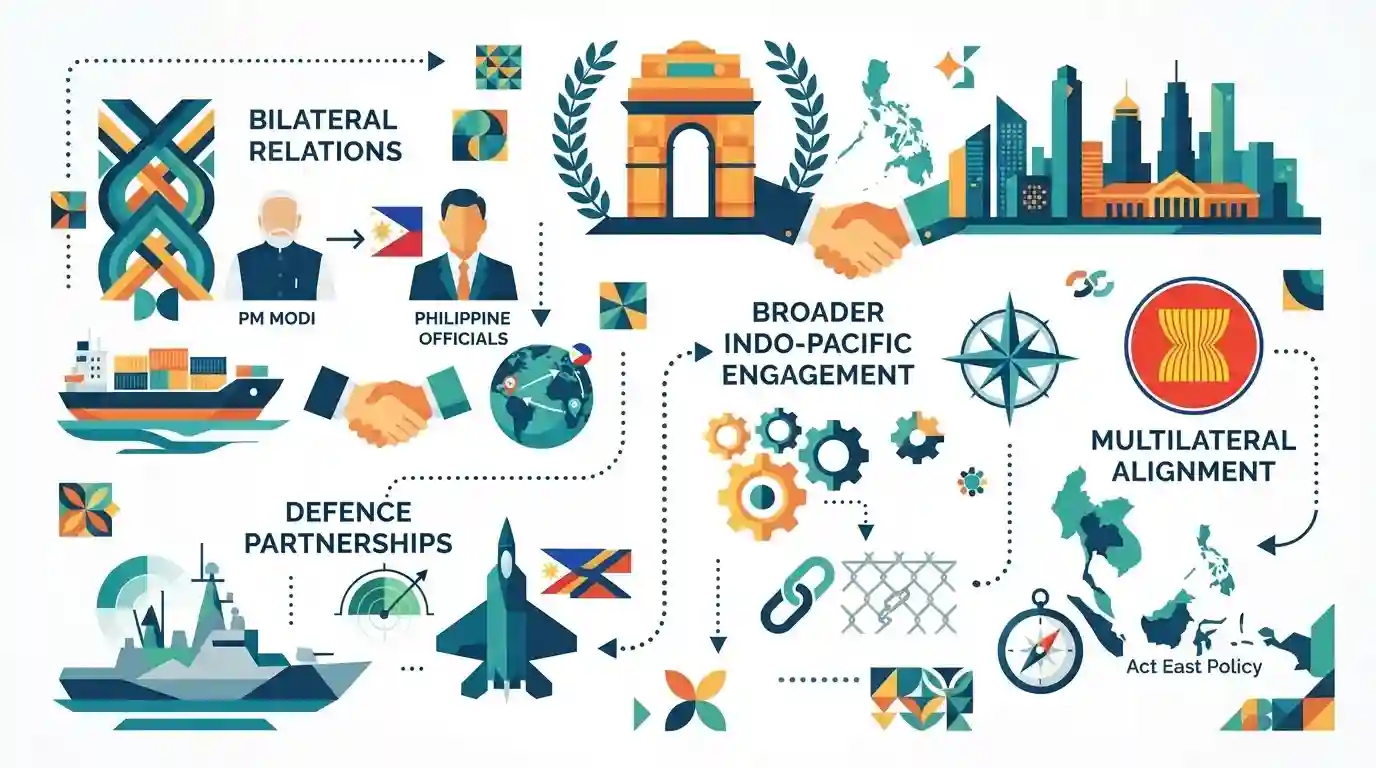
Prime Minister Narendra Modi's visit to Manila, Philippines marked a significant consolidation of India-Philippines bilateral relations and broader Indo-Pacific engagement. The outcomes of the visit encompass enhanced maritime security cooperation, trade, defence partnerships, and multilateral alignment within ASEAN-centred frameworks, reinforcing India's Act East Policy.
Key Points
- Prime Minister Narendra Modi visited Manila, Philippines, strengthening bilateral ties, defense cooperation, and maritime security in the Indo-Pacific region.
- Outcomes included enhanced collaboration in critical technologies, trade, capacity building, and regional architecture under India's Act East Policy.
- The visit underscored shared commitments to a free, open, and inclusive Indo-Pacific and ASEAN-led regional mechanisms.
Important Terms
ASEAN

An intergovernmental organization comprising ten Southeast Asian nations, promoting regional economic integration, security, and cooperation. It forms the anchor of India's Act East Policy and Indo-Pacific strategy.
UPSC context
GS Paper II (International Relations) — Tests understanding of India's bilateral/multilateral groupings, Act East Policy, and strategic partnerships in Southeast Asia.
Static Concepts Connected
What is the institutional structure and core principles of the Association of Southeast Asian Nations (ASEAN)?
- Founding Members: Established in 1967 via the Bangkok Declaration by Indonesia, Malaysia, Philippines, Singapore, and Thailand.
- Core Principle: Operates strictly on consensus and non-interference, ensuring ASEAN centrality in regional security architecture.
- India-ASEAN Ties: India became a Sectoral Dialogue Partner in 1992, Summit-level partner in 2002, and Strategic Partner in 2012.
Cross-Topic Patterns
Defence Exports + Indo-Pacific Maritime Security
India's defence exports to ASEAN nations (like BrahMos to the Philippines) bridge bilateral security ties with broader Indo-Pacific maritime security frameworks under the Act East Policy.
ASEAN Centrality vs. Mini-lateral Groupings
Manila outcomes intersect with multilateral groupings where India balances strategic autonomy through ASEAN centrality without formal treaty alliances.

ASEAN centrality, Indo-Pacific maritime security, and India-Philippines defence exports (e.g., BrahMos) will feature in prelims/mains.
Linked PYQs · 3
Linked PYQs · 3
- 2014MainsGS2
With respect to the South China sea, maritime territorial disputes and rising tension affirm the need for safeguarding maritime security to ensure freedom of navigation and over flight throughout the region. In this context, discuss the bilateral issues between India and China.
- 2016MainsGS2
Evaluate the economic and strategic dimensions of India's Look East Policy in the context of the post Cold War international scenario.
- 2012MainsGS2
What are India's stakes in the South China Sea?
