CRCS Regional Office Functioning Reviewed in Pune
Source:PIB ↗
Why It Matters
This article provides key updates on governance reforms in India's cooperative sector, relevant for questions concerning rural credit, institutional streamlining, and economic growth through cooperatives.
Summary
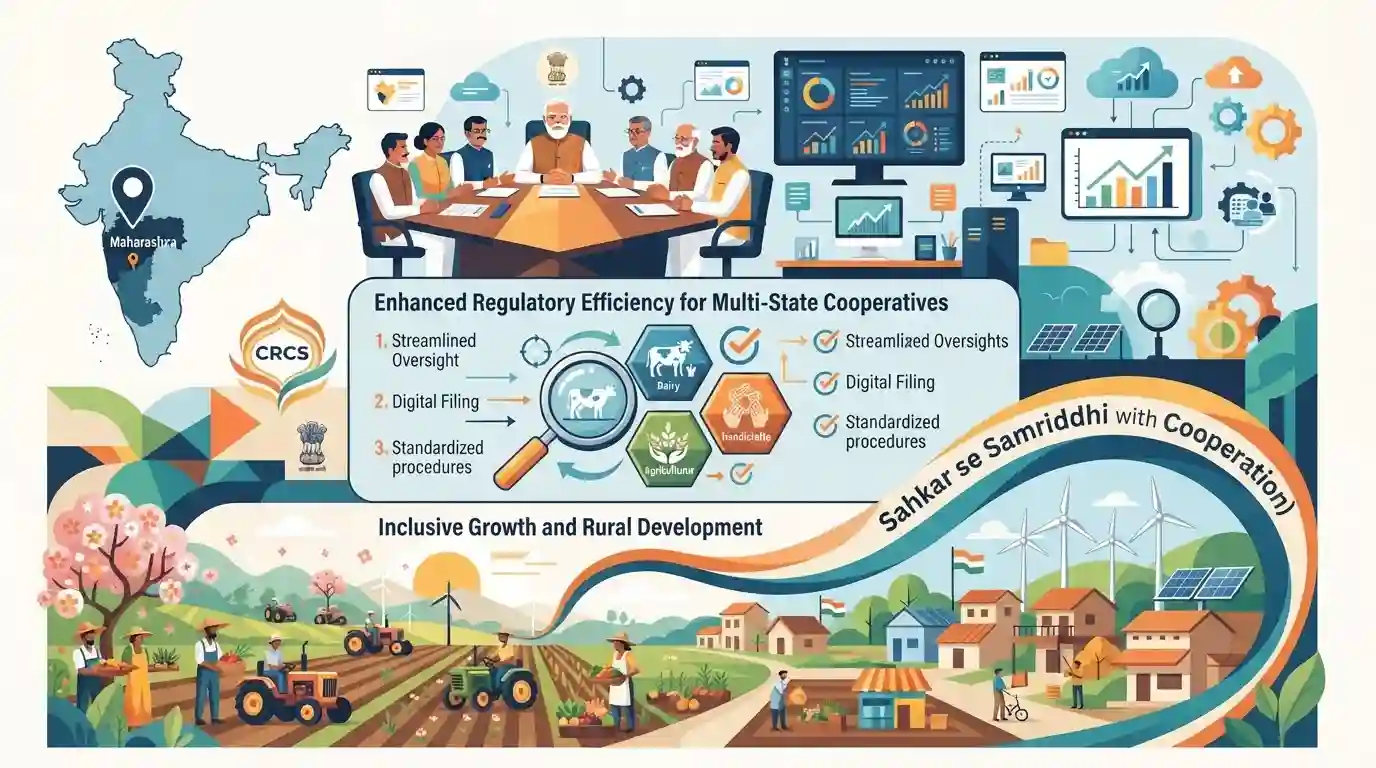
The Union Home Minister and Minister of Cooperation reviewed the operations of the Central Registrar of Cooperative Societies (CRCS) regional office in Pune. The review focused on evaluating digital initiatives, enhancing regulatory efficiency, and promoting transparency for multi-state cooperative societies to advance rural economic development and the 'Sahkar se Samriddhi' framework.
Key Points
- Union Home Minister and Minister of Cooperation reviewed the functioning of the Regional Office of the Central Registrar of Cooperative Societies (CRCS) in Pune.
- Evaluated the progress of various digital initiatives and regulatory reforms undertaken to streamline multi-state cooperative societies.
- Emphasized transparency, modernization, and ease of doing business for cooperative institutions across the country.
- Highlighted the role of structural reforms in strengthening the cooperative movement as part of the 'Sahkar se Samriddhi' vision.
Important Terms
Central Registrar of Cooperative Societies (CRCS)

The apex regulatory authority responsible for administering the Multi-State Co-operative Societies Act, 2002, overseeing registration, regulation, and functioning of multi-state cooperatives in India.
UPSC context
GS Paper II / Polity and Governance. Tests statutory bodies, federal governance, and regulation of multi-state cooperatives.
Ministry of Cooperation
A separate Union ministry created in 2021 to provide a dedicated administrative and legal framework to strengthen the cooperative movement in India under the vision of 'Sahkar se Samriddhi'.
UPSC context
GS Paper II / Government Policies & Interventions. Tests institutional frameworks for rural development, inclusive growth, and cooperative federalism.
Prelims Trap
Multi-State Cooperative Societies are registered and regulated by the respective State Cooperative Ministers where their headquarters are located.
Aspirants often confuse MSCS jurisdiction with state cooperative departments. Multi-state cooperatives are registered and regulated solely by the Central Registrar under the MSCS Act, 2002, not state registrars.
Static Concepts Connected
What is the legal framework governing Multi-State Cooperative Societies (MSCS) in India?
- Legal Basis: Statutory backing under the Multi-State Cooperative Societies Act, 2002, administered centrally by the Central Registrar of Cooperative Societies (CRCS).
- Jurisdiction: Applies to cooperatives whose objects/operations extend beyond a single state, safeguarding member interests and ensuring administrative uniformity.
- Regulatory Powers: Registration, audit, inquiry, and winding up of such societies are handled directly by the central regulatory machinery.
Cross-Topic Patterns
Cooperation vs Federalism: Constitutional Limits
The creation of a dedicated Ministry of Cooperation ties directly into federalism debates, cooperative federalism, and the constitutional mandate under Part IXB (97th Constitutional Amendment).
Administrative Decentralization in Economic Regulators
Decentralization of CRCS offices mirrors administrative reforms in corporate governance (MCA-21) and RBI's regional monitoring framework.

Expect statement-based questions on MSCS Act 2002 jurisdiction vs state cooperative laws, and the role of the Central Registrar.
Linked PYQs · 2
Linked PYQs · 2
- 2024MainsGS2
What changes has the Union Government recently introduced in the domain of Centre-State relations ? Suggest measures to be adopted to build the trust between the Centre and the States and for strengthening federalism.
- 2014MainsGS3
In the villages itself no form of credit organization will be suitable except the cooperative society. -All India Rural Credit Survey. Discuss this statement in the background of agricultural finance in India. What constraints and challenges do financial institutions supplying agricultural finance face? How can technology be used to better reach and serve rural clients?
