India Just Transition Mechanism Climate Finance COP31
Source:PIB ↗
Why It Matters
Essential for understanding India's negotiating stance at international climate summits (COP), focusing on equity, common but differentiated responsibilities (CBDR), and financial support for developing countries.
Summary
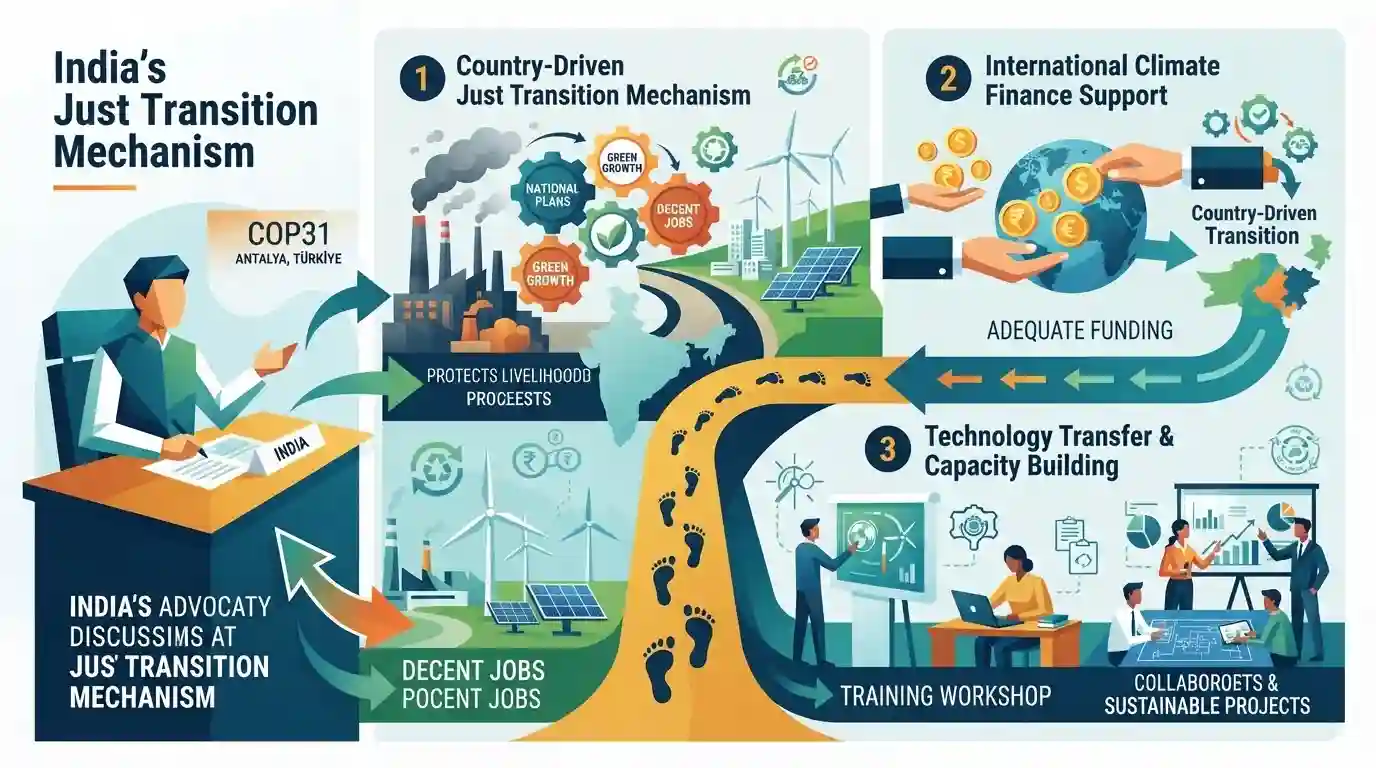
At COP31 in Antalya, Türkiye, India advocated for a country-driven Just Transition Mechanism, emphasizing that climate transition must be equitable, supported by adequate international climate finance, technology transfer, and capacity building for developing countries without hampering their growth goals.
Key Points
- India emphasized a country-driven Just Transition Mechanism at COP31 in Antalya, Türkiye.
- Highlighted the critical need for adequate climate finance, technology transfer, and capacity building for developing nations.
- Stressed that climate action must not compromise developmental priorities and energy security of emerging economies.
Important Terms
COP31

The 31st United Nations Climate Change Conference, held in Antalya, Türkiye, focusing on advancing global climate action, finance, and the operationalization of a just transition mechanism for developing nations.
UPSC context
UPSC Prelims/Mains (GS Paper III): Important international environmental summits, India's negotiating stance, and multilateral climate commitments.
Paris Agreement
A landmark 2015 international climate treaty under the UNFCCC aiming to hold global warming to well below 2°C and pursue efforts to limit it to 1.5°C.
UPSC context
UPSC Prelims/Mains (GS Paper III): Core global framework for climate change mitigation, nationally determined contributions, and equity principles.
UNFCCC
The United Nations Framework Convention on Climate Change, an international environmental treaty providing the overarching institutional framework for global climate negotiations and annual COP summits.
UPSC context
UPSC Prelims/Mains (GS Paper III): Foundational treaty guiding global environmental governance, climate diplomacy, and UNFCCC processes.
Prelims Trap
COP31 is scheduled to be hosted by Türkiye in Antalya
Aspirants often confuse COP hosting venues and presidencies; Türkiye is hosting COP31 in Antalya, whereas COP presidencies rotate regionally under UN rules.
Static Concepts Connected
What are the core principles governing international climate change negotiations under the UNFCCC framework?
- CBDR-RC Principle: CBDR-RC acknowledges historical responsibility of developed nations and differing capabilities of developing countries.
- Equity & Fairness: Equity ensures burden-sharing is fair, accounting for per-capita emissions rather than just aggregate national totals.
- National Sovereignty: National Circumstances respects sovereignty in designing domestic mitigation and adaptation pathways without external imposition.
Cross-Topic Patterns
Climate Finance vs. Trade Protectionism (CBAM)
India's stance at COP links the global climate negotiations under UNFCCC directly with multilateral trade forums like WTO, where carbon border adjustment mechanisms (CBAM) are challenged as protectionist non-tariff barriers.
Just Transition & Domestic Social Security Schemes
Just transition principles bridge environmental conservation with domestic labor welfare, linking fossil-fuel phase-down dialogues to social security schemes for coal-dependent regions in states like Jharkhand and Odisha.

Expect a multi-statement prelims question distinguishing between UNFCCC-mandated mechanisms (like Just Transition) and country-led NDCs.
Linked PYQs · 2
Linked PYQs · 2
- 2021MainsGS3
Describe the major outcomes of the 26th session of the Conference of the Parties (COP) to the United Nations Framework Convention on Climate Change (UNFCCC). What are the commitments made by India in this conference?
- 2025MainsGS3
Write a review on India's climate commitments under the Paris Agreement (2015) and mention how these have been further strengthened in COP26 (2021). In this direction, how has the first Nationally Determined Contribution intended by India been updated in 2022?
