Senior Citizen Welfare Convergence in Cantonment Areas
Source:PIB ↗
Why It Matters
Demonstrates cooperative federalism and inter-ministerial convergence for targeting vulnerable groups like senior citizens in unique administrative zones such as cantonments.
Summary
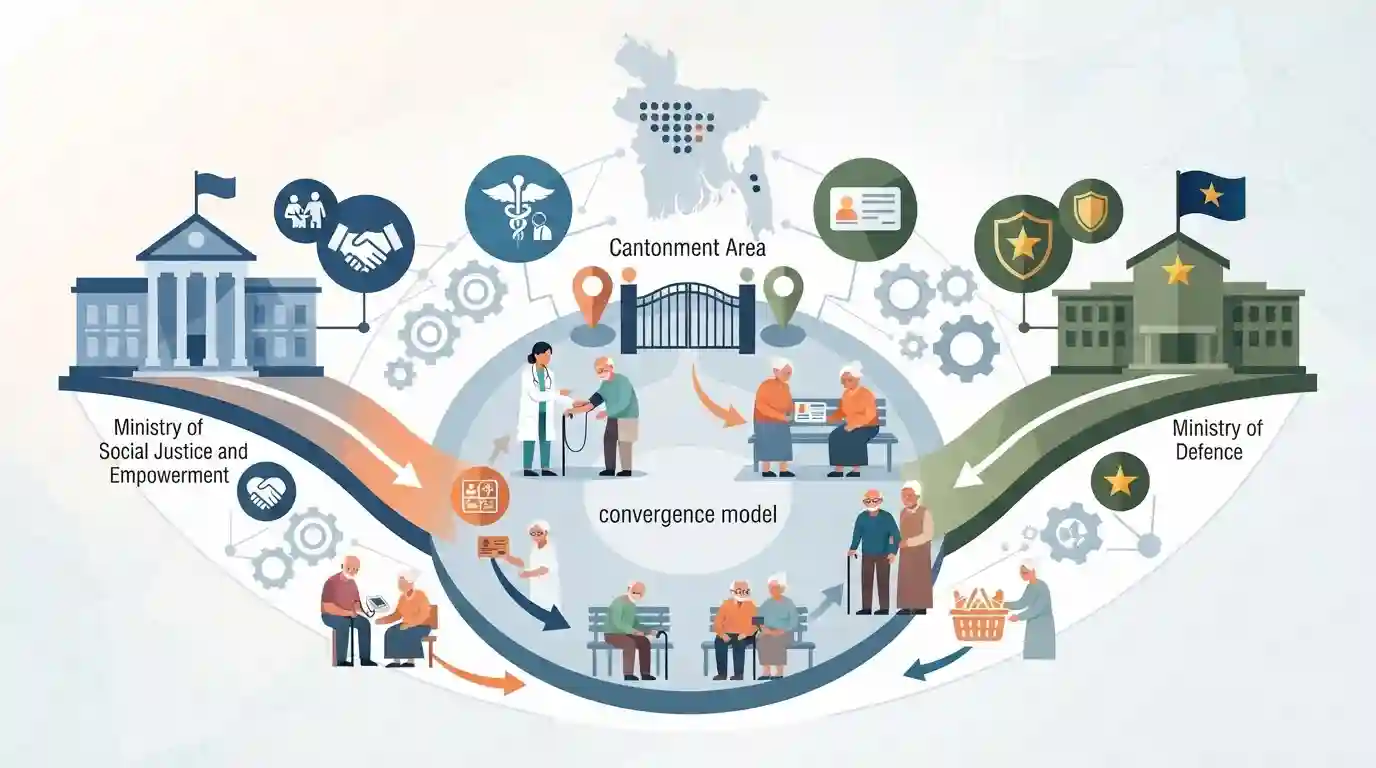
The Ministry of Social Justice and Empowerment and the Ministry of Defence have collaborated to strengthen senior citizen welfare in cantonment areas nationwide. This convergence model aims to bridge administrative gaps, delivering essential geriatric care, social security, and welfare benefits directly to elderly residents within defence-managed cantonments.
Key Points
- The Ministry of Social Justice and Empowerment (MoSJE) and the Ministry of Defence have partnered to enhance the welfare and well-being of senior citizens residing in cantonment areas across India.
- The initiative focuses on institutional convergence to extend social security, healthcare, and geriatric welfare schemes to elderly populations within military cantonments.
- It addresses administrative overlaps and leverages existing defence infrastructure to reach marginalized or overlooked elderly demographics in urban-military pockets.
Important Terms
Ministry of Social Justice and Empowerment

The nodal central ministry responsible for welfare, social justice, and empowerment of disadvantaged and marginalized sections of society, including senior citizens, persons with disabilities, and Scheduled Castes.
UPSC context
UPSC CSE Prelims and Mains (GS Paper II - Social Justice): Relevant for questions on government policies, vulnerable sections, and welfare administration.
Ministry of Defence
The central government department charged with coordinating and supervising all agencies and functions of the government relating directly to national security and the Indian Armed Forces.
UPSC context
UPSC CSE Prelims and Mains (GS Paper II/III): Important for administrative convergence, defence estate management, and inter-ministerial coordination frameworks.
Prelims Trap
Cantonment areas are exclusively administered by the Ministry of Defence, precluding the implementation of civil ministry welfare schemes like AVYAY.
Cantonment boards are managed under the Ministry of Defence via the DGDE, but welfare schemes of other ministries like MoSJE can be extended via MoUs without transferring administrative control.
Static Concepts Connected
What are the statutory functions and administrative control of Cantonment Boards in India?
- Statutory Framework: Statutory status under the Cantonments Act, 2006 (replacing the 1924 Act), functioning as bodies corporate under the administrative control of the Ministry of Defence via the Directorate General of Defence Estates (DGDE).
- Classification & Finance: Classified into four categories (I to IV) based on civilian population size, with revenue raised through local taxation supplemented by central grants.
- Composition: Comprise both elected civilian members and ex-officio military members (with the Station Commander acting as the President of the Board).
Cross-Topic Patterns
Cantonment Administration vs. Urban Local Bodies
Cantonment boards governed by the Cantonments Act 2006 often exist as distinct local bodies separate from municipal corporations, creating unique administrative grey areas for central welfare schemes.

Inter-ministerial convergence models like MoSJE + Defence are high-yield for prelims statements on institutional mandates.
Linked PYQs · 2
Linked PYQs · 2
- 2023MainsGS2
“Development and welfare schemes for the vulnerable, by its nature, are discriminatory in approach.” Do you agree? Give reasons for your answer.
- 2024PrelimsGS1
Operations undertaken by the Army towards upliftment of the local population in remote areas to include addressing of their basic needs is called:
