Self-Enumeration for Census 2027 Phase II Commences in States
Source:PIB ↗
Why It Matters
The introduction of self-enumeration in India's decennial census marks a critical shift toward digital governance, e-governance, and citizen participation in official data collection, which is foundational for policy-making and resource allocation.
Summary
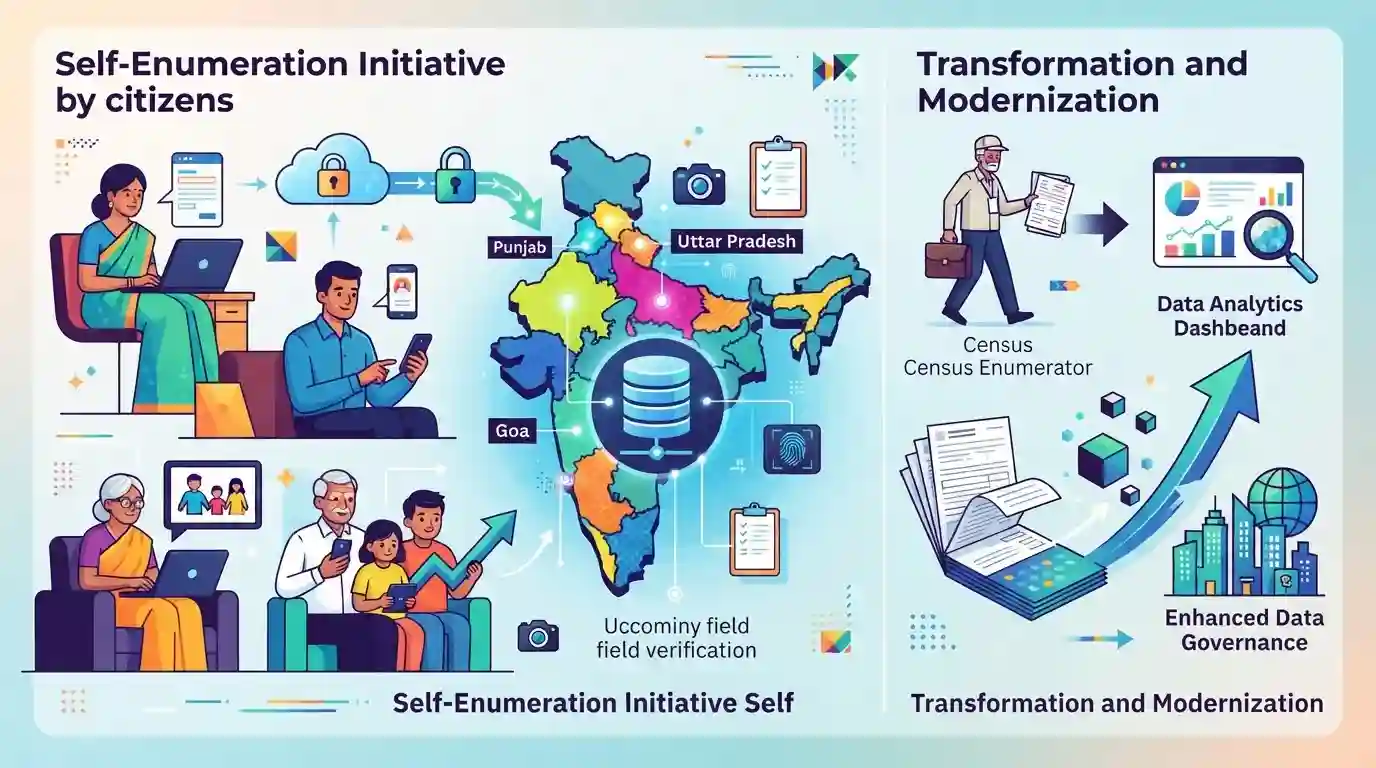
Self-enumeration for Phase II of Census 2027 has begun in Goa, Punjab, Uttar Pradesh, and non-snow-bound areas of Uttarakhand. This digital initiative allows citizens to provide demographic information online ahead of field verification, marking a transformative step in modernizing India's decennial census exercise and enhancing data governance.
Key Points
- Self-enumeration for Phase II of Census 2027 has officially commenced across Goa, Punjab, Uttar Pradesh, and non-snow-bound regions of Uttarakhand.
- Self-enumeration allows citizens to securely fill out their census questionnaire online prior to the formal house-to-house enumeration phase.
- This initiative represents a major digital governance reform in India's official demographic data collection process.
- The exercise aims to improve data accuracy, convenience, and efficiency while reducing administrative burdens on enumerators.
Important Terms
Census 2027

The 16th decennial census exercise of India, featuring digital governance initiatives such as a public self-enumeration web portal and mobile applications for population and housing data collection.
UPSC context
GS Paper II/III (Governance, E-governance applications, Social Justice). Tests understanding of digital modernization in national demographic exercises.
Office of the Registrar General and Census Commissioner India
The statutory body functioning under the Ministry of Home Affairs responsible for conducting the decennial Census, implementing the Civil Registration System, and managing the National Population Register in India.
UPSC context
GS Paper II (Governance, Statutory Bodies). Important for questions regarding administrative machinery for population surveys and civil registration.
Ministry of Home Affairs
The Union government ministry responsible for internal security, domestic policy, and administrative oversight of the Census Act, 1948, and demographic operations through the Registrar General of India.
UPSC context
GS Paper II (Polity and Governance). Tests understanding of ministerial responsibilities regarding internal administration and census operations.
Prelims Trap
Self-enumeration completely replaces the traditional house-to-house physical enumeration phase conducted by government officials.
Aspirants often assume online self-enumeration replaces the entire field-verification step, whereas it only precedes it and requires submitting a unique SE ID to enumerators.
Static Concepts Connected
What is the statutory framework governing the decennial Census in India?
- Legislative Basis: Statutory backing provided by the Census Act of 1948, which empowers the Central Government to notify and conduct a census.
- Nodal Authority: The Census Commissioner of India, under the Ministry of Home Affairs, is designated as the authority to coordinate and direct census operations.
- Confidentiality Provision: Individual data collected under the Act is legally protected, kept strictly confidential, and barred from being used as evidence in courts of law.
Cross-Topic Patterns
Census Modernization + Digital Public Infrastructure (DPI)
Digital self-enumeration for Census 2027 mirrors Aadhaar-based authentication frameworks and Digital India initiatives, bridging civil registration, e-governance, and statutory democratic data collection.

Expect a statement-based prelims question on the statutory basis of Census Act 1948 and mandatory vs. optional nature of self-enumeration.
Linked PYQs · 2
Linked PYQs · 2
- 2022PrelimsGS1
In India, which one of the following compiles information on industrial disputes, closures, retrenchments and lay-offs in factories employing workers ?
- 2016MainsGS2
Demographic Dividend in India will remain only theoretical unless our manpower becomes more educated, aware, skilled and creative." What measures have been taken by the government to enhance the capacity of our population to be more productive and employable?
