AI for Digital Transformation in Minority Affairs Governance
Source:PIB ↗
Why It Matters
This initiative illustrates the practical application of Artificial Intelligence in public administration and e-governance, directly tying into UPSC GS2 syllabus items regarding technology-driven governance, transparency, and targeted service delivery.
Summary
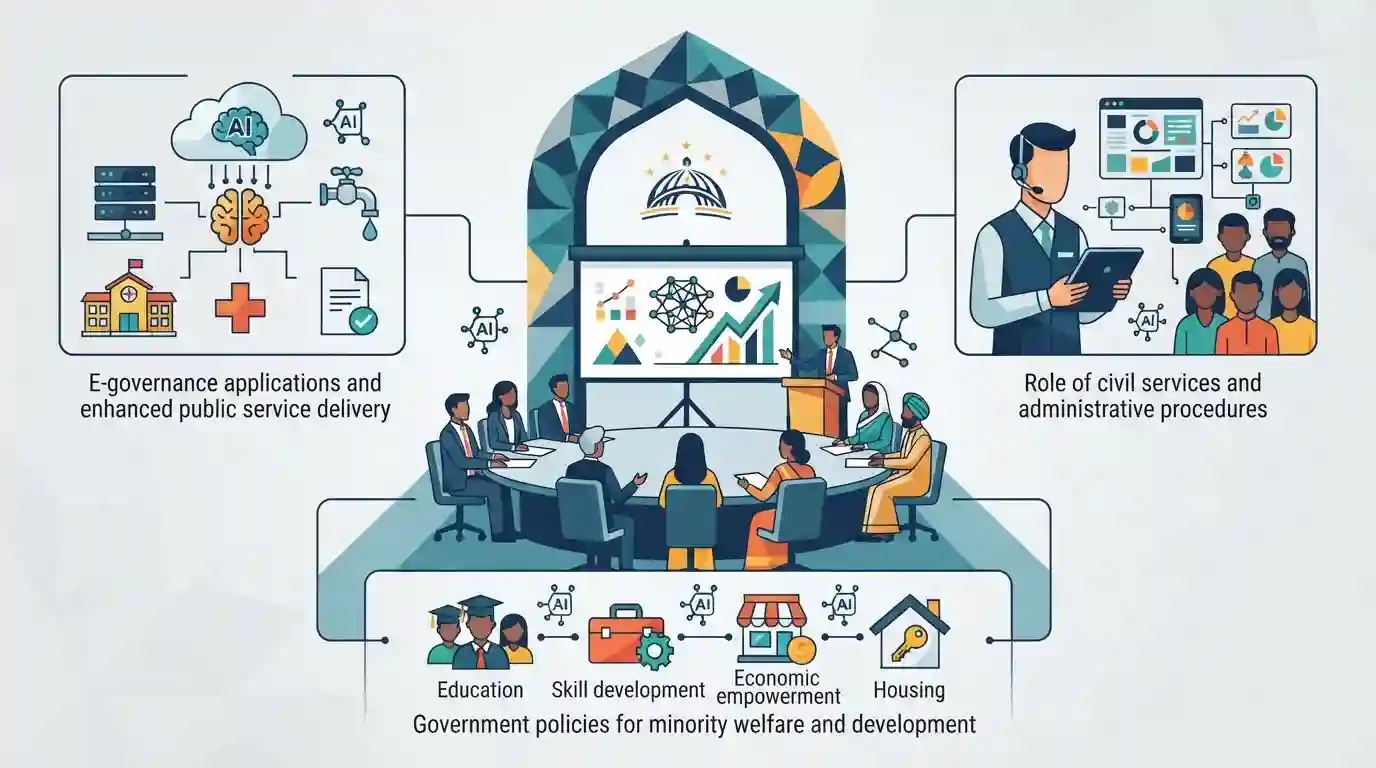
The Ministry of Minority Affairs organized a workshop on 'AI for Digital Transformation' aimed at incorporating Artificial Intelligence to improve governance frameworks, enhance public service delivery, and streamline administrative procedures for minority welfare.
Key Points
- The Ministry of Minority Affairs organized a workshop focused on 'AI for Digital Transformation' to strengthen AI-enabled governance.
- The initiative highlights the integration of emerging technologies like Artificial Intelligence to enhance administrative efficiency, transparency, and public service delivery for minority welfare schemes.
- Discussions centered on leveraging digital transformation tools to streamline processes, improve data-driven decision making, and foster inclusive growth.
Important Terms
Ministry of Minority Affairs

The Union ministry responsible for formulating policies, planning, and coordinating programs for the socio-economic and educational development of notified minority communities in India.
UPSC context
UPSC GS Paper II (Social Justice): Government policies, welfare schemes, and administrative frameworks for vulnerable and minority sections.
IndiaAI Mission
A flagship national initiative by the Government of India designed to build a robust domestic artificial intelligence ecosystem, focusing on compute infrastructure, foundation models, and responsible AI governance.
UPSC context
UPSC GS Paper III (Science & Technology): Applications of emerging technologies, IT policies, and national development strategies.
Digital Personal Data Protection Act, 2023
India's comprehensive legislative framework regulating the processing of digital personal data, balancing individual privacy rights with lawful processing for governance and national development.
UPSC context
UPSC GS Paper II & III (Polity & Governance / Security): Data privacy, cyber security, and citizen rights in the digital age.
Static Concepts Connected
What are the key pillars and objectives of the IndiaAI Mission?
- Supercomputing Access: Compute Capacity: Establishing a scalable supercomputing infrastructure through public-private partnerships to fuel AI innovation.
- Data Platform: Dataset Platform: Building a unified National Data Platform to provide non-personal data for startup and researcher training.
- Sovereign AI: Application Development: Promoting indigenous AI models for critical sectors like healthcare, agriculture, and governance.
Cross-Topic Patterns
AI Governance + Data Protection Act
The push for AI-enabled governance intersects directly with the Digital Personal Data Protection Act, 2023, requiring strict adherence to data minimization and citizen consent when processing minority welfare beneficiary data.
E-governance Models + Civil Service Training
Integrating emerging technologies into welfare administration tests the limits of bureaucratic capacity-building, linking e-governance administrative reforms directly to civil service training institutional frameworks.

AI in governance + IndiaAI guidelines + DPDP Act 2023 integration will likely form a multi-statement Prelims/Mains question.
Linked PYQs · 3
Linked PYQs · 3
- 2024MainsGS2
e-governance is not just about the routine application of digital technology in service delivery process. It is as much about multifarious interactions for ensuring transparency and accountability. In this context evaluate the role of the 'Interactive Service Model' of e-governance.
- 2025MainsGS2
e-governance projects have a built-in bias towards technology and back-end integration than user-centric designs. Examine.
- 2023MainsGS2
e-governance, as a critical tool of governance, has ushered in effectiveness, transparency and accountability in governments. What inadequacies hamper the enhancement of these features ?
