Janjatiya Gaurav Diwas and Tribal Development Initiatives
Source:PIB ↗
Why It Matters
Important for understanding government policies, cultural recognition, and welfare frameworks dedicated to Scheduled Tribes and tribal freedom fighters in India.
Summary
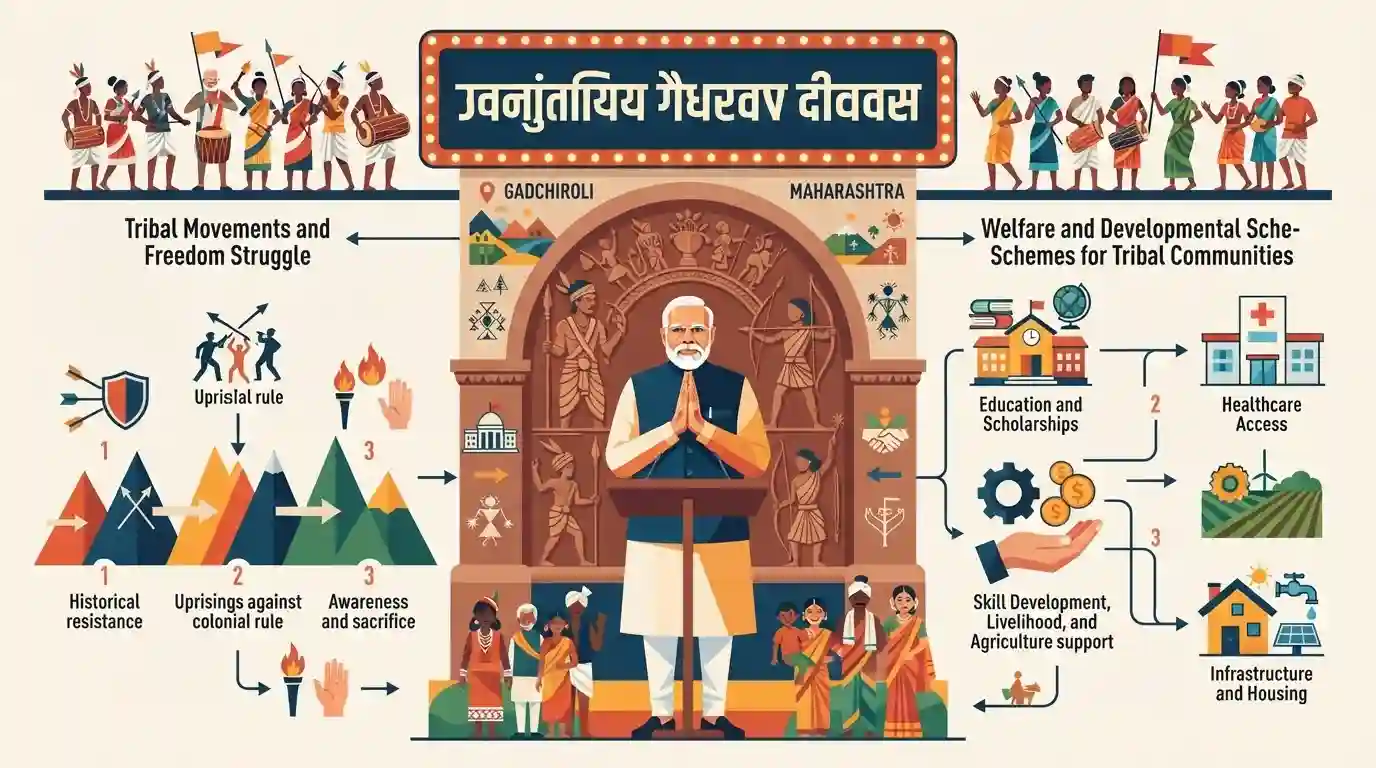
Prime Minister Narendra Modi participated in the Janjatiya Gaurav Diwas celebrations in Gadchiroli, Maharashtra, emphasizing the rich contribution of tribal freedom fighters to India's history and highlighting ongoing welfare and developmental schemes for tribal communities.
Key Points
- Prime Minister Narendra Modi participated in the Janjatiya Gaurav Diwas programme in Gadchiroli, Maharashtra.
- The occasion highlights the rich heritage, culture, and contribution of tribal communities to India's freedom struggle.
- Emphasis was laid on various developmental initiatives and welfare schemes targeted at improving the socio-economic conditions of tribal populations.
Important Terms
Janjatiya Gaurav Diwas

Observed annually on November 15 to commemorate the birth anniversary of tribal freedom fighter Bhagwan Birsa Munda, celebrating the rich heritage and contributions of tribal communities to India's freedom struggle.
UPSC context
UPSC CSE Prelims and Mains (GS Paper I - Modern Indian History and GS Paper II - Vulnerable Sections), testing awareness of tribal icons and history.
Pradhan Mantri Janjati Adivasi Nyaya Maha Abhiyan (PM-JANMAN)
A flagship government mission aimed at saturating Particularly Vulnerable Tribal Groups (PVTGs) households and habitations with basic facilities like safe housing, clean water, education, and healthcare.
UPSC context
UPSC CSE Prelims and Mains (GS Paper II - Welfare Schemes for Vulnerable Sections), testing implementation of tribal development policies.
Dharti Aaba Janjatiya Gram Utkarsh Abhiyan
An umbrella initiative launched to cover critical gaps in social infrastructure, health, education, and livelihood opportunities in tribal-majority villages across India.
UPSC context
UPSC CSE Prelims and Mains (GS Paper II - Government Policies and Interventions), evaluating rural and tribal development strategies.
Eklavya Model Residential Schools (EMRS)
Schools established to provide quality middle and high-level education to Scheduled Tribe (ST) students in remote areas, ensuring holistic academic and cultural development.
UPSC context
UPSC CSE Prelims and Mains (GS Paper II - Social Sector/Education), assessing educational equity schemes for scheduled tribes.
Prelims Trap
Commemorates the enactment of the Fifth Schedule or the PESA Act of 1996.
Aspirants often assume Janjatiya Gaurav Diwas commemorates the passing of the PESA Act or a constitutional amendment, whereas it marks the birth anniversary of Bhagwan Birsa Munda.
Static Concepts Connected
What are the key constitutional safeguards and provisions for Scheduled Tribes (STs) in India?
- Article 342: Article 346/342 empowers the President to specify tribes as STs after consulting state Governors.
- Fifth Schedule: Provides for Governors to direct that any particular Act of Parliament or State Legislature does not apply to a Scheduled Area.
- PESA Act 1996: Extends the provisions of Panchayats to the Scheduled Areas, granting sweeping self-governance powers to Gram Sabhas.
- Article 338A: Establishes a constitutional commission to investigate, monitor, and evaluate safeguards provided for STs.
Cross-Topic Patterns
LWE affected districts and developmental saturation
Gadchiroli represents a key frontier for Left Wing Extremism (LWE) management, where security operations are increasingly paired with saturation welfare schemes like Janjatiya Gaurav Diwas outreach.
Tribal freedom fighters in official historiography
Tribal icons like Birsa Munda bridge cultural heritage with historical education reforms under the National Curriculum Framework.

Birsa Munda's birth anniversary & PESA Act provisions are high-yield matches for multi-statement prelims questions.
Linked PYQs · 2
Linked PYQs · 2
- 2023MainsGS1
How did the colonial rule affect the tribals in India and what was the tribal response to the colonial oppression?
- 2023MainsGS2
“Development and welfare schemes for the vulnerable, by its nature, are discriminatory in approach.” Do you agree? Give reasons for your answer.
