NHEC Multi State Cooperative Society Bhoomi Pujan in Pune
Source:PIB ↗
Why It Matters
Relevant for understanding the expansion of the cooperative movement, rural credit/development structures, and multi-state cooperative governance in India.
Summary
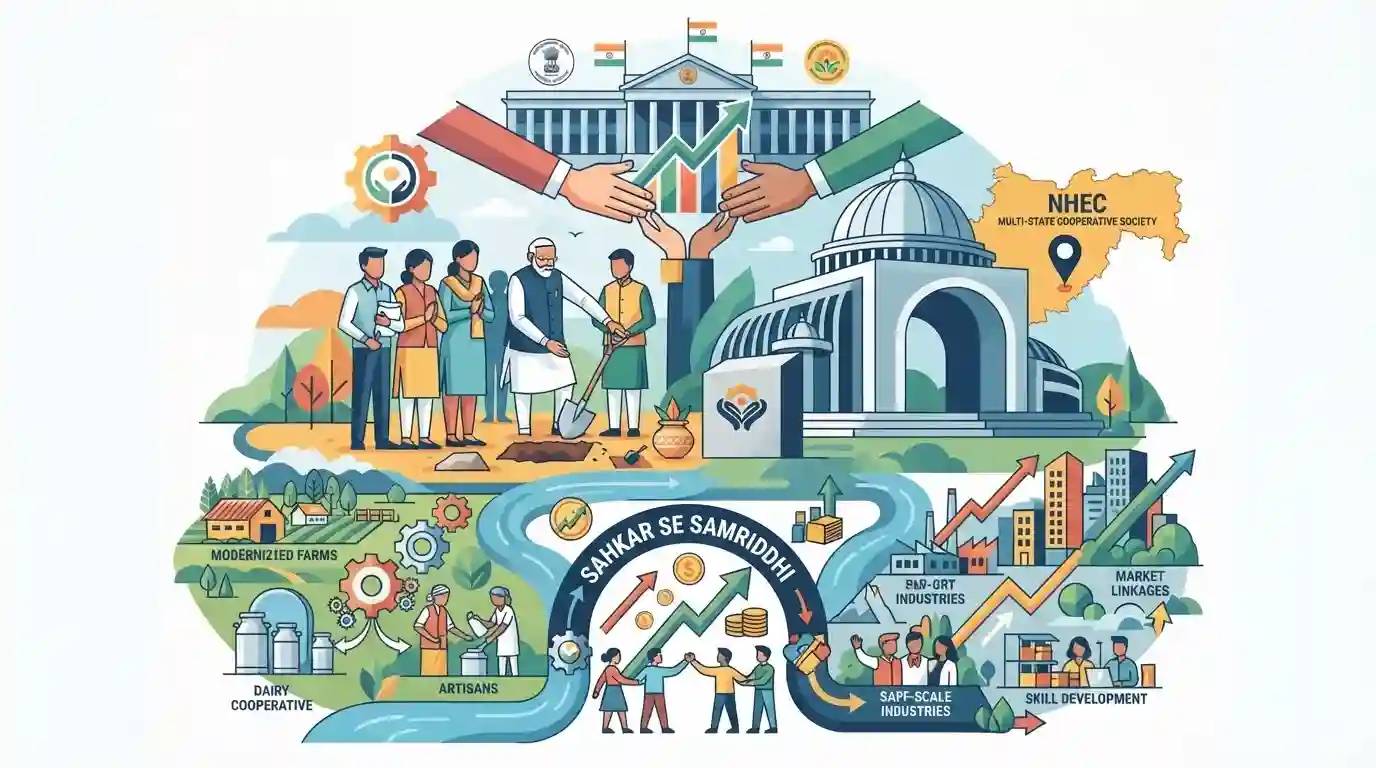
Union Home Minister and Minister of Cooperation Shri Amit Shah performed the Bhoomi Pujan for the NHEC Multi-State Cooperative Society in Pune, Maharashtra. The event highlights government efforts to scale up the cooperative movement, foster rural development, and implement the 'Sahkar se Samriddhi' framework through multi-state institutional mechanisms.
Key Points
- Union Home Minister and Minister of Cooperation performed the Bhoomi Pujan of the NHEC Multi-State Cooperative Society in Pune, Maharashtra.
- The initiative aims to strengthen the cooperative sector, foster rural growth, and operationalize cooperative models in targeted economic sectors under the Ministry of Cooperation's vision of 'Sahkar se Samriddhi'.
- Multi-State Cooperative Societies function under national frameworks to expand economic reach across state boundaries, supporting cooperative federalism and economic integration.
Important Terms
Ministry of Cooperation

A specialized central ministry established in July 2021 to provide a dedicated legal, administrative, and policy framework for strengthening cooperatives and implementing the 'Sahkar se Samriddhi' framework across India.
UPSC context
UPSC GS Paper II (Governance / Polity): Tests understanding of administrative structures, cooperative federalism, and government interventions for rural development.
Multi-State Cooperative Societies Act
Legislation governing cooperatives whose operations are not confined to a single state, updated via major amendments in 2023 to improve transparency, governance, and autonomous functioning.
UPSC context
UPSC GS Paper III (Economy / Inclusive Growth): Tests legal frameworks governing federal economic entities and cooperative sector reforms.
NHEC Multi-State Cooperative Society
National Heavy Engineering Cooperative Ltd., a Pune-based multi-state cooperative society revived to manufacture heavy engineering equipment, fostering cooperative-led industrial self-reliance.
UPSC context
UPSC GS Paper III (Economy / Industrial Policy): Tests initiatives on cooperative-led manufacturing, asset revival, and Atmanirbhar Bharat.
Prelims Trap
Because Multi-State Cooperative Societies are centrally registered, "Cooperation" has been permanently shifted from the State List to the Union List.
Multi-state cooperatives are registered under the Central Registrar and governed by central law, but cooperatives themselves remain primarily a State subject under the State List of the Seventh Schedule.
Static Concepts Connected
What is the legal framework and regulatory mechanism for Multi-State Cooperative Societies in India?
- Statutory Basis: Statutory backing governed centrally by the Multi-State Cooperative Societies (MSCS) Act, 2002 (amended recently in 2023).
- Regulatory Authority: Function under the administrative control of the Central Registrar of Cooperative Societies, operating across more than one state.
- Federal Scope: Cooperative federalism principle where state-level societies can expand operations nationally without seeking separate state registrations.
Cross-Topic Patterns
Cooperatives and Cooperative Federalism
The Ministry of Cooperation is leveraging central legislation to integrate rural economies, paralleling agricultural federalism debates under the Seventh Schedule.
Financial Inclusion and Rural Credit
Multi-state cooperatives provide an institutional mechanism for financial inclusion, bridging the gap between priority sector lending and rural credit access.

Multi-State Cooperative Societies Act provisions and Central Registrar powers frequently appear in Polity matching sets.
Linked PYQs · 1
Linked PYQs · 1
- 2014MainsGS3
In the villages itself no form of credit organization will be suitable except the cooperative society. -All India Rural Credit Survey. Discuss this statement in the background of agricultural finance in India. What constraints and challenges do financial institutions supplying agricultural finance face? How can technology be used to better reach and serve rural clients?
