PMAY G Housing Allocation for Odisha Rural Development
Source:PIB ↗
Why It Matters
PMAY-G is a flagship national social welfare scheme aimed at achieving Housing for All in rural areas. Analyzing state-level allocations and implementation bottlenecks is vital for understanding welfare administration, center-state cooperation, and rural development strategies in India.
Summary
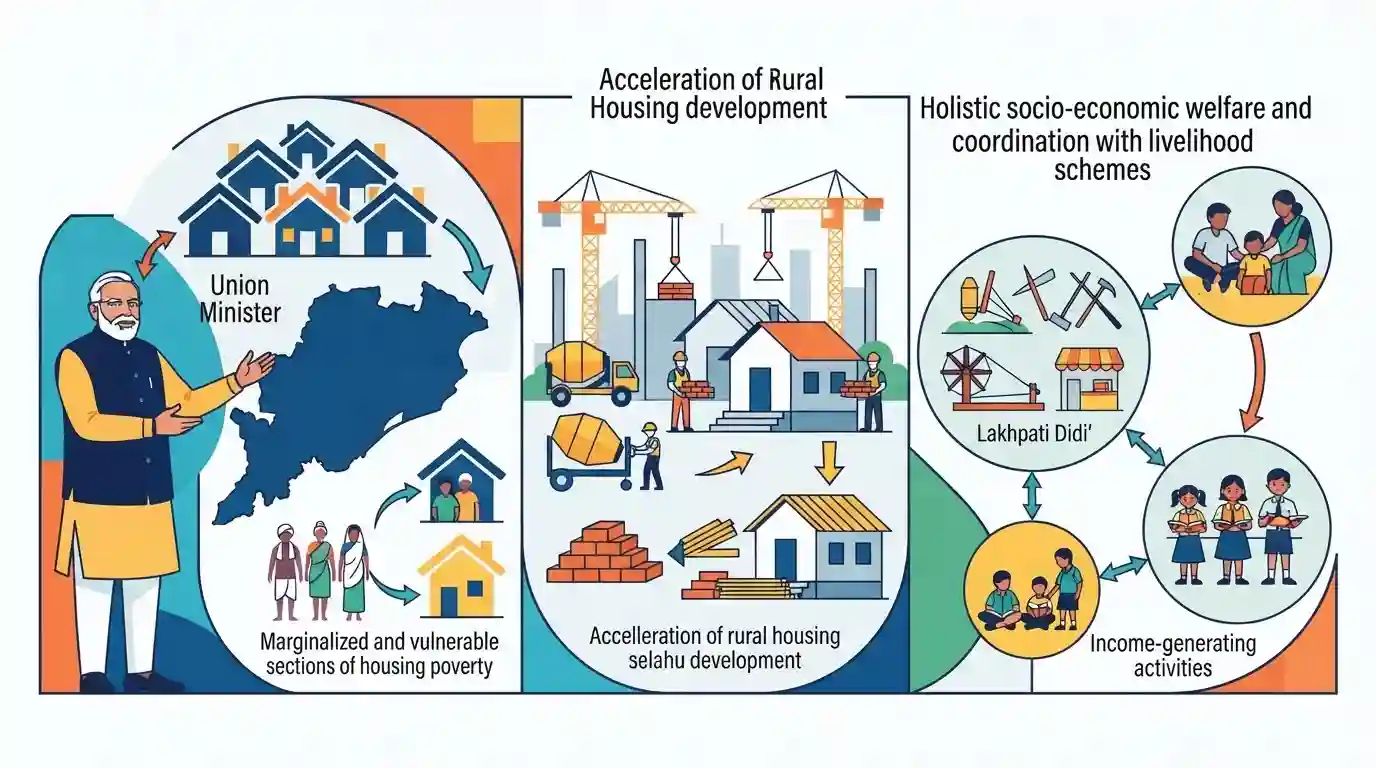
Union Minister for Rural Development Shivraj Singh Chouhan announced an allocation of five lakh additional rural houses under the Pradhan Mantri Awas Yojana-Gramin (PMAY-G) for Odisha. The move aims to accelerate rural housing development, eradicate housing poverty among marginalized and vulnerable sections, and ensure holistic socio-economic welfare in coordination with livelihood schemes like Lakhpati Didi.
Key Points
- Union Minister for Rural Development Shivraj Singh Chouhan announced the allocation of 5 lakh additional houses under Pradhan Mantri Awas Yojana-Gramin (PMAY-G) for Odisha.
- Emphasis was placed on ensuring transparency, timely completion, and quality construction of rural housing for marginalized communities.
- The initiative aims to address housing poverty in rural areas and support vulnerable households, particularly in backward and remote districts of Odisha.
- Synergies with other central and state welfare programs like Lakhpati Didi were highlighted to boost rural livelihoods.
Important Terms
Pradhan Mantri Awas Yojana-Gramin (PMAY-G)

A flagship rural housing welfare scheme implemented by the Ministry of Rural Development to provide financial assistance for building pucca houses with basic amenities to eligible rural poor.
UPSC context
UPSC Mains GS Paper II: Welfare schemes for vulnerable sections of the population and performance of these schemes.
Lakhpati Didi scheme
A Central government initiative under DAY-NRLM aiming to enable rural women in self-help groups to earn a sustainable annual household income of at least ₹1 lakh.
UPSC context
UPSC Mains GS Paper II & III: Poverty, developmental issues, women empowerment, and inclusive growth.
Ministry of Rural Development
The Union government department responsible for formulating and implementing policies related to rural development, poverty alleviation, livelihood promotion, and rural infrastructure in India.
UPSC context
UPSC Mains GS Paper II: Governance, institutional structures, and implementation of government policies.
Static Concepts Connected
How are beneficiaries identified and targeted under the Pradhan Mantri Awas Yojana-Gramin (PMAY-G)?
- Database Source: SECC 2011 data is used to identify deprived households based on housing-deprivation and other vulnerability indicators.
- Gram Sabha Role: Gram Sabha vetting ensures transparency and local verification of the priority lists generated from SECC 2011.
- Exclusion Filters: Exclusion criteria automatically filter out households owning motorized vehicles, income tax payers, or institutional workers.
Cross-Topic Patterns
PMAY-G and SECC 2011 Data Governance
PMAY-G target selection relies entirely on SECC 2011 data, linking social welfare delivery with administrative data validity debates.
Welfare Convergence and Multidimensional Poverty Reduction
Convergence models combine housing grants under PMAY-G with sanitation, cooking gas, and wage employment, reflecting holistic social infrastructure planning.

PMAY-G beneficiary identification criteria (SECC 2011 + Gram Sabha verification) and convergence schemes are frequent UPSC match targets.
Linked PYQs · 3
Linked PYQs · 3
- 2024PrelimsGS1
With reference to the Pradhan Mantri Jan Dhan Yojana (PMJDY), which of the following statements is/are correct? 1. The scheme aims to open bank accounts for unbanked households. 2. There is a minimum balance requirement for accounts opened under this scheme. 3. Beneficiaries get a Rupay Debit Card with an inbuilt accident insurance cover. Select the correct answer using the code given below.
- 2024PrelimsGS1
With reference to the Pradhan Mantri Shram Yogi Maan-dhan (PM-SYM) Yojana, consider the following statements : 1. The entry age group for enrolment in the scheme is 21 to 40 years. 2. Age specific contribution shall be made by the beneficiary. 3. Each subscriber under the scheme shall receive a minimum pension of ₹ 3,000 per month after attaining the age of 60 years. 4. Family pension is applicable to the spouse and unmarried daughters. Which of the statements given above is/are correct?
- 2021PrelimsGS1
At the national level, which ministry is the nodal agency to ensure effective implementation of the Scheduled Tribes and Other Traditional Forest Dwellers (Recognition of Forest Rights) Act, 2006?
