Senior Citizen Welfare Schemes Extended to Cantonment Boards
Source:PIB ↗
Why It Matters
This cooperative framework between government departments ensures that senior citizens residing in cantonment areas—often overlooked by regular municipal welfare networks—gain access to central social security and welfare schemes.
Summary
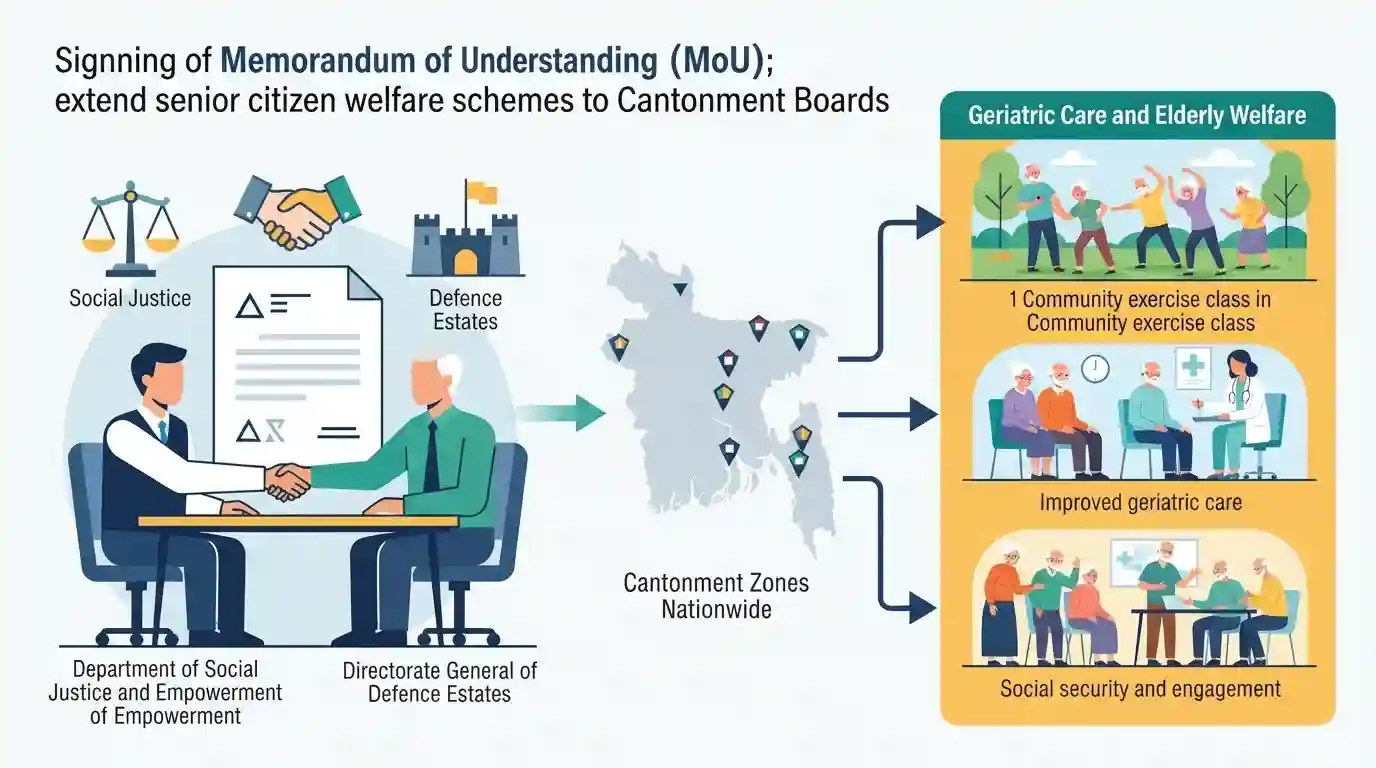
An MoU has been signed between the Department of Social Justice and Empowerment and the Directorate General of Defence Estates to extend senior citizen welfare schemes to Cantonment Boards nationwide, improving geriatric care and social security for elderly residents in cantonment zones.
Key Points
- The Department of Social Justice and Empowerment (DoSJE) and the Directorate General of Defence Estates (DGDE) signed a Memorandum of Understanding (MoU).
- The MoU aims to extend senior citizen welfare schemes to Cantonment Boards across India.
- Focuses on integrating vulnerable elderly populations residing in cantonment areas into national social security frameworks.
- Aligns with the objectives of schemes like Atal Vayo Abhyudaya Yojana (AVYAY) for geriatric care and empowerment.
Important Terms
Atal Vayo Abhyudaya Yojana

An umbrella scheme launched by the Ministry of Social Justice and Empowerment to promote healthy, dignified, and secure ageing by funding elderly care facilities, assistive devices, and helplines.
UPSC context
UPSC CSE GS Paper II (Social Justice/Vulnerable Sections): Crucial for welfare schemes for senior citizens and geriatric care initiatives.
Department of Social Justice and Empowerment
The central government ministry responsible for policy formulation, planning, and implementation of welfare, social defense, and empowerment programs for marginalized groups, including senior citizens.
UPSC context
UPSC CSE GS Paper II (Governance and Social Justice): Nodal authority handling social security schemes for vulnerable segments of society.
Directorate General of Defence Estates
An attached office under the Ministry of Defence that regulates land management and municipal governance across cantonments through the Indian Defence Estates Service.
UPSC context
UPSC CSE GS Paper II (Governance and Defence/Administration): Important for understanding civil-military administration and local urban governance in cantonment areas.
Cantonment Boards
Statutory municipal bodies established under the Cantonments Act, 2006, responsible for civic administration, public health, and welfare implementation in military-civilian hybrid zones.
UPSC context
UPSC CSE GS Paper II (Polity and Governance): Key urban local bodies operating under Central government control rather than state municipal laws.
Prelims Trap
Cantonment Boards are administrative units under the Ministry of Housing and Urban Affairs.
Aspirants might assume Cantonment Boards fall exclusively under the Ministry of Housing and Urban Affairs (MoHUA), missing that they are controlled by the Ministry of Defence.
Static Concepts Connected
What are the key features and administrative structure of Cantonment Boards in India?
- Legal Basis: Statutory body established under the Cantonments Act (currently the Cantonments Act, 2006).
- Administrative Control: Administered directly by the Ministry of Defence through the Directorate General of Defence Estates (DGDE).
- Composition: A mix of elected civilian members and ex-officio military members presided over by the military station commander.
Cross-Topic Patterns
Cantonment Boards & Urban Local Governance
Cantonment Boards are unique municipal bodies administered by the Ministry of Defence under the Cantonments Act 2006, bridging urban local governance and military administration.

Atal Vayo Abhyudaya Yojana (AVYAY) implementation details and unique administrative convergence like DoSJE-DGDE MoUs are prime prelims targets.
Linked PYQs · 2
Linked PYQs · 2
- 2020MainsGS2
In order to enhance the prospects of social development, sound and adequate health care policies are needed particularly in the fields of geriatric and maternal health care. Discuss.
- 2019MainsGS2
Performance of welfare schemes that are implemented for vulnerable sections is not so effective due to absence of their awareness and active involvement at all stages of policy process. Discuss.
