India Nepal Rail Link Connecting Janakpur Dham and Ayodhya
Source:PIB ↗
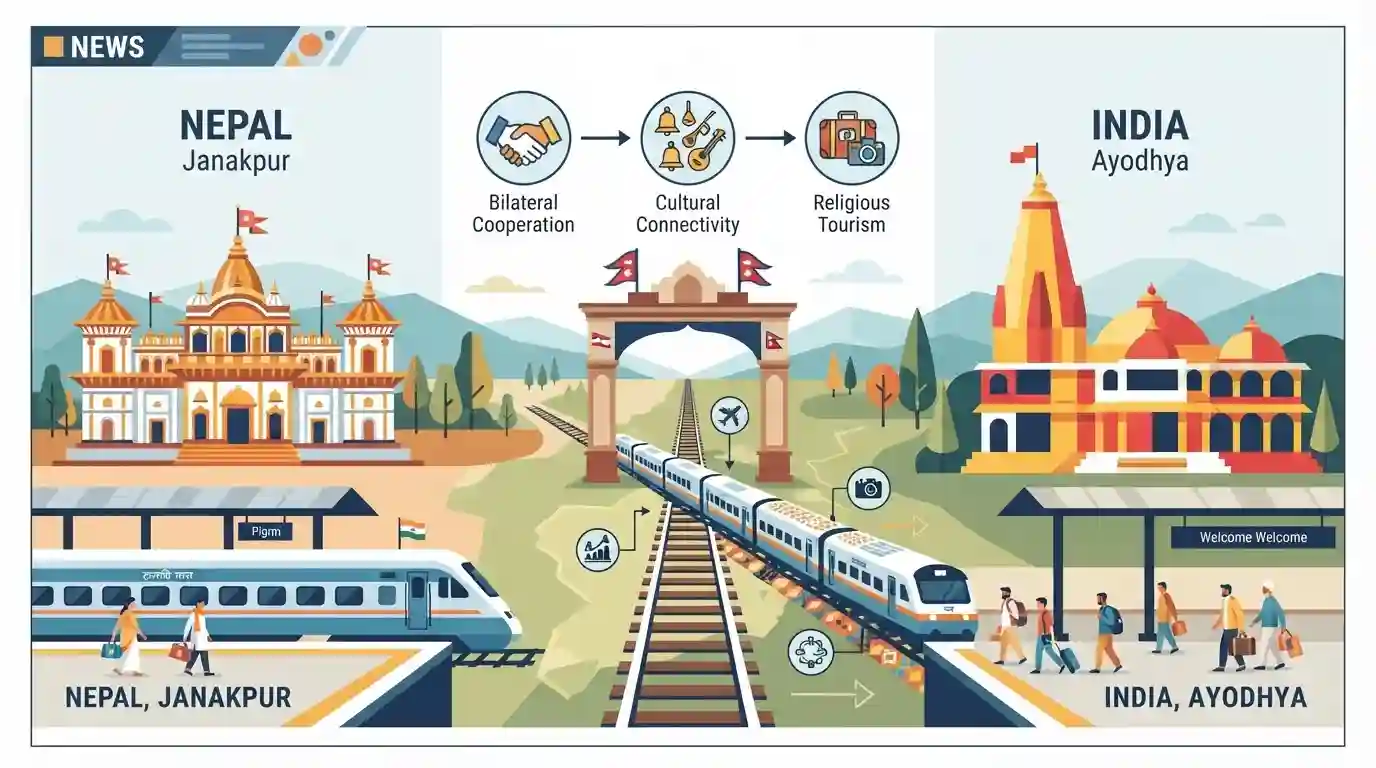
Why It Matters
This development highlights the deepening infrastructure, economic, and cultural integration between India and Nepal under cross-border connectivity initiatives, acting as a crucial element of regional diplomacy and people-to-people ties.
Summary
Indian Railways has approved a weekly train service linking Janakpur Dham in Nepal with Ayodhya in India, boosting cross-border religious tourism, bilateral cooperation, and cultural connectivity between the two nations.
Key Points
- Indian Railways has approved a new weekly train service connecting Janakpur Dham in Nepal with Ayodhya in India.
- The initiative aims to strengthen bilateral ties, religious tourism, and cultural connectivity between India and Nepal.
- It operationalizes cross-border rail linkages, reinforcing people-to-people ties and shared heritage.
Important Terms
Indian Railways

The state railway system of India owned and operated by the Ministry of Railways, Government of India, serving as a primary driver of national logistics, passenger transport, and regional connectivity.
UPSC context
UPSC GS Paper III (Infrastructure, Transport) and GS Paper II (Bilateral Connectivity). Tests understanding of India's cross-border infrastructure initiatives.
Government of Nepal
The federal executive and administrative authority of the Republic of Nepal, responsible for national governance, foreign policy, and bilateral relations with India.
UPSC context
UPSC GS Paper II (International Relations - India and Neighbors). Tests India-Nepal diplomatic ties, cross-border projects, and regional diplomacy.
Government of India
The central executive government of India, responsible for framing national policies, foreign relations, strategic connectivity, and developmental assistance programs with neighboring countries.
UPSC context
UPSC GS Paper II (Polity and International Relations). Tests foreign policy implementation, neighborhood first policy, and bilateral economic cooperation.
Prelims Trap
The Janakpur Dham–Ayodhya rail link is funded and operated under a specialized SAARC multilateral railway convention.
Aspirants often assume international rail links in South Asia are exclusively funded and operated via multilateral agencies like the Asian Development Bank, missing bilateral Indian Railway corridors.
Static Concepts Connected
What are the key components and objectives of India's Ramayana Circuit under the Swadesh Darshan scheme?
- Thematic Circuit: Identifies key destinations associated with the life of Lord Rama across India, including Ayodhya, Sitamarhi, Janakpur (Nepal), Chitrakoot, and Rameshwaram.
- Objective: Aims to develop tourism infrastructure, improve last-mile connectivity, and promote cultural heritage tourism across partner nations.
Cross-Topic Patterns
Religious Tourism + Regional Connectivity Frameworks
India-Nepal connectivity projects like Ramayana Circuit trains tie into broader Buddhist and Ramayana tourism circuits under Swadesh Darshan and PRASHAD schemes.
Bilateral Rail Links + Sub-regional Integration
Cross-border rail networks act as strategic economic corridors in South Asia, complementing BBIN (Bangladesh, Bhutan, India, Nepal) sub-regional initiatives.

Expect matching questions linking cross-border religious circuits (Ramayana/Buddhist) to their specific terminal pairs and bilateral schemes.
Linked PYQs · 3
Linked PYQs · 3
- 2022MainsGS2
The Gati-Shakti Yojana needs meticulous coordination between the government and the private sector to achieve the goal of connectivity. Discuss.
- 2026PrelimsGS1
Consider the following statements about river bridges connecting India with neighbouring countries : 1. 'Maitri Setu', built over Feni river, connects Ramgarh in India with Sabroom in Bangladesh. 2. Jhulaghat suspension bridge connects India with Myanmar. 3. Mechi bridge and its approaches connect Panitanki Bypass in India with Kakarvitta in Nepal. Which of the statements given above is/are correct ?
- 2025PrelimsGS1
Consider the following statements in respect of BIMSTEC : I. It is a regional organization consisting of seven member States till January 2025. II. It came into existence with the signing of the Dhaka Declaration, 1999. III. Bangladesh, India, Sri Lanka, Thailand and Nepal are founding member States of BIMSTEC. IV. In BIMSTEC, the subsector of 'tourism' is being led by India. Which of the statements given above is/are correct?
