INS Sahyadri and Malabar Exercise in Indo Pacific Security
Source:PIB ↗
Why It Matters
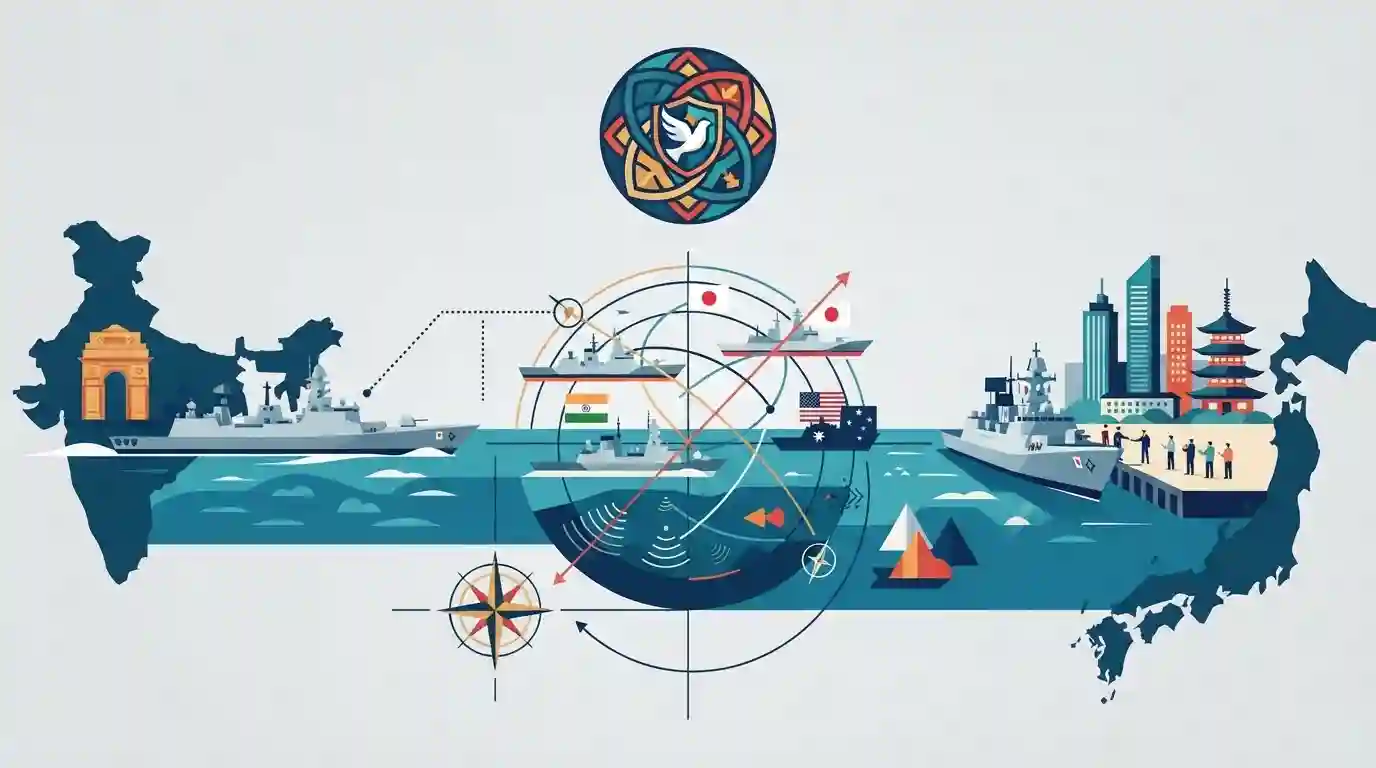
It highlights India's naval diplomacy, strategic partnerships under the Quad framework, and cooperative maritime security measures in the Indo-Pacific region.
Summary
INS Sahyadri visited Yokosuka, Japan, after participating in the multilateral naval exercise Malabar 2026. This exercise involving Quad countries enhances interoperability, maritime security, and strategic cooperation in the Indo-Pacific region.
Key Points
- INS Sahyadri completed its visit to Yokosuka, Japan, following participation in Exercise Malabar 2026.
- Exercise Malabar brings together navies of the Quad nations: India, USA, Japan, and Australia.
- The deployment highlights India's strategic outreach, defense diplomacy, and commitment to a free, open, and inclusive Indo-Pacific.
Important Terms
Malabar Exercise

An annual multilateral naval exercise involving the Quad countries (India, the United States, Japan, and Australia), designed to enhance maritime interoperability, strategic cooperation, and security in the Indo-Pacific region.
UPSC context
Important for GS Paper II (International Relations - Groupings) and GS Paper III (Security and Defense Cooperation in the Indo-Pacific).
Indian Navy
The naval branch of the Indian Armed Forces, responsible for safeguarding India's maritime borders, projecting power, and conducting diplomatic and humanitarian missions across the Indo-Pacific.
UPSC context
Important for GS Paper III (Security, Defense Preparedness, and India's Maritime Strategy).
Japan Maritime Self-Defense Force
The naval warfare branch of the Japan Self-Defense Forces, tasked with defending Japan's maritime interests and participating in collective security and multilateral exercises like Malabar.
UPSC context
Important for GS Paper II (International Relations - Bilateral and Regional Security Partnerships in East Asia).
US Navy
The maritime service branch of the United States Armed Forces, playing a vital role in maintaining global maritime security, freedom of navigation, and deterrence in the Indo-Pacific.
UPSC context
Important for GS Paper II (India-US Strategic Relations) and GS Paper III (Global Security Architecture).
Royal Australian Navy
The naval warfare branch of the Australian Defence Force, contributing to regional maritime security, freedom of navigation, and joint exercises alongside Quad partners.
UPSC context
Important for GS Paper II (India-Australia Bilateral Ties and Indo-Pacific Security Architecture).
Static Concepts Connected
What is the origin, evolution, and participating nations of Exercise Malabar?
- Bilateral Origin: Bilateral origin started in 1992 as a bilateral naval exercise between India and the United States.
- Multilateral Expansion: Multilateral expansion Japan joined permanently in 2015, and Australia became a regular participant in 2020, completing the Quad naval grouping.
- Core Objectives: Core objectives focuses on high-end tactical warfare, anti-submarine warfare, interoperability, and ensuring a rules-based maritime order in the Indo-Pacific.
Cross-Topic Patterns
Minilateralism + Indo-Pacific Maritime Security
Exercise Malabar started bilaterally in 1992 before expanding, illustrating how minilateral groupings formalise security architecture in the Indo-Pacific.

Quad minilateral exercises like Malabar + India's Indo-Pacific Oceans Initiative (IPOI) will be tested in multi-statement prelims.
Linked PYQs · 2
Linked PYQs · 2
- 2020MainsGS2
Quadrilateral Security Dialogue (Quad)' is transforming itself into a trade bloc from a military alliance, in present times - Discuss.
- 2021MainsGS2
The newly tri-nation partnership AUKUS is aimed at countering China's ambitions in the Indo-Pacific region. Is it going to supersede the existing partnerships in the region? Discuss the strength and impact of AUKUS in the present scenario.
