NAMASTE Scheme Impact on Sanitation Workers Livelihood
Source:PIB ↗
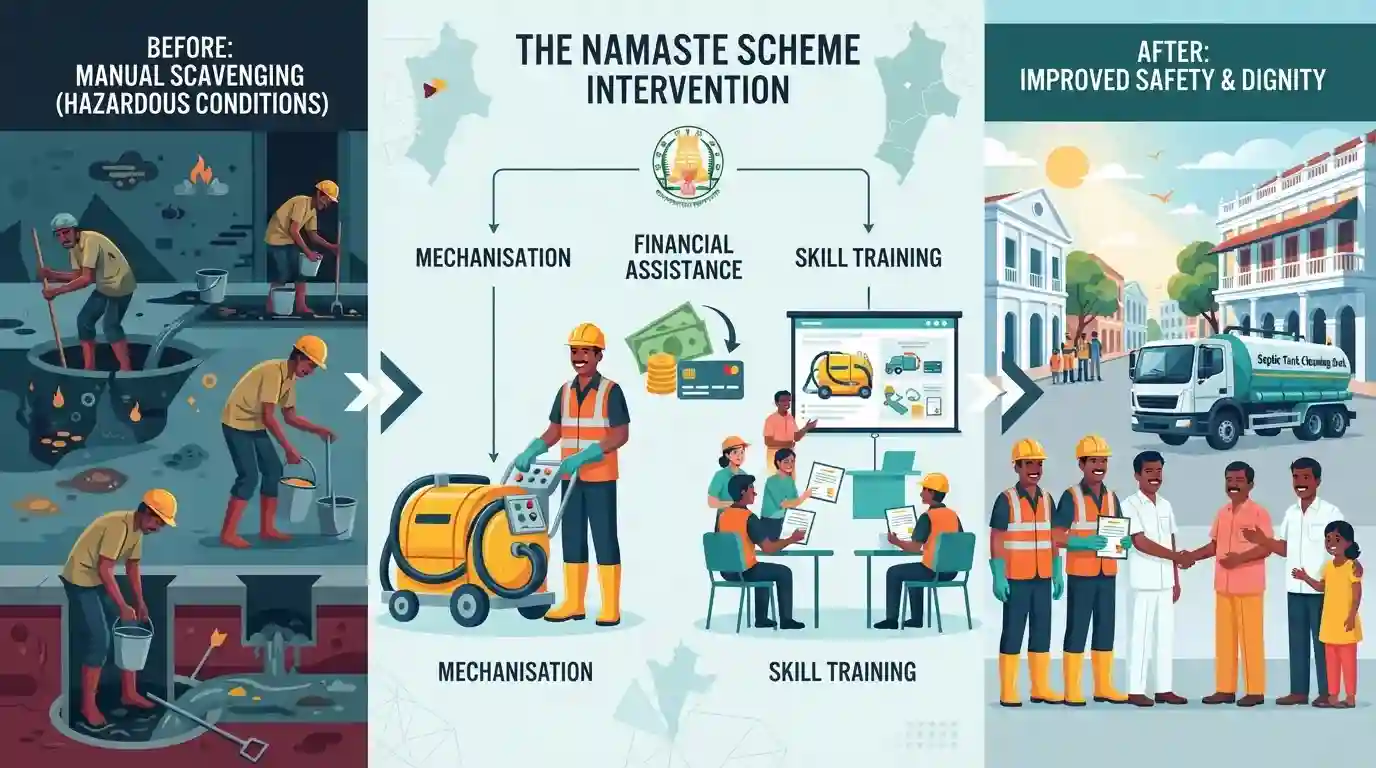
Why It Matters
It highlights the implementation and grassroots impact of the NAMASTE scheme for sanitation workers, directly connecting with governance, social justice, and the elimination of hazardous manual labor.
Summary
The article details a success story from Puducherry under the NAMASTE (National Action Plan for Mechanised Sanitation Ecosystem) scheme, highlighting how transition from manual scavenging to mechanised operations, combined with financial assistance and skill training, has improved the safety, livelihood, and social dignity of sanitation workers.
Key Points
- The NAMASTE scheme aims to eradicate hazardous manual cleaning of sewers and septic tanks and promote mechanised sanitation work.
- Beneficiaries receive safety gear, skill training, financial assistance, and health insurance to ensure dignified livelihoods and improved working conditions.
- Success stories from Puducherry illustrate how convergence with welfare schemes transforms sanitation workers into independent sanitation entrepreneurs.
- The initiative addresses social exclusion, safety, and occupational health hazards faced by vulnerable communities engaged in sanitation work.
Important Terms
NAMASTE Scheme

A joint central sector scheme by the Ministry of Social Justice and Empowerment and the Ministry of Housing and Urban Affairs aimed at eliminating manual scavenging, ensuring zero fatalities in sanitation work, and providing mechanized equipment and livelihood support.
UPSC context
UPSC GS Paper II (Welfare Schemes for Vulnerable Sections, Governance). Tests understanding of occupational safety and social security for sanitation workers.
Ministry of Social Justice and Empowerment
The nodal ministry responsible for the overall welfare, social justice, and empowerment of marginalized communities, including safai karamcharis and manual scavengers.
UPSC context
UPSC GS Paper II (Governance and Institutional Framework). Tests knowledge of ministerial mandates and implementation of social welfare policies.
Ministry of Housing and Urban Affairs
The central ministry responsible for formulating policies and overseeing urban development, municipal governance, and urban sanitation initiatives like Swachh Bharat and mechanized cleaning ecosystems.
UPSC context
UPSC GS Paper II & III (Urbanization, Governance, and Infrastructure). Tests role in urban sanitation management and inter-ministerial schemes.
Prelims Trap
NAMASTE is a single-ministry scheme exclusively for eradicating manual scavenging in sewers.
Aspirants often assume NAMASTE is implemented by a single ministry or exclusively targets manual scavengers of sewers, missing its joint ministry framework and recent inclusion of waste pickers.
Static Concepts Connected
What are the key institutional mechanisms and mandates of the National Safai Karamcharis Finance and Development Corporation (NSKFDC)?
- Apex Body: Apex corporation under the Ministry of Social Justice and Empowerment incorporated in 1997 for economic upliftment of Safai Karamcharis and manual scavengers.
- Financial Role: Provides concessional finance, capital subsidies, and skill development training to facilitate self-employment and rehabilitation.
- NAMASTE Anchor: Acts as the primary implementing agency for the NAMASTE scheme across Urban Local Bodies nationwide.
Cross-Topic Patterns
Urban Sanitation meets Solid Waste Rules
The expansion of NAMASTE to waste pickers bridges urban sanitation with urban local governance (74th Amendment) and solid waste management rules under environmental law.

NAMASTE scheme convergence with NSKFDC and AB-PMJAY is a prime target for a matching or multi-statement prelims question.
Linked PYQs · 2
Linked PYQs · 2
- 2017MainsGS2
To ensure effective implementation of policies addressing water, sanitation and hygiene needs the identification of the beneficiary segments is to be synchronized with the anticipated outcomes." Examine the statement in the context of the WASH scheme.
- 2023MainsGS2
“Development and welfare schemes for the vulnerable, by its nature, are discriminatory in approach.” Do you agree? Give reasons for your answer.
