PLI Scheme and India Manufacturing Sector Transformation
Source:PIB ↗
Why It Matters
The PLI scheme is a flagship policy instrument of the Indian government to boost domestic manufacturing, attract investments, and drive export-led growth, making it a critical topic for GS Paper 3 economy questions.
Summary
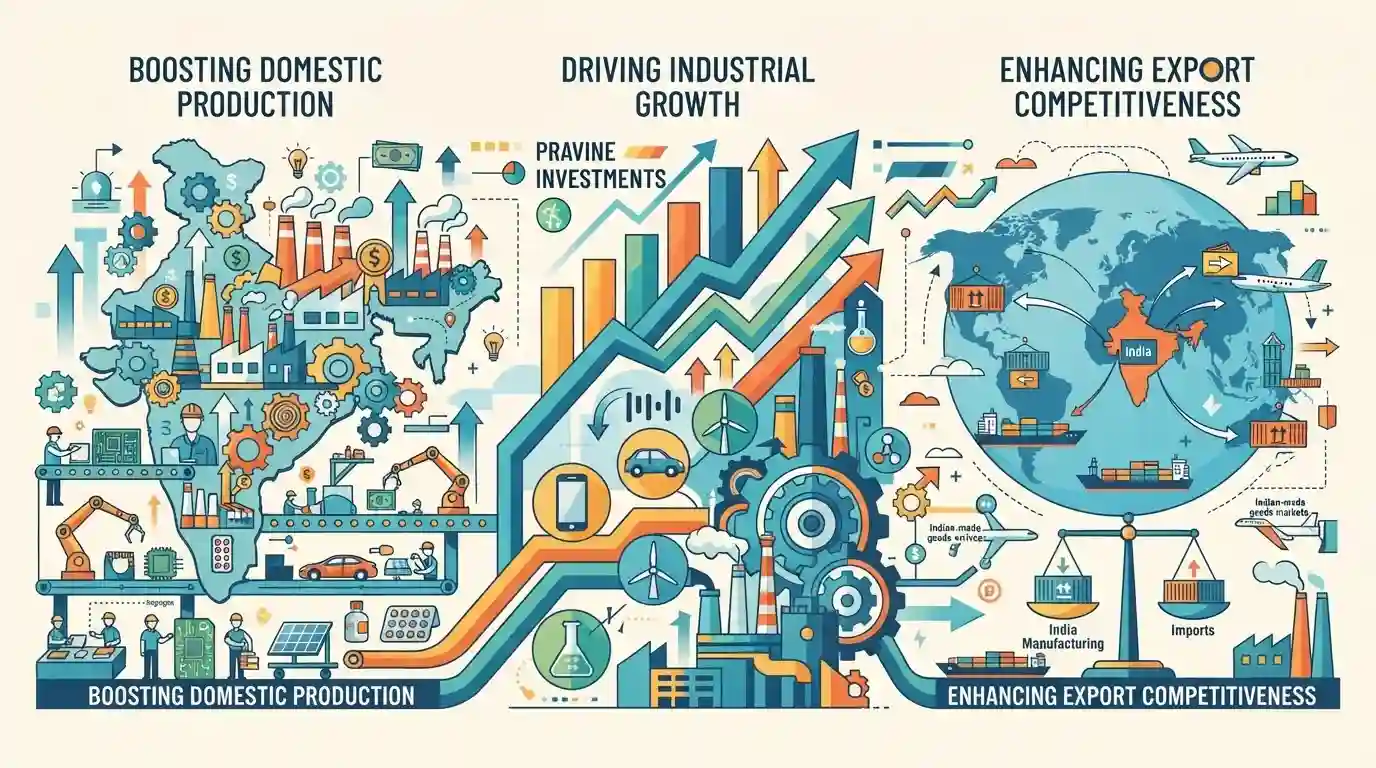
An overview of how the Production Linked Incentive (PLI) scheme has transformed India's manufacturing sector by boosting domestic production, driving industrial growth, and enhancing export competitiveness.
Key Points
- The Production Linked Incentive (PLI) scheme has significantly transformed India's manufacturing landscape across multiple sectors.
- It has boosted domestic production, attracted substantial foreign direct investment (FDI), and enhanced exports.
- The scheme plays a crucial role in reducing import dependence and positioning India as a global manufacturing hub.
Important Terms
Production Linked Incentive Scheme

A flagship Indian government scheme launched to boost domestic manufacturing, attract investments, and enhance export competitiveness by offering financial incentives based on incremental sales in key sectors.
UPSC context
GS Paper III (Indian Economy): Tests understanding of industrial policy, manufacturing growth, export competitiveness, and government incentives.
Prelims Trap
PLI scheme provides upfront financial grants and capital subsidies to companies before production begins.
Aspirants often assume PLI is an upfront capital subsidy (like a grant to build a factory). In reality, it is a post-performance incentive disbursed as a percentage of incremental sales.
Static Concepts Connected
What are the key features and operational mechanisms of the Production Linked Incentive (PLI) scheme in India?
- Incentive Structure: Provides financial incentives ranging from 4% to 6% on incremental sales of goods manufactured in India over a base year.
- Sectoral Coverage: Covers 14 critical sectors including mobile manufacturing, pharmaceuticals, medical devices, automobiles, and advanced chemistry cell batteries.
- Strategic Intent: Aims to plug critical gaps in the supply chain, offset domestic disability costs, and build global champions in manufacturing.
Cross-Topic Patterns
PLI incentives vs Fiscal Deficit targets
PLI disbursement data ties industrial policy to fiscal deficit management and capital expenditure trends in the Union Budget.
PLI schemes vs WTO Subsidy Rules
Export surges from electronics PLI intersect directly with WTO rules on domestic content requirements and export subsidies.

PLI scheme target sectors, outlay scale (~₹1.97 lakh crore), and WTO subsidy compatibility will appear in Prelims/Mains.
Linked PYQs · 2
Linked PYQs · 2
- 2025MainsGS3
Discuss the rationale of the Production Linked Incentive (PLI) scheme. What are its achievements? In what way can the functioning and outcomes of the scheme be improved?
- 2023MainsGS3
Faster economic growth requires increased share of the manufacturing sector in GDP, particularly of MSMEs. Comment on the present policies of the Government in this regard.
